National Assembly Chairman Tran Thanh Man recently signed and promulgated Resolution 112/2025 on administrative unit standards.
Compared to previous regulations, the 2025 resolution restructured the standard framework to clearly differentiate between rural and urban administrative units. It focuses on establishing fundamental eligibility thresholds for each type of administrative unit.
The new resolution's most significant change lies in the urban standards. Instead of dividing into multiple categories like centrally-run cities, provincial cities, towns, and urban districts as before, the new resolution redesigned the framework to focus on two levels for standardization under a new model.
For centrally-run cities, the population standard increased to a minimum of 2,5 million people, replacing the one million people required by the old regulation. The minimum area rose to 2,500 km2 from 1,500 km2 in the old regulation. Additionally, cities must achieve an urbanization rate of at least 45%, a criterion added for the first time. Furthermore, a city must have at least 30% of its commune-level administrative units designated as wards, be recognized as a type one urban area, and serve as a national or regional comprehensive center.
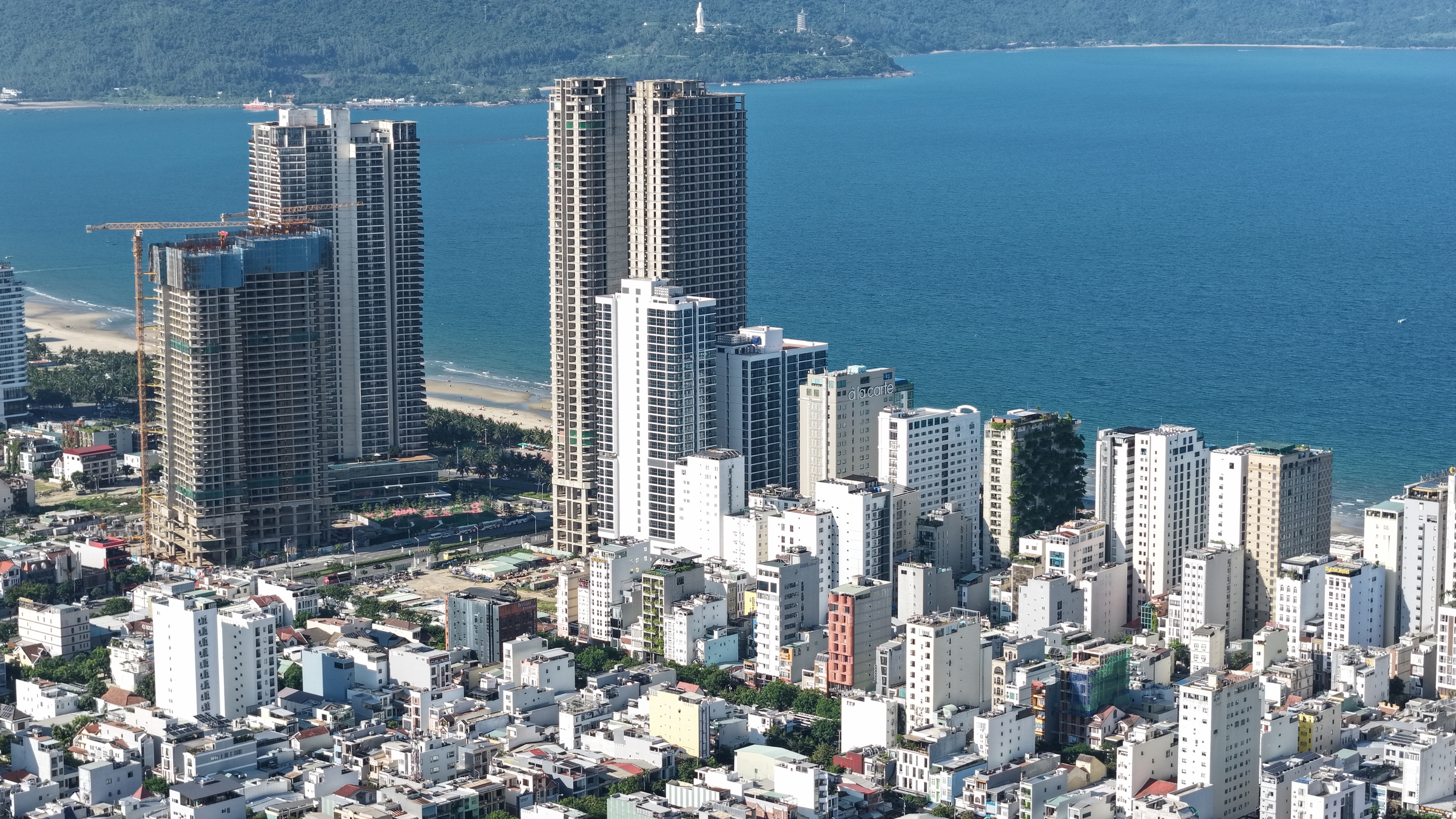 |
Coastal real estate projects in Da Nang. Photo: Nguyen Dong
The resolution added a mandatory criteria system for the socio-economic structure and development level of cities. This includes requirements such as not receiving additional balancing from the central budget, with the proportion of industry and services reaching at least 80%. Average per capita income and growth rate must also be higher than the national average.
For wards, the new resolution also raised the population threshold to 21,000 people, significantly higher than the previous 5,000–15,000 range. Criteria for economic structure, proportion of non-agricultural labor, budget revenue and expenditure, and average income are now directly regulated, replacing the previous detailed scoring method.
For rural provinces, the population standard is 900,000 for mountainous provinces and 1,4 million for other provinces. Mountainous provinces must have a minimum area of 8,000 km2, while other provinces require 5,000 km2.
Provinces must have a socio-economic development orientation consistent with the national five-year development plan. They must also have at least one urban area recognized as a type two urban area. Under the old regulation, provinces only required a certain number of district-level administrative units and were not directly linked to the quality of urban development.
For communes, the new resolution significantly raised the population threshold for communes not in mountainous or island areas, from 8,000 people to 16,000 people. The minimum area for communes not in special areas remains at 30 km2. Mountainous and island communes have separate area and population thresholds, suitable for their specific natural and residential conditions.
This adjustment aims to reduce the number of small-scale communes while imposing higher population requirements for communes in rapidly urbanizing lowland areas.
Resolution 112/2025 also stipulates detailed requirements for the content of proposals for establishing, dissolving, merging, dividing administrative units, and adjusting boundaries. Each proposal must include five mandatory sections and accompanying appendices, including current status maps, proposed maps, and documentary films reflecting the socio-economic development conditions and infrastructure of the relevant areas.
Compared to before, the new resolution provides more detailed regulations on naming and renaming administrative units. Names must be concise, easy to remember, consistent with historical and cultural traditions, and approved by local residents. The name of a provincial-level administrative unit must not duplicate any unit of the same level nationwide. Commune-level names must not duplicate within the provincial scope. Renaming not associated with boundary rearrangements requires a separate proposal, fully assessing the impacts, instead of the simplified process used previously.
Resolution 112/2025 affirms that administrative units established before the effective date of the resolution do not need to be re-evaluated under the new standards. Adjustments to boundaries with an area change of no more than 20% and no change in the number of administrative units are also exempt from re-evaluation of standards.
Discussing this resolution before its adoption, National Assembly Vice Chairman Nguyen Khac Dinh stated that issuing this resolution at this time is necessary due to changes in the Law on Organization of Local Government and the urban system. The resolution aims to serve socio-economic development management, not for further rearrangement of administrative units.
Currently, the country has 34 provinces and cities and 3,321 commune-level units. He added that the competent authorities have no policy to continue splitting or merging for many years to come.
Son Ha