|
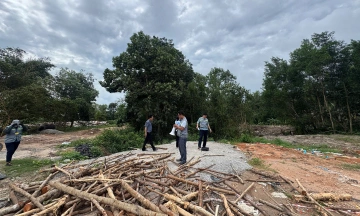
An unidentified grave. The sampling process follows a sequence: excavation, sample collection, and grave restoration. Each stage is coordinated to ensure both progress and solemnity for the resting place of the fallen soldiers. |
In early July, with the dry, hot Lao wind searing, Team 589 of Fallen Soldiers' Remains Collection, under the Political Department of the Military Command of Quang Tri Province, collected biological samples at Ba Doc martyrs' cemetery in Nam Trach commune.
This cemetery inters 3,126 graves, of which 1,320 remain unidentified. The DNA sampling is part of the "500-Day and Night Campaign to Accelerate the Search, Collection, and Identification of Fallen Soldiers' Remains".
 |
Before excavating each grave, Lieutenant Colonel Nguyen Thanh Binh, team leader of Team 589, lights incense and performs a ritual. According to him, the entire sampling process adheres to technical standards, from locating the grave, collecting samples, preserving, sealing, to updating data and handing over samples, ensuring scientific rigor, accuracy, and solemnity. |
 |
Once the grave is opened, the soldiers carefully remove the urn containing the remains and transfer it to the sampling area. |
To open the grave, Major Dinh Xuan Khanh uses a cutting machine on the base of the grave. "The cut must be even, straight, and precisely positioned to maintain the grave's structure after restoration," Major Khanh said. After separating the grave section, an iron lifting frame with pulleys is positioned to hoist the concrete block. This equipment reduces labor, shortens operational time, and minimizes impact on the grave's structure.
 |
Each biological sample is assigned a code and carefully preserved before being sent for identification. After analysis is complete, the samples will be returned to Team 589 for reburial in the fallen soldiers' graves. |
Each grave is fully documented with images and information at every stage, from excavation and sampling to grave restoration. This data is stored and digitized for management and cross-referencing during the process of identifying fallen soldiers.
 |
Working under the blazing sun, with heat radiating from the concrete ground, Major Nguyen Quoc Hoan wears a hat and wraps a scarf tightly around his face.
At the sampling area, medical personnel wear protective suits and gloves, open the urns, and select remains suitable for DNA identification. The samples are then sent to specialized agencies under the Ministry of Health for analysis. After medical personnel complete DNA sample collection, the remains are carefully wrapped, placed back into the urn, and returned to their original position for grave restoration.
 |
 |
Close to 11:00, as the sun reached its zenith and the outdoor temperature neared 40 degrees Celsius, the soldiers restored each grave, returning it to its original state. The surrounding area was cleaned up thoroughly, and incense sticks were lit before the sampling was completed.
At the end of a workday, the soldiers' shirts were soaked with sweat.
Captain Dinh Xuan Suu, a member of Team 589, stated that despite the harsh heat, the officers and soldiers always perform their duties with care, responsibility, and gratitude for the fallen heroes.
"Contributing a part of our effort to the journey of returning names to fallen soldiers who lack identification information is an honor for every officer and soldier," Captain Suu said.
Dac Thanh