On 21/8, the National Assembly discussed proposed amendments to the Land Law. Le Van The, Deputy Head of the Ninh Binh Provincial National Assembly Delegation, argued that land acquisition policies should consider areas beyond individual project boundaries to resolve issues and enhance land management and utilization efficiency.
When the State invests in major roads or infrastructure projects, acquiring only the land within project boundaries can result in small, irregular, or fragmented plots in surrounding areas. For agricultural land, these remaining parcels may become difficult to access, unsuitable for cultivation, or lose their utility.
Therefore, site clearance must not only secure sufficient land for construction but also account for land use efficiency and the quality of the spatial layout after a project is completed.
The draft stipulates that if a land user wishes the State to acquire the remaining area of their plot, the competent authority will consider the decision and provide compensation and support. Mr. The noted that relying solely on individual household requests could lead to inconsistencies within a single project, with some wanting acquisition and others wanting to retain their land. This would allow small, irregular, or inefficient plots to persist, negatively impacting the overall spatial organization.
Therefore, the representative proposed adding objective criteria to evaluate remaining land parcels immediately when preparing acquisition, compensation, support, and resettlement plans. If an area can still be used effectively, the people's right to choose must be respected. Should acquisition be necessary for broader urban restructuring or spatial reorganization, authorities must have specific legal grounds, align with planning, and clearly define the scope and implementation plan.
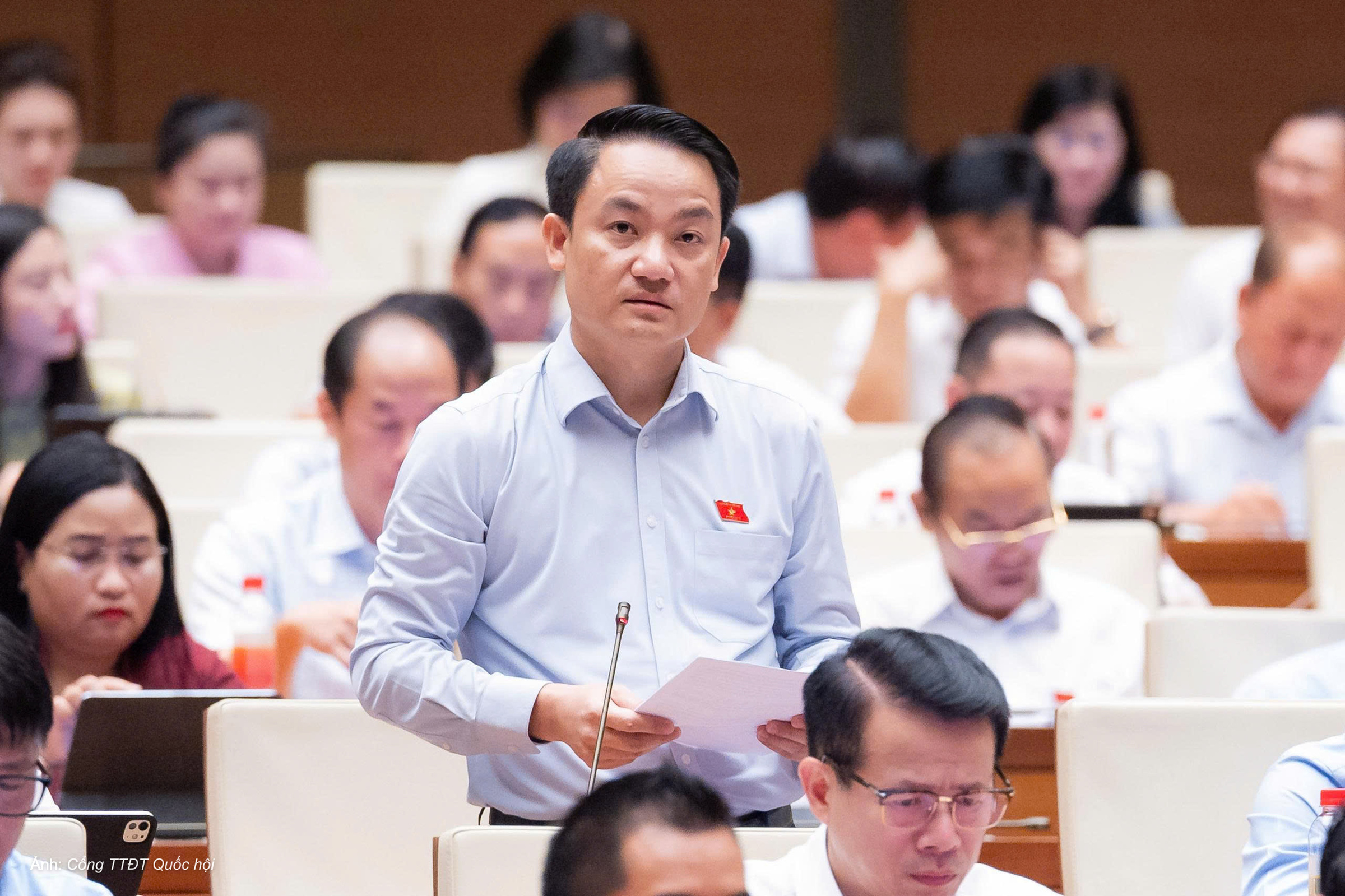 |
Le Van The, Deputy Head of the Ninh Binh Provincial National Assembly Delegation, speaks at Dien Hong Hall. *Photo: National Assembly E-portal*
The issue of excessively small, fragmented, or awkwardly shaped land plots has arisen in several major cities. In Hanoi, for instance, after the expansion of Ring Road 1, Lang ward identified 21 cases of houses and land plots unsuitable for construction, with four plots measuring less than 1 m2.
The Lang Ward People's Committee has requested owners of these plots and structures to coordinate with adjacent owners to merge their parcels for renovation and urban restructuring.
Rethinking the 75% consensus rule for residual land acquisition
Also addressing land acquisition policy, Nguyen Thi Viet Nga, Deputy Head of the Hai Phong City National Assembly Delegation, urged reconsideration of the mechanism allowing the State to acquire remaining land when investors have already reached agreement with over 75% of the area and over 75% of land users.
She argued that when investors have agreed on most of an area, but the State proceeds to acquire the remaining 25%, the relationship between parties shifts from a civil agreement to the exercise of public power. Therefore, acquisition decisions should not solely rely on the two 75% ratios.
Competent authorities should further consider project scale, the number of non-consenting individuals, the type of land acquired—especially residential land—and the extent of impact on housing and livelihoods. The same 75% ratio can represent significantly different numbers of people and affected land areas.
The draft also stipulates that compensation for land-acquired individuals must not be lower than the average of agreed land prices. Ms. Nga proposed clarifying how to calculate this average, the scope of transactions used, and the determination method when agreed prices among households vary widely. "If not clearly regulated, the very mechanism intended to protect land-acquired individuals could become a source of new disputes", she stated.
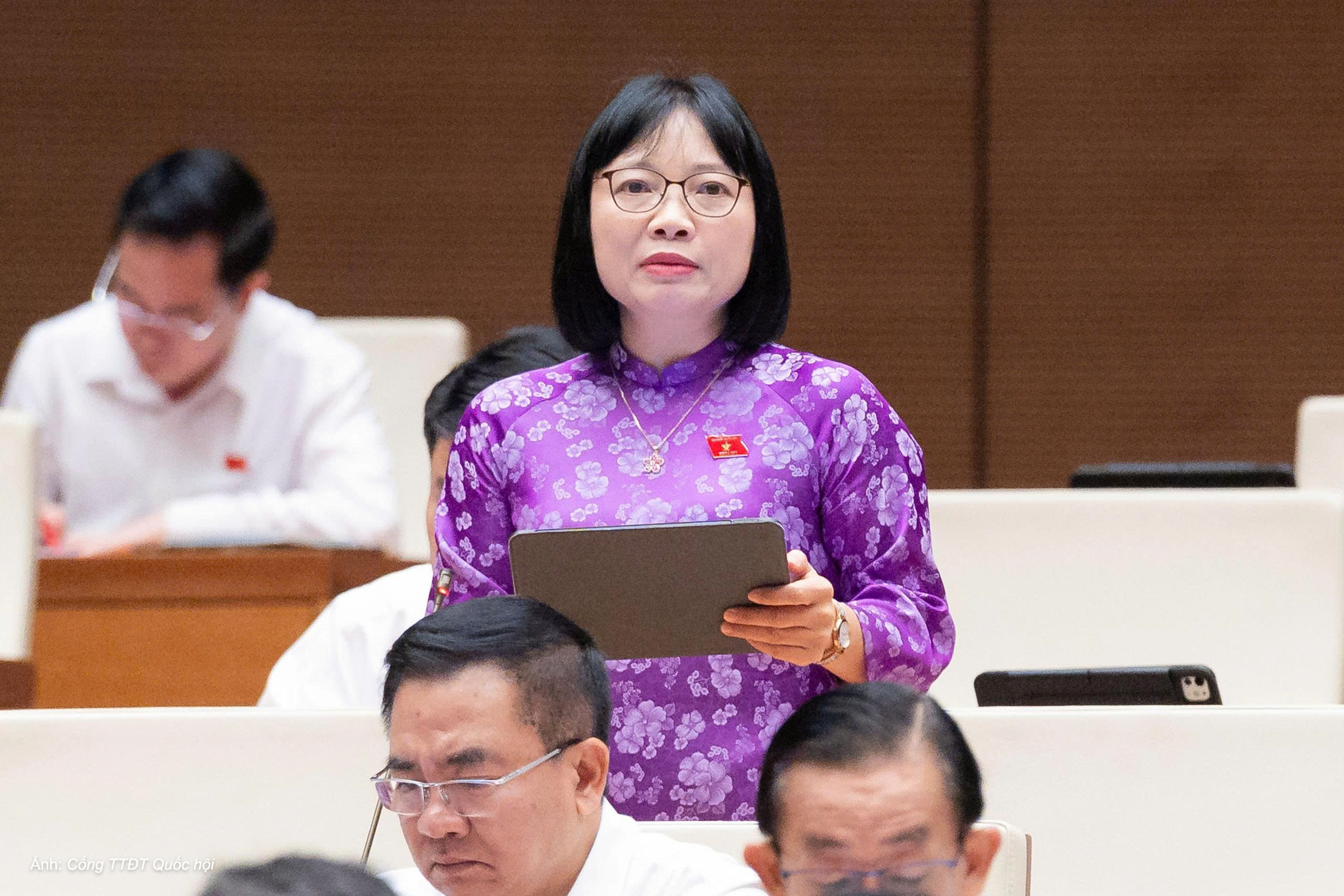 |
Representative Nguyen Thi Viet Nga speaks at Dien Hong Hall. *Photo: National Assembly E-portal*
Shifting from asset compensation to livelihood reconstruction
Nguyen Dai Thang, Vice Chairman of the Committee for Delegate Affairs, supported the approach of shifting from asset compensation to livelihood reconstruction for those whose land is acquired.
He proposed concretizing the requirement to ensure that affected individuals have housing, living conditions, and livelihoods equal to or better than their previous ones. Compensation forms also need clear prioritization and application conditions. People should be prioritized for land with the same use purpose or resettlement housing. Monetary compensation should only be provided when no suitable land or housing fund is available or at the request of the land-acquired individual.
Compensation and resettlement plans must be evaluated using specific criteria, including location, area, technical and social infrastructure, access to essential services, and conditions for maintaining livelihoods.
Regarding increased land value, Mr. Thang proposed studying mechanisms for the State and society to reasonably benefit from planning, infrastructure investment, land use conversion, and urban expansion.
The National Assembly is expected to continue reviewing and approving the amended Land Law during its October session.
Son Ha