The Traffic Police Department (TPD) under the Ministry of Public Security announced that, starting 1/7, the processing time for issuing driving licenses will be reduced from seven to 3.5 days. Electronic data integration, previously taking three days, will now be completed within two hours. Within two hours of a driving test's conclusion, the Traffic Police Division will review, compile, and transfer the data of successful candidates to the TPD for the issuance of electronic driving licenses.
The renewal period for driving licenses will also be shortened from 5 to 2.5 days, with electronic data integration reduced from three days to one day. Furthermore, the issuance time for international driving licenses will decrease from 5 to 2.5 days.
If a driving license expires for less than one month from its expiration date, and the holder is unable to complete the renewal process due to illness, natural disaster, calamity, fire, or epidemic, they will not be required to take a theoretical test for a new license.
For licenses expired for less than one year, holders must pass a theoretical test. If expired for one year or more, both theoretical and practical driving tests (on a closed course and on the road) are mandatory. Individuals who have violated road traffic safety regulations and have not fulfilled state agency requirements will not be re-issued a driving license.
Electronic driving licenses will become the default issuance format, integrated into electronic data systems and digital identification accounts. Physical PET cards will be issued only upon request.
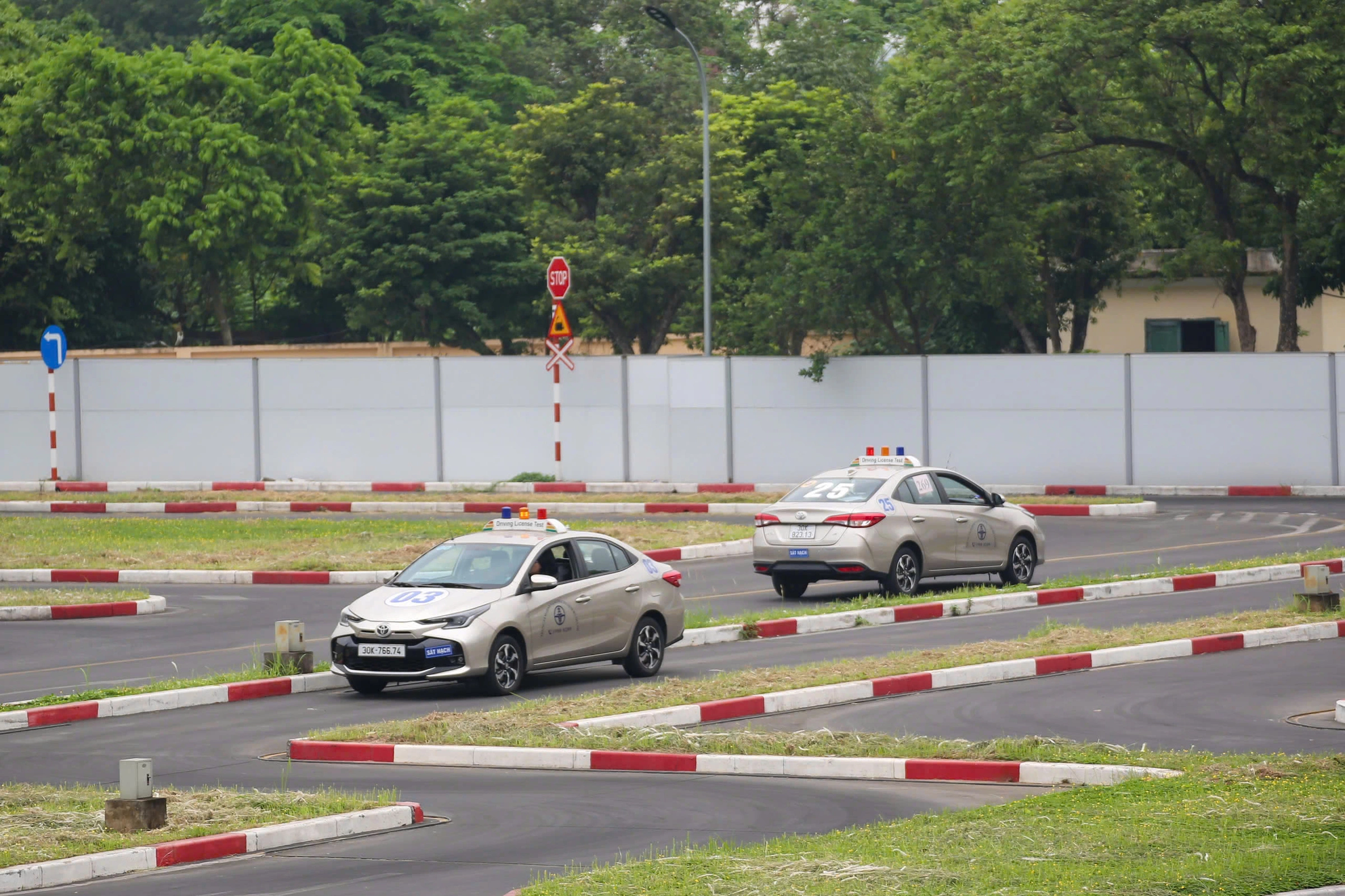 |
A driving test on a closed course. *Tien Trach* |
Stricter driving tests implemented
Also effective 1/7, several practical driving test regulations will be revised to be stricter, emphasizing genuine learning, skill development, and driving ethics.
The computer simulation test will be eliminated. Candidates will now undergo sequential testing: for motorcycles, they must pass the theoretical test, followed by two practical and situational tests; for cars, they must pass the theoretical test, then the closed course test, and finally the road test. Candidates must pass each section in order to proceed to the next. Previously, candidates could continue to the practical test even if they failed the theoretical portion.
The number of theoretical test questions and the allotted time will nearly double. For example, motorbike categories A and A1 will see questions increase from 25 to 40, and test duration from 19 to 27 minutes, requiring 36 out of 40 correct answers to pass. Car category B will increase questions from 30 to 50, and test duration from 20 to 33 minutes, requiring 45 out of 50 correct answers to pass.
Theoretical questions will also incorporate knowledge of the Criminal Code related to traffic offenses, administrative violation laws concerning road traffic order and safety, and accident prevention awareness.
Meanwhile, the practical road test for cars will increase from two to 5 km. The test route will include various traffic situations such as: T-junctions, four-way intersections, merging from a minor road onto a main road or from a non-priority road onto a priority road, roundabouts, traffic lights, and pedestrian crossings. In this section, candidates will navigate through 12 scenarios. These tests can be performed multiple times and not necessarily in a specific order.
Pham Chieu