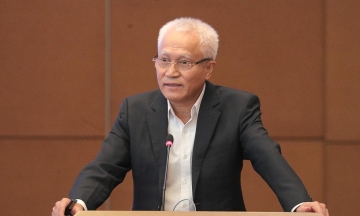
At the workshop "Vietnam's Material Industry and Mechanical Engineering, Manufacturing Industry in the New Development Phase", organized by the Committee for Science, Technology and Environment on 15/6, the issue of self-sufficiency in defense materials drew significant attention from many delegates.
Lieutenant Colonel Ta Thanh Hai, Director of Company Z189 (General Department of Defense Industry), stated that materials currently pose a major challenge for defense industry development. Despite advancements in domestic mechanical engineering capabilities, many high-tech and specialized materials still require import. This makes it difficult for enterprises to secure a proactive supply, especially for products demanding high technical standards and long production cycles.
According to Hai, Vietnam has not yet developed the capacity to produce many types of high-tech steel, which are foundational for a modern defense industry. Unlike common steel used in construction or civil mechanical engineering, armor steel must meet strict requirements for impact resistance, penetration resistance, and durability under special operating conditions.
This material is also crucial for producing many important defense products: high-strength shipbuilding steel, bulletproof steel for armored vehicles, steel for manufacturing gun barrels and artillery, bulletproof aluminum, and dual-use materials for military applications.
Experts believe that producing armor steel is not merely about creating a new material; it also signifies mastering advanced metallurgy technology, special alloy technology, heat treatment, and high-level quality control systems. Thus, armor steel benchmarks a nation's material technology capabilities.
 |
Armor used by elite military forces displayed at Defense Expo 2024. Photo: Giang Huy |
Colonel Do Hong Quang, Deputy Director of Company Z111 (General Department of Defense Industry), noted that many countries, including the US, China, Russia, Japan, and Germany, have mastered material technology after a long development process in their mechanical engineering industries.
He cited many new materials that are transforming national defense capabilities: composite armor, engineering ceramic armor, explosive reactive armor; military aluminum and titanium alloys for fighter jets, submarines, and missiles; carbon fiber composite materials for UAVs, radar, and warships; radar-absorbing materials; and ultra-high temperature resistant materials for jet engines and hypersonic missiles.
According to Quang, Z111 specializes in producing high-precision mechanical parts, so most raw materials are still imported. In a volatile global environment, supply chains can face disruptions, directly impacting production and national defense missions.
Given this reality, the Standing Committee of the Committee for Science, Technology and Environment proposed developing a national strategic materials list for key technology sectors. This list would prioritize armor steel for development, alongside titanium alloys, military composite materials, and radar-absorbing materials.
The Committee believes that strategic materials not only serve national defense but also form the foundation for many new technology sectors, including artificial intelligence, robotics, semiconductors, aerospace, and new energy. Many material technologies developed for defense can also find applications in aviation, shipbuilding, high-speed transport, energy, and precision mechanical engineering.
Experts therefore proposed establishing a National Program for Strategic Material Industry Development until 2045. This program would focus on: machine manufacturing steel, tool steel, specialized steel, specialized aluminum alloys, titanium, composite materials, semiconductor materials, and defense materials.
Additionally, the State needs to implement specific incentive mechanisms for domestic strategic material production projects through tax policies, long-term credit, and support for research infrastructure investment.
The Director of Company Z189 recommended that the Government issue breakthrough policies for developing new material technology. This should be coupled with strengthening links between enterprises, research institutes, and universities to gradually master advanced material manufacturing technology.
A representative from Company Z111 also proposed boosting high-quality human resource training in material science, particularly for new material technologies and dual-use materials that serve both economic development and national defense.
Son Ha