On the morning of 24/8, in Hai Phong City, the Center for Journalism Training (Vietnam Journalists' Association) organized a seminar titled "New points in the Press Law and legal sanctions: Identifying risks, protecting journalistic ethics". This event launched a series of in-depth seminars implemented by the Vietnam Journalists' Association nationwide.
The event occurred as the media landscape undergoes profound changes due to digital technology, social media, and artificial intelligence (AI). These factors are altering how information is produced, distributed, and received, while also posing significant legal risks for newsrooms.
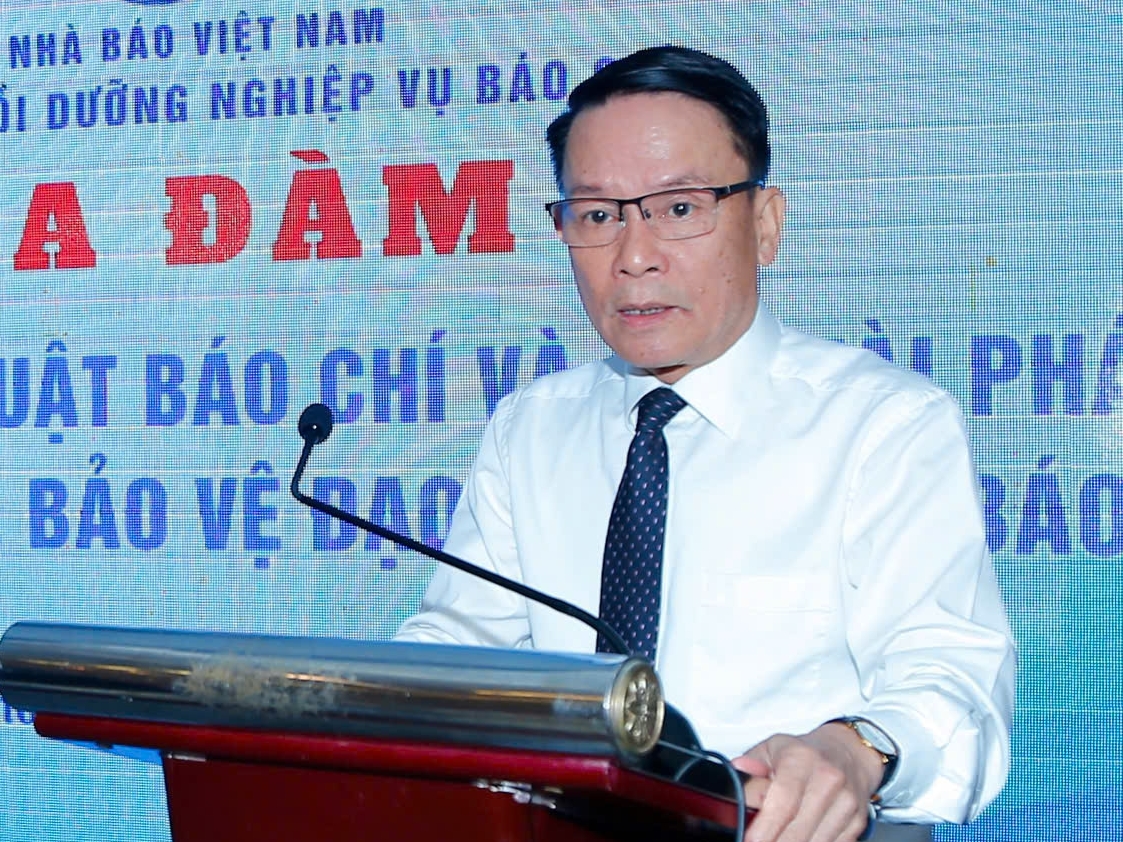 |
Nguyen Duc Loi, permanent vice chairman of the Vietnam Journalists' Association, at the seminar. *Photo: Le Tan*
Speaking at the seminar, Nguyen Duc Loi affirmed that journalistic professionalism cannot be measured solely by reporting speed or interaction rates. Instead, it must be built upon truth, responsibility, and respect for the law.
The law provides a framework protecting journalists' rights to operate and defining their social responsibilities. However, some issues cannot be fully regulated by law. In these instances, conscience, responsibility, and professional standards guide journalists to stop at the right moment before information can harm individuals, organizations, or the community. "Professional ethics is the first barrier that helps journalists identify and prevent risks", he said.
During the seminar, delegates analyzed common operational risks, including: publishing false or unverified information, or violating the privacy and honor of individuals and organizations. Additionally, the tendency to chase views, exploit sensational elements, and use unverified sources from social media was discussed.
From a management perspective, experts agreed that risk control is not only the individual responsibility of reporters but must be standardized into newsroom operating procedures. Press agencies need to tighten verification and editing processes, clearly define responsibilities at each publication stage, and enhance coordination among reporters, editors, and the editorial board.
Legislation of journalistic ethical duties
Regarding the new points in the Press Law 2025, Nguyen Van Hieu, deputy director of the Press Department, emphasized that while the new law has 10 fewer articles than the 2016 version, it does not narrow the scope of management. Instead, the law is designed to be more flexible by focusing on core principles and entrusting the Government with detailed technical guidance.
According to Hieu, this approach helps the legal framework adapt quickly to digital technology changes. It also clarifies new concepts such as publishing journalism in cyberspace and distinctly defines magazines to prevent them from becoming "news-like" (bao hoa).
Hieu also noted significant changes in the regulations for managing journalist's cards. The card's validity is now 5 years from the issuance date, rather than a common expiry date for the entire industry. This provides more flexible management and reduces administrative procedures. Personnel at purely research-focused scientific journals will no longer be eligible for card issuance. Crucially, to enhance input quality, from 1/1/2027, individuals applying for a card for the first time must complete an in-depth training course on professional skills and ethics.
 |
Nguyen Van Hieu, deputy director of the Press Department, speaking at the seminar on 24/8. *Photo: Le Tan*
The Press Law 2025 supplements the role of the Vietnam Journalists' Association in handling violations of journalistic ethics. The law stipulates that journalists have a duty to comply with professional ethics. Non-compliance constitutes a violation of a journalist's duties as defined in the Press Law.
Under the law, the Vietnam Journalists' Association concludes on ethical violations by its members and recommends that competent authorities handle ethical violations by non-member journalists. "This regulation enhances the effectiveness of addressing ethical violations and affirms the Vietnam Journalists' Association's role in building and protecting professional standards", Hieu stated.
Regarding copyright, Pham Thi Kim Oanh, deputy director of the Copyright Office, Ministry of Culture, Sports and Tourism, advised journalists to understand three legal pillars, use AI responsibly, and uphold professional ethics. Journalists need a clear understanding of moral rights, economic rights, protection periods, and limitations and exceptions to rights. When using AI, cross-verification is essential, treating AI as a supporting tool, not a replacement for creative thinking.
"Protecting journalistic copyright is protecting the vitality of Vietnam's revolutionary press", Oanh emphasized.
The seminar focused on discussing solutions for internal risk control within newsrooms: from censorship processes and defining production responsibilities to incident handling and coordination among reporters, editors, and leadership. The relationship between legal compliance and journalistic ethics was a recurring theme discussed by delegates.
Le Tan