The five additional routes include: northern mountainous ring road, northern midland ring road, Ha Tinh - Cau Treo, Hue - A Luoi, and Phan Thiet - Bao Loc - Gia Nghia - Bu Prang.
According to the decision, the northern mountainous ring road will be approximately 327 km long. It will start from Ta Lung border gate (Cao Bang), pass through Lang Son, Thai Nguyen, Tuyen Quang, Lao Cai provinces, and end in Son La.
This route is divided into seven sections: Ta Lung - Dong Khe; Dong Khe - That Khe (coinciding with the Dong Dang - Tra Linh expressway); Lang Son - Thai Nguyen; Thai Nguyen - Tuyen Quang; Tuyen Quang - Lao Cai; Lao Cai - Lai Chau (coinciding with the Bao Ha - Lai Chau expressway); and Lai Chau - Son La. The route is planned with 4 lanes and is expected to be invested in after 2030.
The northern midland ring road is approximately 378 km long, connecting Tan Thanh border gate (Lang Son) with Son La. This route is divided into three sections: Lang Son - Thai Nguyen; Thai Nguyen - Lao Cai; and Lao Cai - Son La. The Lang Son - Thai Nguyen section is slated for implementation before and after 2030, while the remaining two sections are expected to be invested in after 2030.
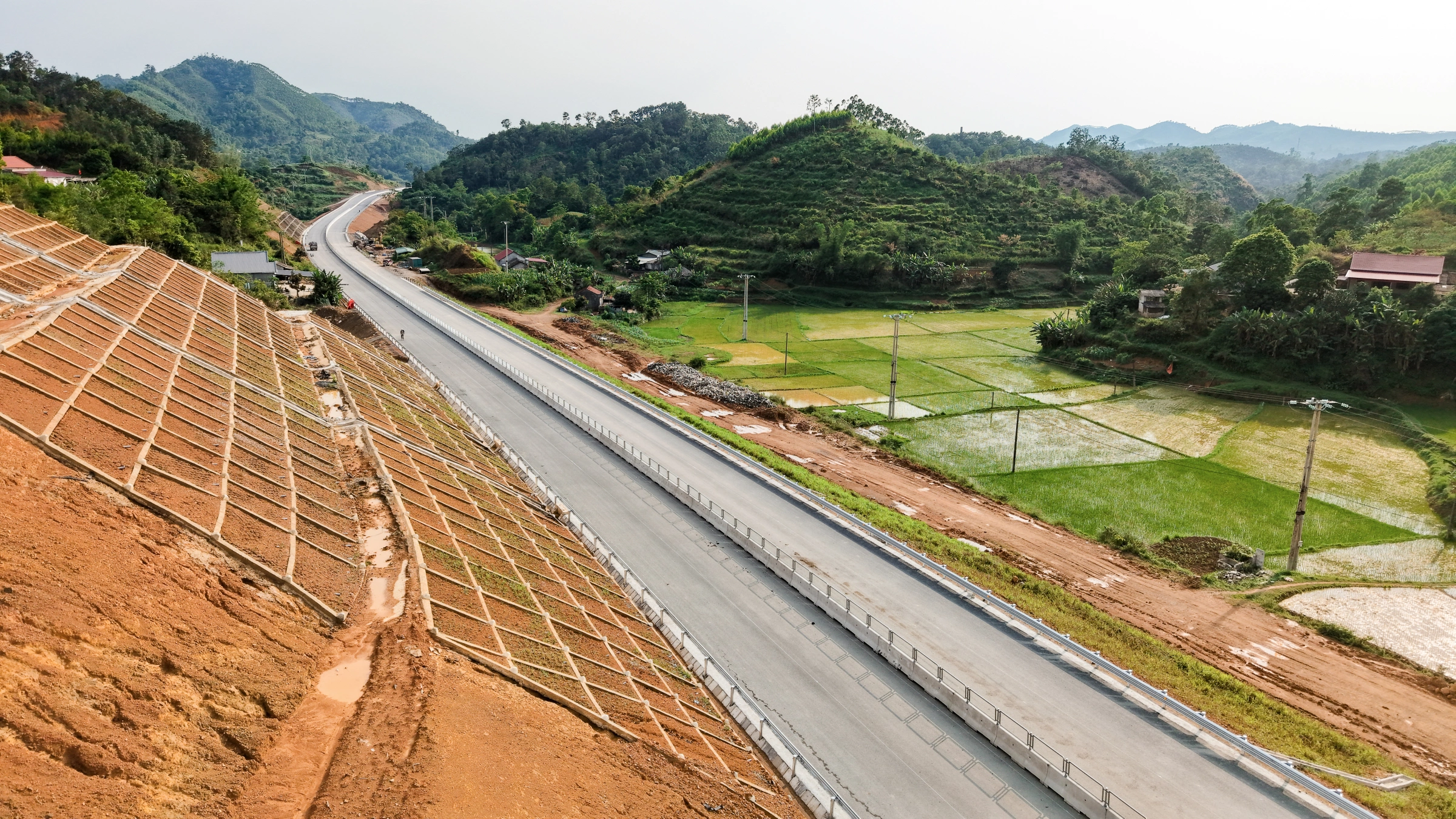 |
Huu Nghi - Chi Lang expressway (Lang Son) is nearing completion and opening to traffic. *Anh Duy*
The Ha Tinh - Cau Treo expressway will be approximately 85 km long, divided into two sections: Ha Tinh - Ho Chi Minh road and Ho Chi Minh road - Cau Treo. This route is planned with 4 to 6 lanes, with an investment schedule before and after 2030.
The Hue - A Luoi expressway, approximately 45 km long, is oriented to connect the western area of Hue City with the eastern North-South expressway. This route is planned with 4 lanes and is expected to be invested in after 2030.
The Phan Thiet - Bao Loc - Gia Nghia - Bu Prang expressway will be approximately 141 km long and divided into two sections: Phan Thiet - Bao Loc - Gia Nghia and Gia Nghia - Bu Prang. This route is planned with 4 lanes. The Phan Thiet - Bao Loc - Gia Nghia section is prioritized for investment before and after 2030, while the Gia Nghia - Bu Prang section is expected to be implemented after 2030.
The Ministry of Construction also adjusted the investment timelines for seven expressways. For instance, the western North-South expressway, Ngoc Hoi - Gia Nghia section, is slated for investment in phases before and after 2030. The Bao Ha - Lai Chau expressway will be invested in before 2030, a change from the previous plan. The Noi Bai - Bac Ninh - Ha Long expressway will also be invested in phases before and after 2030.
The Vung Ang - Cha Lo; Phu Yen - Dak Lak, Phu Yen - Buon Ho section; Nha Trang - Lien Khuong; and TP HCM - Vinh Long - Can Tho - Ca Mau routes are all planned with 4 lanes, to be implemented in phases before and after 2030.
According to the Vietnam Road Administration, the addition of five expressways aims to meet the strong growth in transportation demand projected for the coming decades. It also seeks to expand development space for new dynamic regions and enhance connectivity among economic centers, international border gates, seaports, and industrial zones.
The agency believes that updating the master plan is also a crucial preparatory step towards gradually completing a synchronous and modern transport infrastructure network, in line with the orientation for 2050.