On 20/6, at the press forum "Journalism Copyright in the AI Era – Protecting the Value of Journalism", Dang Thi Phuong Thao, Deputy Director of the Press Department, Ministry of Culture, Sports and Tourism, outlined an alarming reality. The industry's total revenue for 2025 is projected to reach only 7,790 billion dong, a 3.7% decrease compared to 2024.
The Vietnamese press system currently comprises 1,733 agencies with approximately 41,000 personnel, including 21,000 licensed journalists. Annually, this entire ecosystem produces a massive volume of content, estimated at 40 million articles, 50,000 hours of television, and 20,000 hours of radio. However, this significant investment faces a paradox: the volume of information created is increasing, but revenue continues to decline.
A core reason for this decline is the widespread unauthorized copying and exploitation of digitized content across social media networks and artificial intelligence (AI) tools. These infringements manifest in four common forms, ranging from crude to sophisticated. Initial methods include direct copying of entire content for reposting on illicit websites and the removal of logos or alteration of brand identities in images/videos for profit on social media. More advanced tactics involve "re-cooking" content by changing titles and phrasing to evade automatic copyright scanning algorithms.
Crucially, the most dangerous threat today is AI models arbitrarily "scraping" and exploiting journalistic data to train algorithms, summarize content, and regenerate information without permission or payment. Major media outlets such as VnExpress, Tuoi Tre, Thanh Nien, Dan Tri, and VietnamNet frequently fall victim to this practice, with investigative articles and in-depth reports being "repurposed" immediately after publication. This directly results in newsrooms experiencing severe reductions in traffic, loss of advertising revenue, and diminished motivation to charge for content. While content producers bear significant investment costs, infringers freely profit from lucrative advertising revenue.
From a technology perspective, Nguyen Thanh Hai, Chairwoman of FPT Online, stated that newsrooms should understand the nature of AI to reverse this trend, rather than fearing it. She affirmed, "The principle of AI is to operate on data; if you withdraw the data, AI dies. Therefore, AI is essentially a partner, a potential customer, not a competitor."
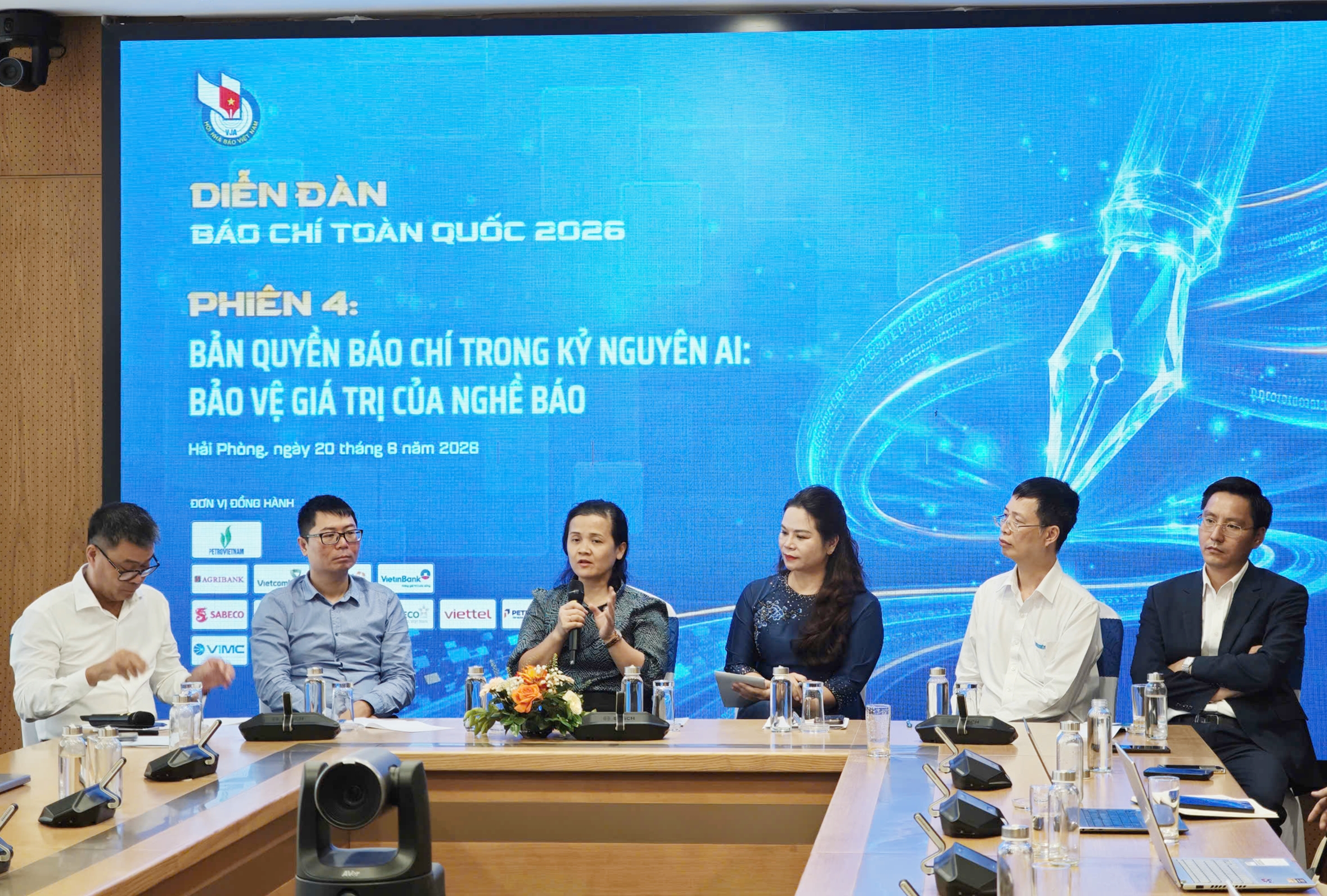 |
Delegates express views on whether to consider AI a friend, partner, or competitor. Photo: Le Tan |
Citing system monitoring data, Hai explained that FPT Online observed that when tech company bots accessed news systems, reader demand via AI was not limited to superficial news, but rather involved in-depth inquiries on specialized topics. Over the past six months, FPT Online has assisted newsrooms in categorizing which content areas AI is interested in and what the public needs. This forms the basis for media agencies to implement a "two-way door" strategy: clearly defining which areas to open for AI to increase visibility, and which to lock down to protect revenue streams.
To demonstrate the feasibility of this solution, the FPT Online Chairwoman referenced two major global models. The New York Times opted to completely close its doors, refusing to negotiate with AI to protect its specialized products. In contrast, NewsCorp adopted a more flexible approach, opening general news content but strictly locking down exclusive features and specialized content for business negotiations.
Indeed, multinational AI corporations have approached FPT to discuss purchasing multi-language journalistic data. Currently, there are two primary transaction methods: bulk purchasing packaged by major topics in unlimited quantities, or segmenting categories for sale at varying prices. Hai emphasized, "Deep-dive content will not be sold or must be sold at the highest possible price, adhering to the principle of maximizing revenue and frequency of sales."
Tran Viet Hung, Deputy Editor-in-Chief of Thanh Nien Newspaper, shared the view on proactively controlling resources, recognizing AI as an effective tool if approached comprehensively. However, Hung also frankly pointed out that a single media agency lacks the resources to independently contend or negotiate with global tech giants. To create a turning point, the entire industry requires a synchronized approach and significant support from the government in mediating and signing international agreements.
To thoroughly resolve the copyright challenge, which lags behind technological development, experts at the forum agreed that Vietnam needs a stable "three-pillar" foundation: a perfected institutional framework, technological empowerment, and a transformed journalistic economic model. Regarding technology, Hoang Dinh Chung, Director of the Digital Copyright Center (DCC) under the Vietnam Digital Communications Association (VDCA), affirmed that the core solution is the application of the National Digital Copyright Axis. This comprehensive technological ecosystem aims to transparently register, verify content ownership, and distribute digital content. By integrating advanced technologies such as AI Matching for audio/visual duplication detection, DRM access control systems, and a Big Data platform (DCC Watcher) for real-time Internet monitoring, newsrooms can immediately detect and block suspicious bots "secretly reading" data, similar to how the Associated Press operates.
Alongside technological protection, the biggest obstacle to overcome is the legal framework. Although Vietnam has a relatively complete set of legal documents, including the Intellectual Property Law, Press Law, Decree 17/2023/ND-CP, and the Prime Minister's Directive 38, specific regulations on AI's use of journalistic data and mechanisms for negotiation and revenue sharing on cross-border platforms (Google, Facebook, TikTok) remain unaddressed.
Internationally, pioneering countries have demonstrated that copyright protection must be linked to economic benefits. A prime example is Australia, whose News Media Bargaining Code (2021) compelled major tech companies to negotiate, resulting in hundreds of millions of USD shared with the country's media. Similarly, the European Union (EU) has recognized the "Publisher's Right", shifting its mindset from merely protecting authors' rights to safeguarding the entire content production ecosystem.
Experts propose the early study and amendment of laws to include regulations on AI data and establish mandatory negotiation mechanisms. Dang Thi Phuong Thao, Deputy Director of the Press Department, stated, "In the coming period, the Ministry of Culture, Sports and Tourism will continue to improve the institutional framework, upgrading the Media Hub solution into a national data platform for journalism copyright protection."
Moreover, the managing agency will research a pilot model for a Journalism Copyright Protection Center, a collective rights management organization. This center would act as a legal representative for newsrooms to license, collect, and transparently distribute royalties with technology corporations. Thao affirmed, "Protecting journalism copyright is not only about protecting intellectual property rights, but also about protecting professional journalism, legitimate news sources, and the public's right to access quality information."
Le Tan