The flight carrying the sangha landed at Noi Bai airport, Hanoi, in the early morning of 15/4, greeted by hundreds of monastics and Buddhists.
This marks Gyalwang Drukpa's 13th return to Vietnam, a country he has been connected with for nearly two decades. He once shared his reason: "Vietnamese people are kind, strong, and united, which is evident in their historical traditions. In Vietnam, I always feel energetic and inspired."
Monastics and Buddhists welcome the Drukpa Lineage delegation at Noi Bai airport on the morning of 15/4. *Video: Drukpa Viet Nam*
During his two-week stay in Vietnam, Gyalwang Drukpa will engage in numerous activities, including meeting Venerable Thich Duc Thien at Phat Tich Pagoda in Bac Ninh province, giving Dharma talks to monastics and the public, and presiding over a three-day prayer ceremony from 25-27/4 at Mandala Tay Thien in Phu Tho province.
Opening the ceremony on 25/4, he will ring a bell and unveil a 150 m meditation scroll, praying for world peace. He once expressed his wish: "This world is a common home where we are all members, and thus, the public needs to strive to transform selfishness and hatred into altruism, love, and treat each other like family."
Various Buddhist cultural activities will take place during the ceremony, such as: the Tara Buddha Mother prayer ceremony – a pivotal female Bodhisattva in Vajrayana Buddhism, representing compassion, wisdom, and the liberation of sentient beings; a great ceremony praying for national peace and prosperity; and a Medicine Buddha blessing ceremony.
The ceremony will be held at the Mandala Tay Thien stupa, a complex of Vajrayana architecture bearing the strong imprint of Himalayan Buddhism. Each structure holds its own symbolic significance, collectively forming a giant mandala that visually represents the "Five Great Elements, Five Wisdoms" doctrine of Vajrayana Buddhism.
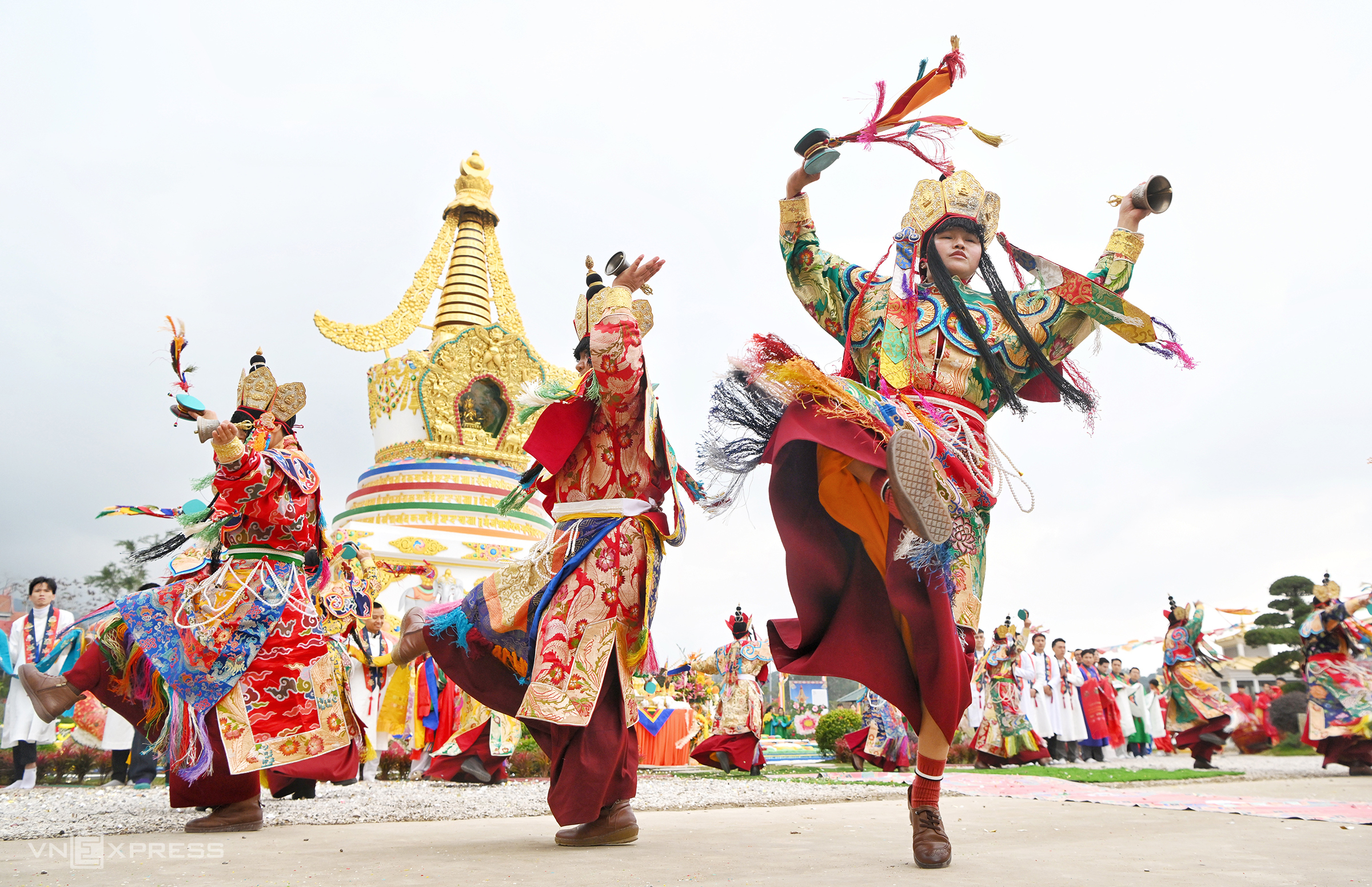 |
Dakini dance ritual during the early 2025 prayer ceremony held at Mandala Tay Thien. *Photo: Giang Huy*
The Drukpa Lineage is an important branch of Vajrayana Buddhism. Its nearly 1,000-year legacy has gradually established the lineage as a central religion shaping Bhutan's cultural identity. This South Asian nation is renowned for its Gross National Happiness (GNH) index, which integrates Buddhist philosophy with public policy, emphasizing a balance of material, spiritual, environmental, and cultural aspects. The Drukpa Lineage provides the ideological foundation for this model, enabling its people to embrace a development direction rooted in happiness and well-being, rather than solely on GDP.
In the 21st century, the Drukpa Lineage has gradually expanded its influence beyond the Indo-Himalayan region, establishing a presence in many countries, including Western nations. Gyalwang Drukpa the 12th, the spiritual leader of the lineage, is not only a religiously influential figure but also actively participates in socio-cultural dialogue, with his contributions recognized internationally.
Phong Linh