Ho Chi Minh City plans to offer free fares on 135 bus routes starting in May, pending final approval. This policy aims to reduce travel costs, encourage public transport use, and consequently alleviate traffic congestion and pollution. If implemented, it will mark the first time all city residents can ride buses for free.
According to Associate Professor-Doctor Nguyen Hong Quan, Director of the Institute for Circular Economy Development at Vietnam National University Ho Chi Minh City, this initiative comes amid rising gasoline prices, offering significant social welfare benefits by reducing residents' travel expenses. However, he believes free fares alone are not the decisive factor for people to give up motorbikes, noting that bus fares have been low for many years and were not the primary deterrent.
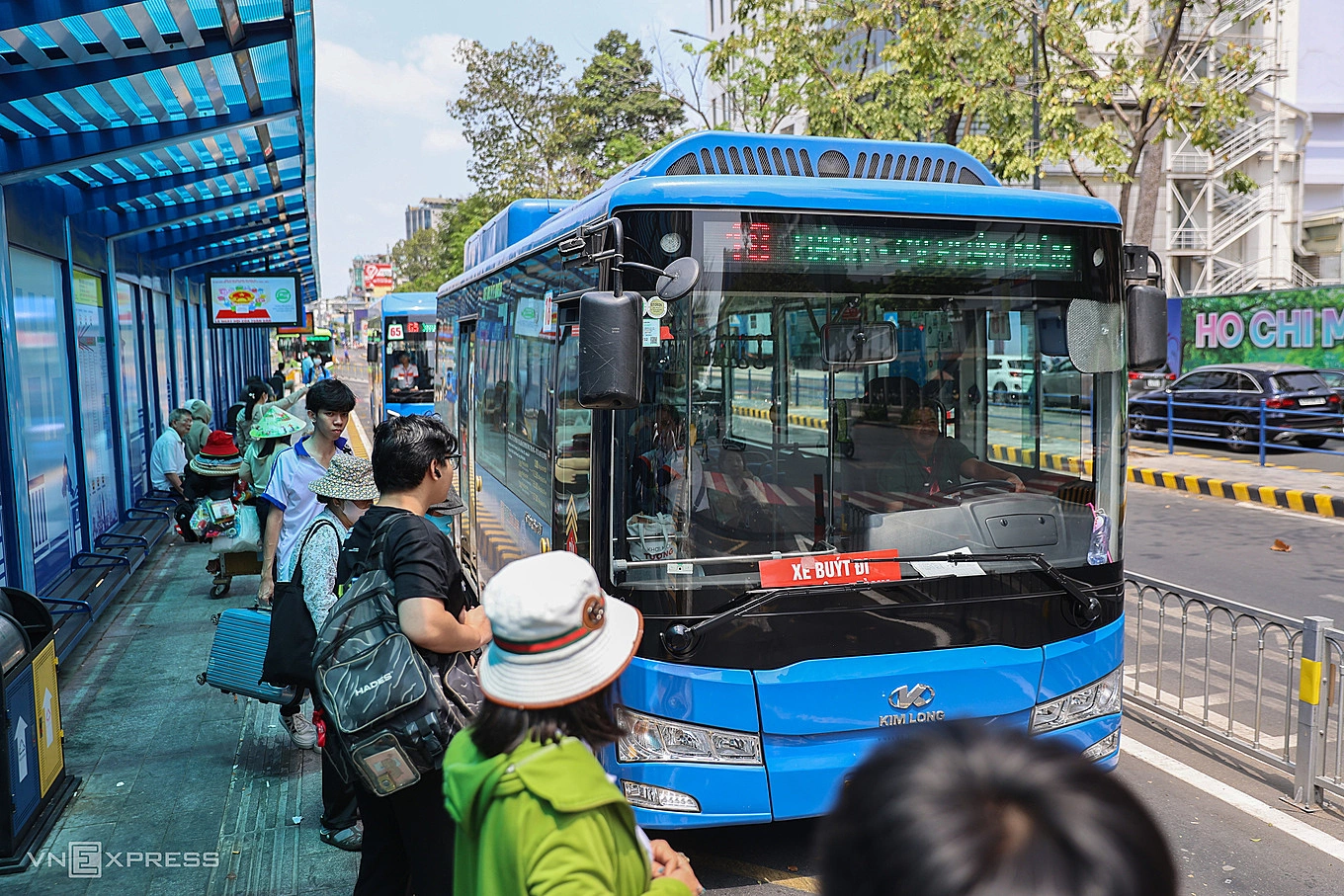 |
Residents board a bus in central Ho Chi Minh City, 4/2026. Photo: Quynh Tran |
Drawing on both domestic and international experiences, Quan noted that free fares typically lead to a rapid increase in passenger numbers, with some areas seeing a 20-30% surge immediately after implementation. In Ho Chi Minh City, previous instances of free bus and metro travel during holidays, Tet, or major events also recorded sharp increases in usage. However, he emphasized that to retain passengers long-term, service quality remains the most crucial factor.
"Residents will only commit if buses are truly convenient, punctual, safe, and clean," Quan stated.
Ho Chi Minh City currently operates 180 bus routes with over 2,400 vehicles, including 135 inter-provincial routes primarily serving the city's original administrative areas before the merger with Binh Duong and Ba Ria-Vung Tau. Despite their pivotal role in public transport, buses have not yet achieved their expected market share.
In 2025, the system served nearly 97 million passengers, an increase from the previous year, yet the percentage of bus users reached only 1,6%, falling far short of the 7,23% target. This disparity indicates that buses lack sufficient appeal, while private vehicles, especially motorbikes, maintain overwhelming dominance. Ho Chi Minh City currently manages almost 13 million vehicles, comprising over 1,4 million cars and nearly 11,3 million motorbikes, the highest number nationwide.
According to Quan, a primary reason for this struggle is traffic congestion, which makes it difficult for buses to maintain their schedules. Furthermore, despite network expansion over the years, routes still largely adhere to main arteries, failing to penetrate smaller streets, alleys, and new residential areas. This limits accessibility, not meeting the recommended walking distance of 300-500 meters to a stop.
In central areas, the walking radius to the nearest bus stop is approximately 100-300 meters, but from many alleys, it can exceed one kilometer; in suburban areas, coverage is even more restricted. With such distances, residents may spend 15-30 minutes walking to a station. If congestion occurs, the total journey could extend to one to two hours. In contrast, traveling by motorbike often takes about half the time and offers greater flexibility, making buses less competitive.
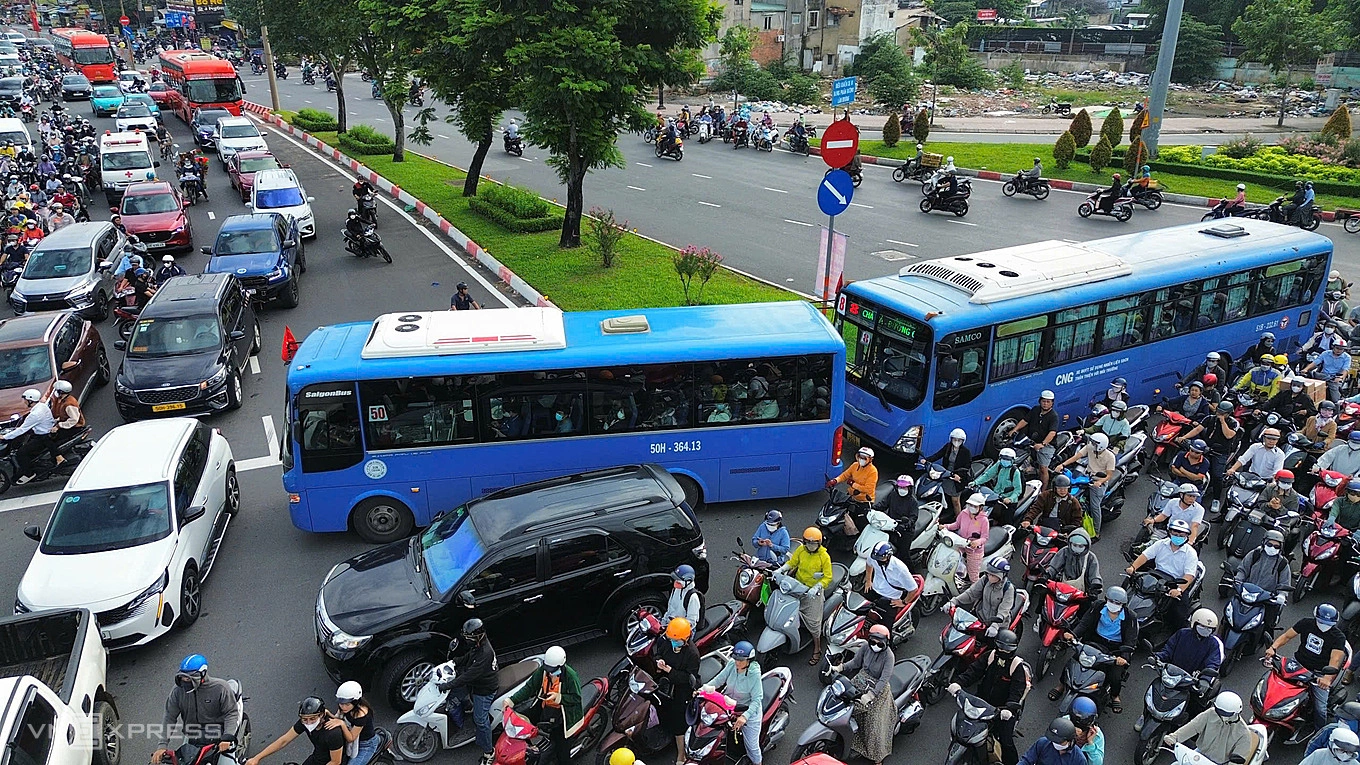 |
Buses navigate through a stream of private cars and motorbikes near Binh Trieu Bridge, 10/2025. Photo: Ha Giang |
Le Trung Tinh, Chairman of the Ho Chi Minh City Passenger Transport Association, also emphasized that the biggest current impediment is frequent bus delays due to congestion. Daily, buses must contend with dense streams of cars and motorbikes, leading to unstable journey times and diminished appeal for passengers.
He recalled that Ho Chi Minh City once implemented dedicated bus lanes on Tran Hung Dao street, but the model was later discontinued. He views this as a setback in the goal of developing public transport.
"When buses are not prioritized on the roads, ensuring punctuality is almost impossible given Ho Chi Minh City’s current traffic conditions," he said.
Beyond infrastructure, Tinh asserted that passenger choice also depends on fleet quality and service attitude. Nevertheless, he noted that bus quality has recently improved significantly, attributed to a newer fleet, an increased proportion of electric buses, and the application of technology in management and operations.
Associate Professor-Doctor Nguyen Thi Bich Hang from the University of Transport Technology similarly stated that free bus fares are merely a "necessary condition." She believes true effectiveness hinges on fundamental factors such as service quality, network coverage, and connectivity.
According to Hang, this presents an opportunity for Ho Chi Minh City to conduct a comprehensive review and upgrade its public transport system. The focus should be on restructuring the network, organizing dedicated lanes to improve punctuality, and enhancing connectivity between buses, the metro, public bicycles, and other transport modes.
"If infrastructure and service preparations are insufficient, initial impacts could diminish quickly, making it hard to achieve set goals," Hang cautioned.
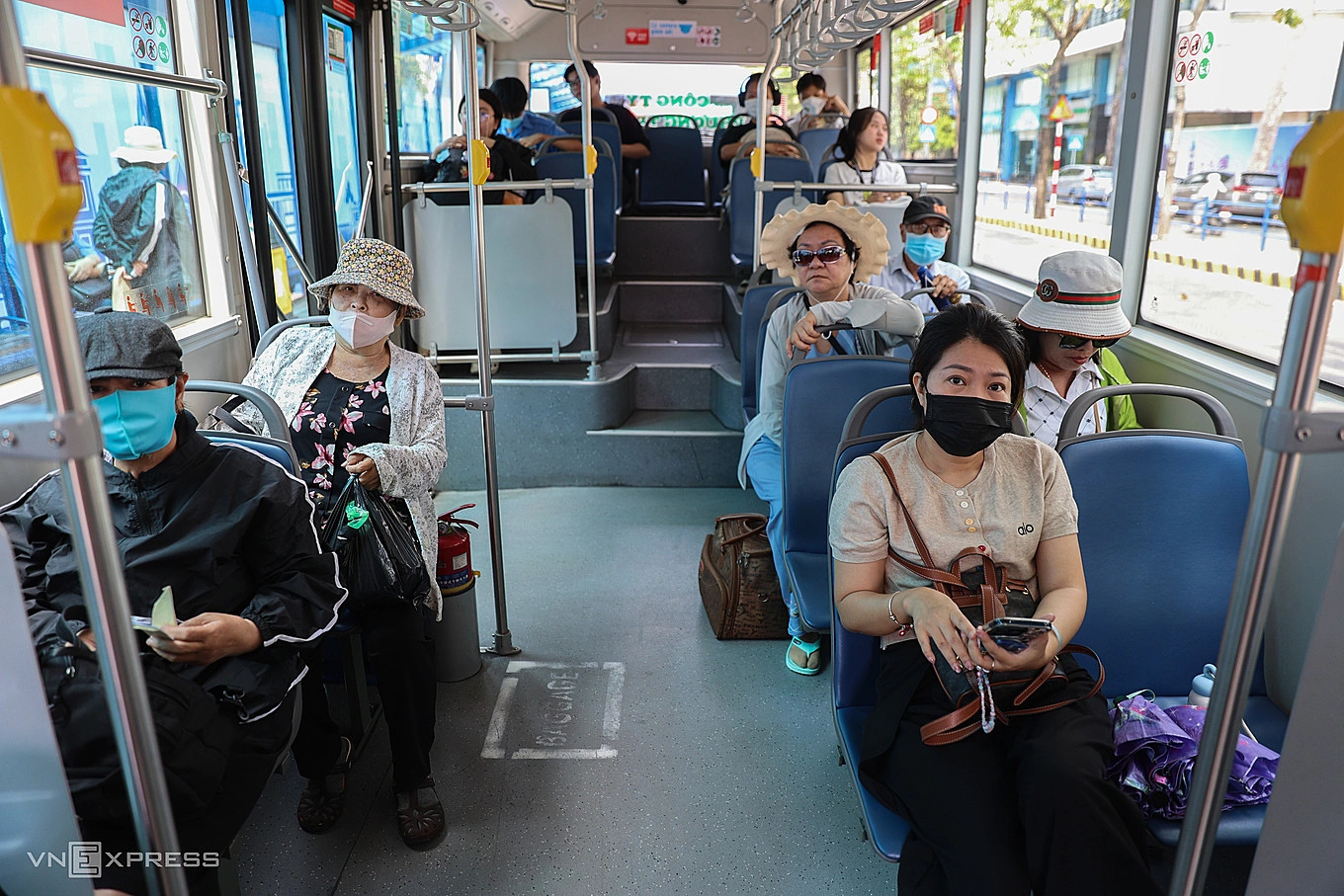 |
Passengers ride an electric bus in Ho Chi Minh City, 4/2026. Photo: Quynh Tran |
The Ho Chi Minh City Department of Construction announced it will continue network restructuring, developing small, green bus routes that penetrate deeper into residential areas, ensuring residents can access stops within a 300-500 meter walking radius. The system will also expand routes connecting Binh Duong, Ba Ria-Vung Tau, and Long Thanh Airport, while exploring night bus services and on-demand transport models.
In the long term, the city aims for all buses to transition to electric and green energy by 2030, alongside investments in more terminals, shelters, connecting walkways, and park-and-ride facilities.
However, both experts and managers agree that technical solutions will only achieve their maximum impact when private vehicle control measures are implemented concurrently.
According to Associate Professor-Doctor Nguyen Hong Quan, in addition to network expansion, buses need increased connectivity with the metro and public bicycles, along with improved green and convenient pedestrian infrastructure. The policy should also prioritize groups with mobility challenges, such as students, the elderly, and people with disabilities.
He referenced the experience of Luxembourg, the first country to offer free public transport, highlighting that such policies not only aim to reduce congestion and pollution but also ensure travel access for low-income individuals. He suggested that Ho Chi Minh City should implement electronic tickets with identification to specifically support priority groups and collect data for policy evaluation and adjustment.
Giang Anh - Le Tuyet