Hanoi Metro began implementing biometric ticketing technology on its two lines, Nhon - Ha Noi Station and Cat Linh - Ha Dong, in early 2026. Previously, elderly passengers entitled to free travel had to queue at ticket counters to register for a card each time, then swipe it at automatic gates to enter the station. The current system allows elderly passengers to use their chip-embedded citizen ID combined with facial recognition at automatic control gates.
The system automatically verifies information and identity through biometric facial authentication. All processing and calculations are completed in under 300 milliseconds, and if the information is valid, the gate automatically opens for passengers to enter.
For single-trip tickets, passengers can purchase tickets for their journey on the app and then scan a QR code at the gate, eliminating the need to queue at ticket counters or automatic vending machines. Additionally, the system accepts bank card and international card payments, such as Visa, directly at automatic control gates using the Tap & Go model, adhering to the EMV international standard. This solution offers passengers, especially tourists and foreigners, greater flexibility and convenience.
Passengers using weekly or monthly passes can purchase tickets anytime, anywhere via the Hanoi Metro app on their smartphones, using various online payment methods. Monthly pass users need to activate their account on the Hanoi Metro app by verifying their chip-embedded citizen ID or linking it with a VNeID app that has level two identification or higher.
 |
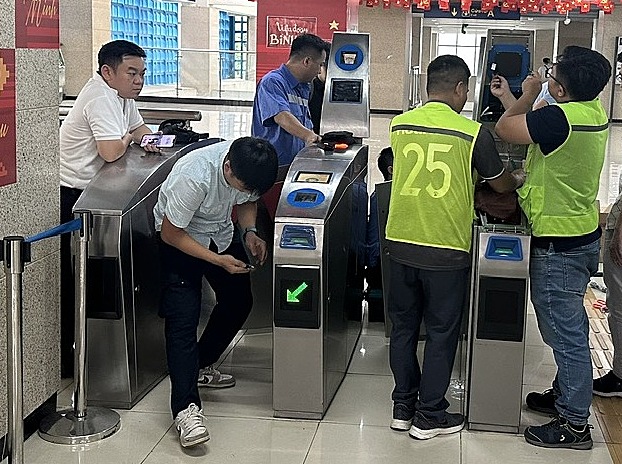
Passengers use their phones to scan QR codes at the ticket gate. Photo: Phuong Linh
When passing through automatic ticket gates, the system identifies monthly passes via a QR code on the phone screen, cross-referencing it with facial recognition to confirm the user matches the pass holder. This solution enhances accuracy, reducing instances of monthly passes or优惠 tickets being lent to others.
Experts from Thang Long Software Joint Stock Company developed the facial recognition solution for automatic ticket gates, with research and development beginning in 8/2025.
According to Mr. Bui Thanh Binh, Deputy General Director of the company, the team studied automatic fare collection solutions from advanced countries like Japan, South Korea, and China. Consequently, the solution for Hanoi Metro meets the latest global standards and is suitable for Vietnam's infrastructure conditions and policy framework. Thang Long Software's engineering team surveyed the technical infrastructure of the two existing railway lines despite limited information and in-depth design documents, as core information was not transferred by ODA contractors.
The project aimed to maximize the use of existing infrastructure, preventing waste, while upgrading it to support diverse new ticket methods and implement biometric passenger identification. This ensures a transit time of under 300 milliseconds per automatic gate transaction, meeting public transport standards.
Mr. Binh noted that the most significant challenge was reading portrait data from citizen IDs, as market-available readers typically took three seconds to complete the task. After extensive research and testing of various readers, combined with optimized processing algorithms, Thang Long Software selected a reader from HID (United Kingdom). This high-end reader supports most advanced card reading technologies globally, capable of reading both chip-embedded citizen IDs and electronic passports according to the ICAO9303 international standard. Vietnamese engineers collaborated with HID experts for one month to precisely control the reader.
 |
Thang Long Software engineers install ticketing equipment at a metro station. Photo: Phuong Linh
To enhance reliability and fault tolerance during operation, Thang Long Software developed QR code solutions that incorporate encryption and byte-level optimization. This enables local (offline) processing in most situations, allowing the system to operate normally even if network connections are interrupted.
After four months of research, the system underwent a one-month trial on the Cat Linh - Ha Dong line. This phase identified several issues, such as slow gate opening, facial recognition affected by standing angles, or passengers walking too close together, making accurate identification difficult. All these errors were adjusted and rectified.
Since early 2026, Hanoi Metro has uniformly applied the new ticketing technology across both metro lines in the city. Initially, some elderly people or those less familiar with technology faced difficulties using their chip-embedded citizen IDs at the control gates, but station staff provided direct assistance.
Compared to traditional methods, the biometric ticketing system helps passengers move quickly through gates, reduces the reliance of elderly passengers on carrying cards or phones, and eases congestion during peak hours. This technology also enhances control accuracy, curbs fraud, and establishes a foundation for deeper integration with future management systems and smart digital services.
According to Mr. Bui Thanh Binh, mastering the technology to produce automatic ticket control gates—from circuit design and control programming to application software development—allows seamless integration with high-end reader devices. This has resulted in automatic control gates manufactured in Vietnam, reducing investment and maintenance costs in urban transport ticketing.
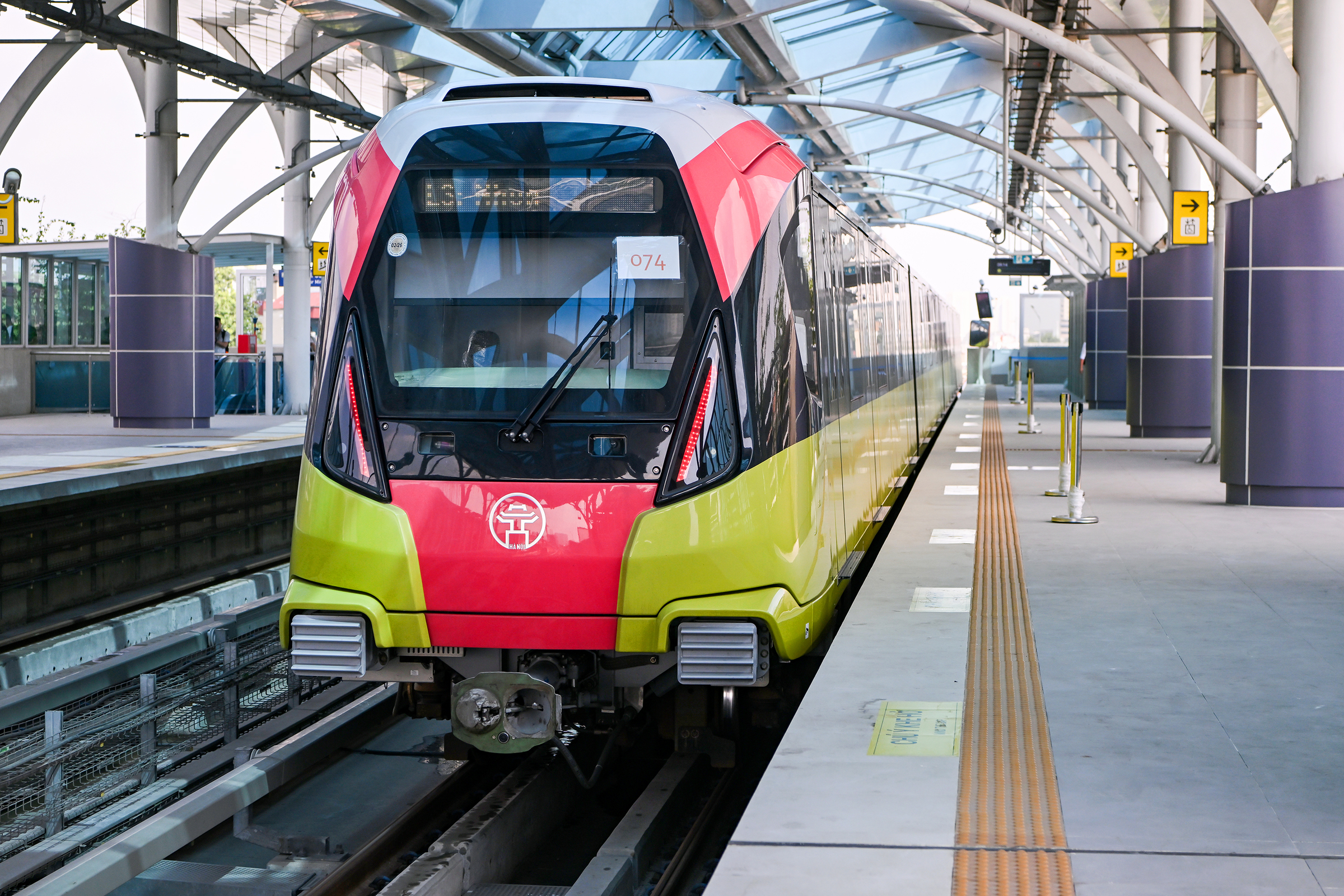 |
A train runs on the Nhon - Ha Noi Station elevated railway line. Photo: Giang Huy
After six months of trial and deployment, Hanoi Metro recorded over 6,1 million passenger trips using the new system, an increase of 15%. Revenue for the two urban railway lines rose by 48%, and the adoption rate of electronic identification and biometrics reached 70%.
Mr. Le Bang An, General Director of Hanoi Metro, stated that the integrated ticketing system not only improves user experience but also enhances management and operational capabilities. It allows the unit to monitor passenger volume and revenue, leading to more efficient schedule adjustments. Maintenance and operation have also improved due to automatic fault detection.
The system successfully passed connection tests with the fire alarm network and emergency response protocols at stations, enabling automatic gate opening to ensure safety during emergencies.
In the coming period, this model will expand across Hanoi's entire inner-city railway network and may connect with other transport modes, such as buses, parking facilities, and smart urban services in Hanoi.
Doan Loan