The Vietnam Railway Authority recently submitted a proposal to the Ministry of Construction for the approval of the master plan for railway lines and stations in Hanoi's key area. A significant new aspect of this plan is the reorganization of railway corridors through the capital, integrating urban railway development with maintaining connectivity for the national railway network.
**Relocating key railway stations**
Under the proposed plan, the North-South railway line within the study area, from Hanoi station to Phu Ly station, spans approximately 56 km and currently operates as a single track, 1,000 mm gauge line. The section from Hanoi station to the Ngoc Hoi complex will be converted into an urban railway after the Eastern ring railway line becomes operational.
The Ngoc Hoi - Phu Xuyen section, about 26,5 km long, will be realigned to run alongside the North-South high-speed railway line corridor.
The Vietnam Railway Authority also proposes converting the Ngoc Hoi - Yen Vien and Gia Lam - Lac Dao sections into urban railways. The construction plan must ensure convenient and efficient passenger transfer between the Ngoc Hoi complex, Gia Lam station, and Yen Vien station with Hanoi's city center.
Specifically, the Gia Lam - Yen Vien section will feature a double track, 1,435 mm gauge; the Gia Lam - Lac Dao section will be a single track, 1,000 mm gauge, sharing the corridor but with separate infrastructure from the urban railway. The construction timeline aligns with the implementation progress of Hanoi's urban railway line one, the Kim Son - Ngoc Hoi Eastern ring railway line, and the Lao Cai - Hanoi - Hai Phong line.
The list of central and main stations proposed no longer includes Hanoi, Giap Bat, and Long Bien stations. Instead, national passenger hub functions will be located at Ngoc Hoi and Gia Lam.
According to the proposed transport organization plan, passengers arriving in Hanoi will be picked up and dropped off at Gia Lam and Ngoc Hoi. Passengers traveling between northern and southern provinces will transfer via the Eastern ring railway line at these two stations.
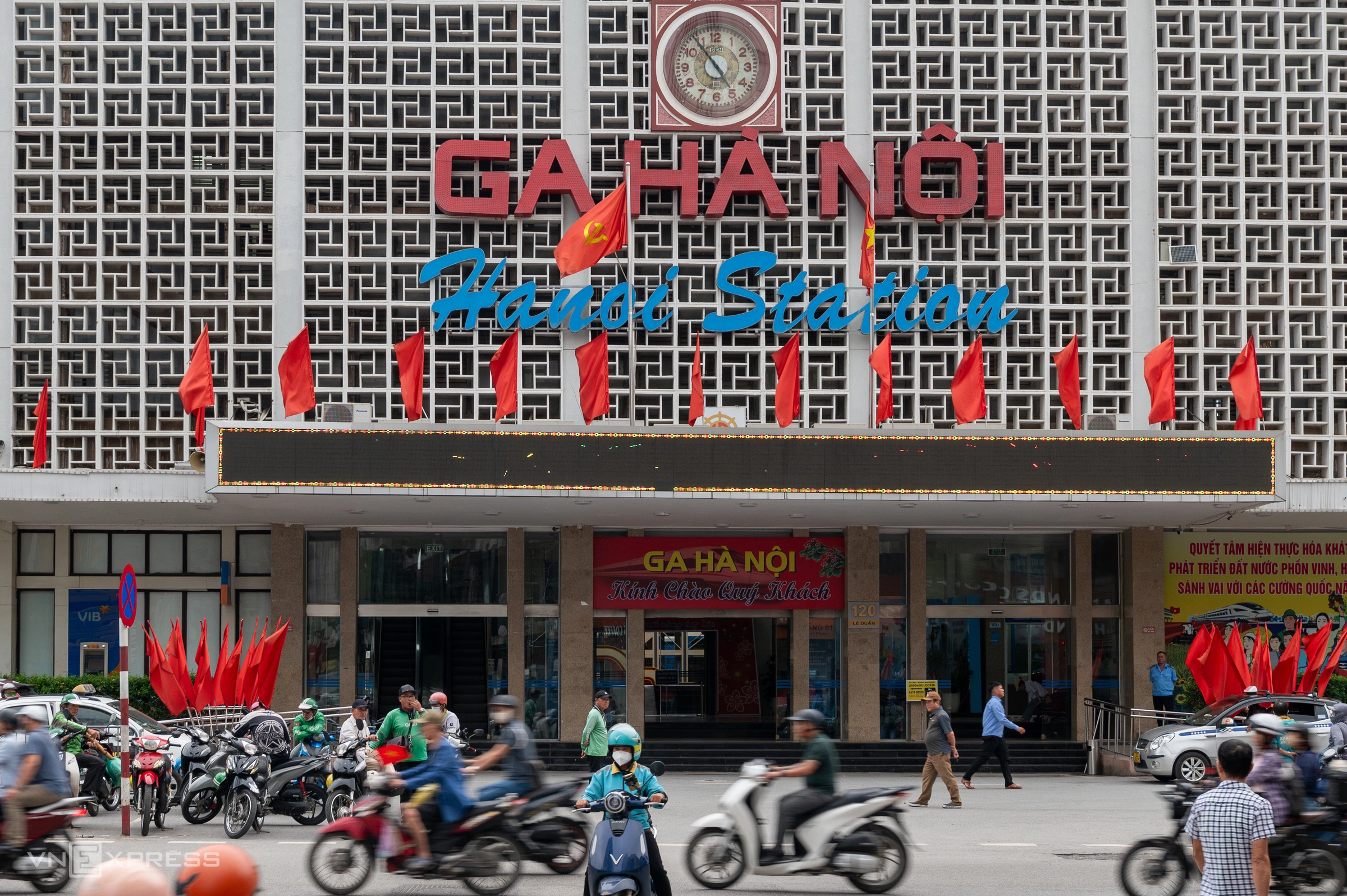 |
Hanoi station will no longer serve as a national railway hub. Photo: The Bang |
For cargo, the main marshalling and loading/unloading stations will be located at Thuong Tin and Yen Thuong. Cargo flow between the areas north and south of the Red River will be transferred via the Eastern ring railway line and the new cargo hubs.
This adjustment will significantly change how railway transport is organized in Hanoi, while opening up opportunities to restructure the capital's transport space by moving major hubs out of the city center.
**Over 40,000 billion VND for replacement infrastructure**
To prepare replacement infrastructure, the Hanoi People's Committee recently requested the Ministry of Construction and the Ministry of Finance to consider allocating approximately 9,453 billion VND in the 2026 capital plan. This funding will support investment preparation, site clearance, and initial work for two national railway projects managed by Hanoi.
Hanoi will implement two railway projects with an estimated total investment of 40,171 billion VND, proposed for allocation from the central budget.
The first project involves the realignment of the existing Hanoi - TP HCM railway line section from Phu Xuyen to Ngoc Hoi, approximately 26,5 km long, along with about 3 km of connection from Ngoc Hoi to the Bac Hong - Van Dien belt line.
This line will be developed as a single track, 1,000 mm gauge line, using diesel traction, and will include three new stations: Ngoc Hoi, Thuong Tin, and Phu Xuyen. The estimated total investment for this project is about 12,419 billion VND, with completion expected on 31/3/2027.
The project also includes the construction of a new freight wagon workshop, a locomotive workshop, and the National Railway Operation Center, which will be relocated from Hanoi station to the new Thuong Tin station.
The second project is the Eastern ring national railway line section from Ngoc Hoi to Kim Son, passing through Hanoi, Hung Yen, and Bac Ninh. The main line from Thuong Tin to Kim Son is approximately 31,3 km long.
As proposed by the Hanoi People's Committee, this line will be developed as a double track, 1,435 mm gauge, electrified line, with an estimated total investment of about 27,752 billion VND, expected to be completed in December 2028.
These projects are directly linked to Hanoi's urban railway development plan and the implementation of the National Highway 1A spatial axis project. Specifically, urban railway line one from Ngoc Hoi to Yen Vien and line six from Ngoc Hoi to Noi Bai share the existing national railway corridor.
Therefore, the construction of the Eastern ring railway line, the realignment of the Phu Xuyen - Ngoc Hoi section, and the new station and technical facilities are considered essential for transferring the existing corridor and infrastructure to the city's urban railway projects.
Currently, approximately 86 passenger and freight trains pass through the Hanoi station area daily. Annual transport volume reaches about 3 million passengers and 2.9 million tons of cargo. During peak periods like Tet and summer, passenger numbers can reach nearly 20,000 daily.
In the current system, Hanoi station serves as a passenger hub, also handling passenger train marshalling and formation, locomotive inspection and repair, and housing the National Railway Operation Center. Gia Lam station is the northern passenger hub, serving national and international intermodal passenger trains.
Meanwhile, Giap Bat and Yen Vien stations serve as the southern and northern freight hubs, respectively, handling freight train marshalling and formation, and locomotive and wagon inspection and repair. Yen Vien also functions as an international intermodal freight station. Therefore, the handover and conversion of existing lines and stations involve not only tracks but also require the relocation of the entire operational, control, and maintenance system for vehicles.
Doan Loan