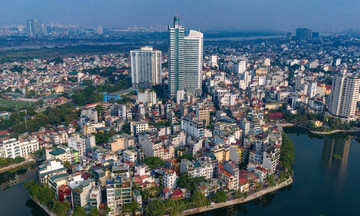
At 21h, the monitoring station of the Environment Agency located at the gate of Hanoi University of Science and Technology on Giai Phong street recorded an air quality index (AQI) of 216, indicating a very unhealthy level and warning of a serious health risk. The primary pollutant was fine particulate matter (PM2.5). This index began to rise from 15h yesterday, surpassing the poor level, maintaining at an unhealthy threshold, and increasing to a very unhealthy level by 20h this evening.
Two other monitoring stations at 556 Nguyen Van Cu recorded an index of 183, while the Khuat Duy Tien park station showed 152. Simultaneously, the Hanoi Department of Agriculture and Environment's air quality monitoring system displayed only three stations, with the Khuat Duy Tien park station registering an index of 153.
According to the data aggregation website IQAir, Hanoi was the world's third most polluted city on the evening of 7/12 with an index of 219, trailing Lahore, Pakistan (291) and Delhi, India (221). An hour prior, Hanoi had topped the list with an index of 230. On this system, many inner-city areas also reported very unhealthy levels, including Tay Ho (276), Vinh Tuy (233), Hoan Kiem (219), and Ha Dong (224). In the northern region, the Bac Giang station displayed an index of 162, and Thai Nguyen 199.
 |
Traffic participants in Hanoi's polluted air. Photo: Hoang Giang
The Environment Agency forecasts that Hanoi's air quality will remain at a very unhealthy level on 8/12, with an index of approximately 230, increasing to 237 on 9/12. On 8/12, Ninh Binh, Hung Yen, Phu Tho, and Quang Ninh are also expected to experience very unhealthy air, with Hai Phong, Bac Ninh, and Lang Son joining this category on 9/12.
In response to the severe pollution, on 27/11, the Ministry of Natural Resources and Environment requested ministries and sectors to implement urgent measures to address air pollution in Hanoi and its surrounding areas. The Ministry of Industry and Trade was asked to direct thermal power plants, steel, chemical, and fertilizer factories to strictly operate their exhaust gas treatment systems, absolutely prevent the discharge of untreated waste, and reduce capacity when the pollution index exceeds 200.
The Ministry of Construction required construction sites to implement covering, vehicle washing, and mist spraying for dust suppression, even temporarily halting major dust-generating activities. Local authorities were tasked with traffic diversion and controlling material transport vehicles to prevent congestion that exacerbates pollution. The Ministry of Public Security was instructed to increase enforcement against uncovered material transport vehicles, expired vehicles emitting black smoke, and illegal waste burning. The Ministry of Health was to guide residents on health protection, especially vulnerable groups, and the Ministry of Education and Training required schools to limit outdoor activities when air quality is unhealthy.
By Gia Chinh