On 5/12, at a workshop on electronic administrative violation processing in traffic order and safety, Colonel Tran Dinh Nghia, Head of the Traffic Police Department of Hanoi Public Security, announced that the city had upgraded its Traffic Control Center. The system, comprising 1,837 cameras and artificial intelligence (AI) traffic lights, is expected to become operational from 10/12, automatically controlling traffic based on real-time flow data.
According to Colonel Nghia, the system will not only process violations via images but also automatically detect red light violations, wrong-lane driving, and illegal stopping or parking. It will also provide congestion alerts, identify tracked vehicles, and allow real-time adjustment of traffic light cycles, shortening or extending phases based on traffic volume. This initiative aims to reduce the need for direct human intervention in traffic regulation and enhance the accuracy and transparency of management.
Hanoi Public Security announced that the entire camera-based fine process will be conducted electronically, reducing 7 procedures compared to the manual process.
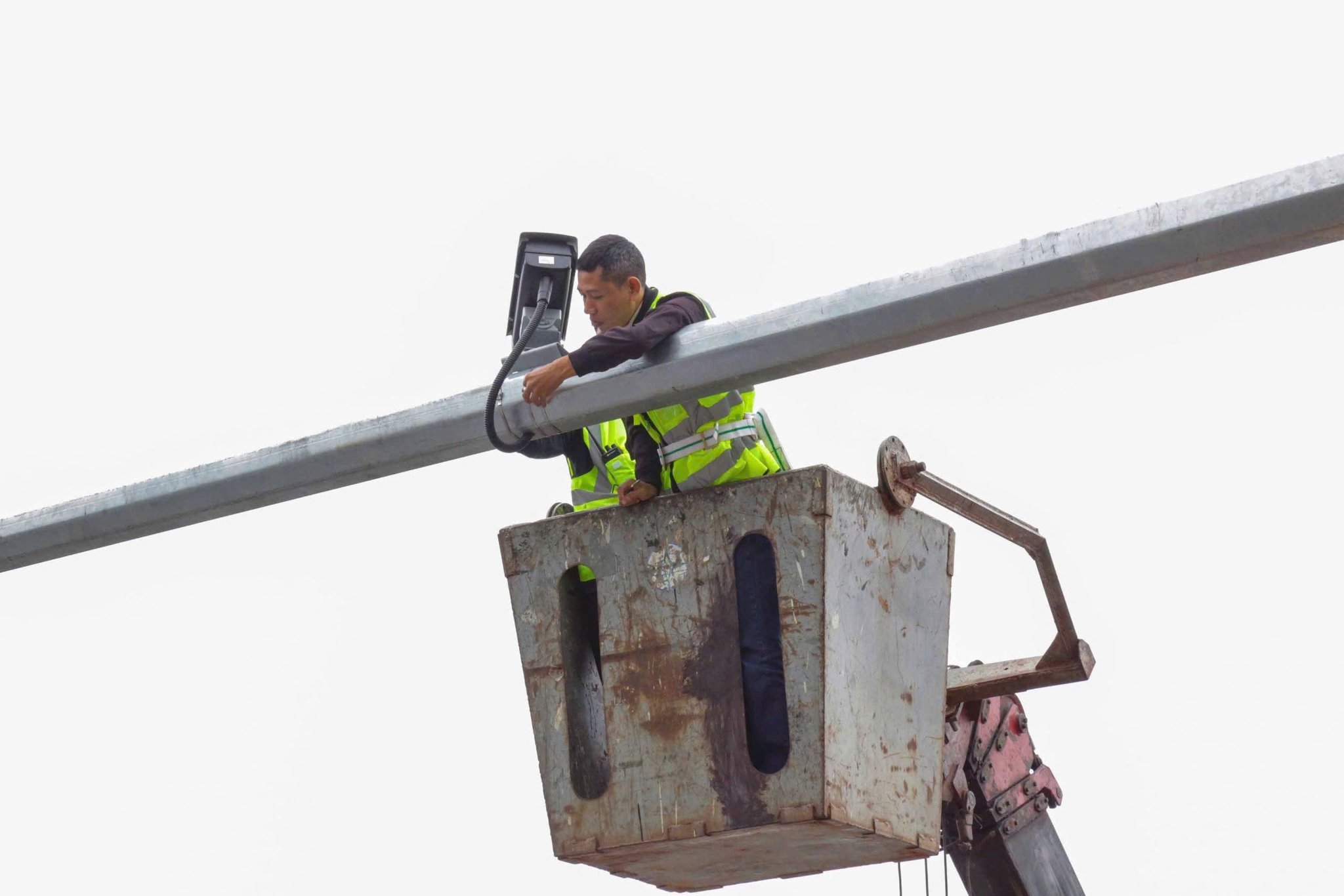 |
Workers installing AI cameras in Hanoi in 11/2025. Photo: Viet An.
Lieutenant General Nguyen Thanh Tung, Director of Hanoi Public Security, noted that a comprehensive electronic administrative violation processing model, if implemented correctly, would mark a turning point in building a digital government, digital society, and digital public security force.
Following a centralized surveillance camera system management project approved by the Hanoi People's Committee, the city has installed 1,873 AI cameras. Hanoi aims to install over 40,000 cameras by 2030, with more than 16,000 dedicated to managing traffic safety, environment, and urban order.
The AI camera system is trained to identify 20 common violations, featuring 360-degree pan-tilt-zoom capabilities, facial and license plate recognition, and the ability to detect violations from a distance of 500 to 700 m.