The Hanoi People's Committee has approved a 24-month program for autonomous vehicle testing. Vehicles will operate exclusively on fixed, high-definition mapped (HD Map) routes, connect to a monitoring system, and must meet all safety requirements before deployment.
The designated testing area encompasses Hoa Lac High-Tech Park and the Hoa Lac facility of Vietnam National University, Hanoi. The City Management Board of High-Tech and Industrial Parks will guide, supervise, and control the program's implementation.
This project aims to evaluate the safety, reliability, and operational capabilities of autonomous vehicles in real traffic conditions. Hanoi will also assess their potential for public transport integration, user experience, and connectivity with existing transportation networks. Data collected during testing will support research and the development of national standards and regulations for autonomous vehicles in Vietnam.
Autonomous vehicles integrate light detection and ranging (LiDAR) technology, cameras, high-definition maps, high-precision global positioning systems (GPS), and artificial intelligence algorithms. The participating company stated it independently developed the autonomous software and fleet management platform, and collaborated on hardware design.
Vehicles are expected to operate at a maximum speed of 40 km/h, from 9 a.m. to 4:30 p.m. Over 12 months of public testing, autonomous buses anticipate serving 40,000 to 50,000 passengers, while robotaxis expect 20,000 to 35,000 passengers. Each autonomous bus can carry up to 8 passengers, and each robotaxi up to 4, excluding the safety supervisor.
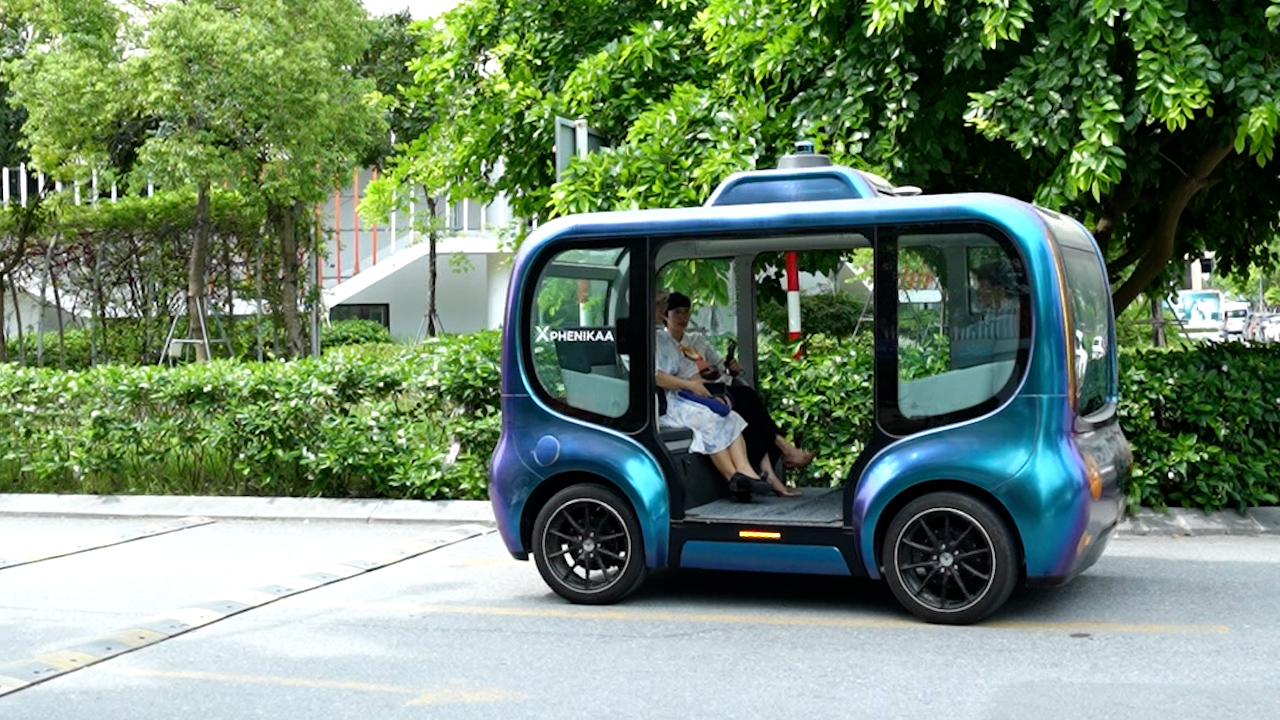 |
Autonomous vehicle undergoing testing in Hoa Lac High-Tech Park. *Photo: Loc Chung*
During the testing period, some existing legal regulations will be temporarily suspended for vehicles operating within the approved scope. In exchange, strict safety control measures will be rigorously enforced. Autonomous buses and robotaxis must have a safety supervisor in the driver's seat, ready to manually intervene immediately if the system malfunctions or exceeds safe operating parameters.
The testing entity is prohibited from engaging in commercial transportation or charging passengers. Each vehicle may only commence operation after fulfilling requirements related to its technical dossier, safety inspection and assessment, designated route, operating conditions, emergency stop plan, rescue protocols, insurance, and connection to the monitoring data system. Any expansion of routes, addition of vehicles, or changes to configuration or software requires re-confirmation from the competent authority before implementation.
The enterprise must submit reports after each operating shift, on a monthly basis, and immediately upon the occurrence or potential occurrence of an incident. Level 3 incidents require a preliminary report within 2 hours, Level 4 incidents within one hour, and Level 5 incidents demand immediate reporting.
Test results will be evaluated based on actual operating data, safety levels, reliability, risk control capabilities, and technical indicators. Any transition to a new phase or expansion of the testing scope must be based on operating data, incident records, technical inspection results, and the safety assessment provided by the supervising agency.
Vo Hai