The Ministry of Construction recently reported its anticipated reception and explanation of National Assembly deputies' opinions on the investment policy for Ring Road 5 - Hanoi Capital Region. During discussions, deputies proposed standardizing compensation levels in border areas, implementing livelihood restoration plans for residents, and completing resettlement areas before land acquisition. The National Assembly is expected to vote on the draft Resolution on the investment policy for Ring Road 5 - Hanoi Capital Region on 24/8.
Regarding compensation for border areas, the Ministry of Construction agreed on the need to limit unreasonable disparities between provinces and cities. Under the Land Law 2024, land prices for compensation are determined by provincial People's Committees based on land price tables, specific land prices, market principles, and actual conditions of each locality. Since each locality has its own land price table and policies, provinces and cities along the route have coordinated to review and compare land prices and compensation and support policies in border areas before approving plans. Land parcels with similar locations, land use purposes, and conditions on both sides of administrative boundaries will receive equivalent compensation and support.
In addition to compensation for land and assets on land, affected residents will have separate livelihood restoration plans. These plans include: support for life stabilization, production, vocational training, career change, and job placement, along with specific cost estimates. This funding is calculated independently within the total investment of the compensation, support, and resettlement component project, not combined with the cost of land and asset compensation or resettlement area construction. To ensure long-term employment for residents after ceding land, localities must develop vocational training programs aligned with the recruitment needs of industrial parks, industrial clusters, and service facilities along the route.
Addressing the requirement for resettlement to "go one step ahead," the Ministry of Construction stated that resettlement areas must have complete technical and social infrastructure according to planning, while also being compatible with the culture, customs, and practices of the communities whose land is acquired. In areas with ethnic minority communities, localities prioritize on-site resettlement or relocation near old residences, minimizing disruption to their lives. Residents also receive support for agricultural land and vocational training appropriate to their livelihood practices.
Ring Road 5 - Hanoi Capital Region is approximately 349 km long, passing through Hanoi, Ninh Binh, Hung Yen, Hai Phong, Bac Ninh, Thai Nguyen, and Phu Tho, and is divided into 22 component projects. The project has an estimated total investment of over 288,200 billion VND, funded by the state budget and other legal capital sources. During giai doan 2026-2030, the central budget is expected to allocate about 59,700 billion VND for the construction of the main expressway route. Approximately 4,011 hectares of land are required, including 1,776 hectares of rice cultivation land, 465 hectares of residential land, 210 hectares of forestry land, and 1,560 hectares of other land.
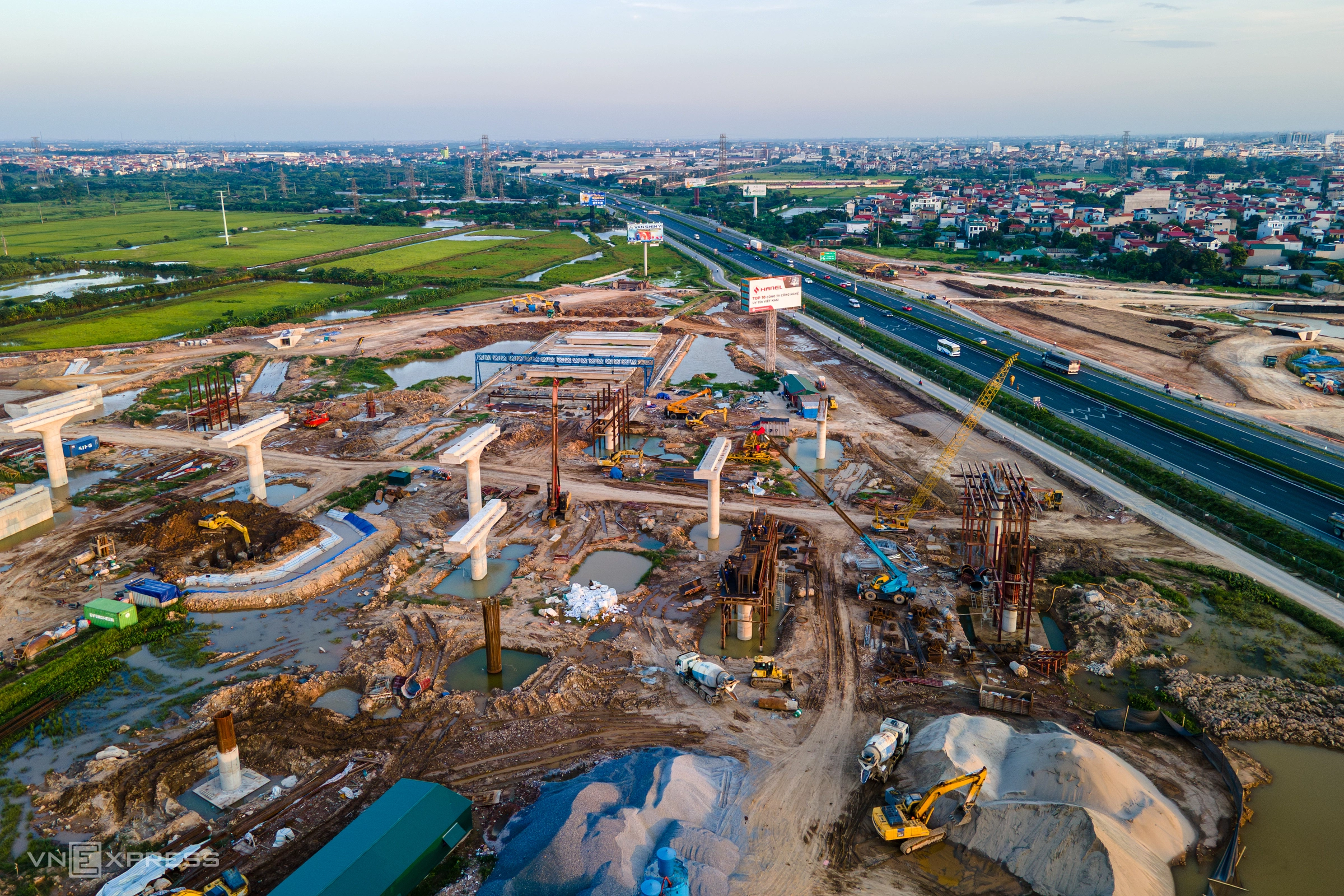 |
Construction site for Ring Road 4 in Hanoi. *The Bang* |
Son Ha