The 14th National Congress of the Communist Party of Vietnam has set a goal to significantly shift from importing and assembling to independently researching and producing military equipment. In a discussion with VnExpress, Major General Pham Thanh Khiet, Deputy Head and Chief of Staff of the General Department of Defense Industry, emphasized that this is not merely an adjustment in production methods, but a strategic shift in mindset. The aim is to ensure the military masters foundational and core technologies, progressively advancing to modernity from 2026.
 |
Major General Pham Thanh Khiet, Deputy Head and Chief of Staff of the General Department of Defense Industry. Photo: Hoang Phong
**A new strategic approach to defense industry development**
The 14th Congress’s document stresses the need to transition from import and assembly to independent research and production of weapons and equipment. This represents a fundamental shift in the defense industry development mindset, highlighted by the explicit emphasis on "self-reliance, self-sufficiency, and self-strengthening" within the national defense industry strategy. Previously, the focus was on modernity, dual-use capabilities, and gradually enhancing domestic production capacity.
However, the current strategic thinking has elevated this to a new level: not just domestic production, but full autonomy across the entire process, encompassing basic research, design, manufacturing, production, and long-term development. This comprehensive approach is crucial given the rapid global and regional developments, the emergence of high-tech weaponry, remote warfare, and cyber warfare. The requirement is no longer limited to possessing weapons but extends to mastering them, which includes foundational technologies, core technologies, and the ability to innovate based on practical needs.
Both the 14th Congress document and the 12th Army Party Congress Resolution clearly define this transition from primarily importing and assembling to independent domestic research and production. Concurrently, there is a push to commercialize defense industry products, including military equipment and dual-use items. Successful implementation of this strategy is expected to be one of three breakthroughs for the 2025-2030 term, laying the groundwork for the military to advance directly to modernity from 2026, one term earlier than previously required.
**Vietnam's robust foundation for self-reliance**
Vietnam possesses a solid foundation for achieving self-reliance in its defense industry. First, the institutional framework is well-established, with a largely synchronized system of legal documents on defense industry. This includes many unique and superior mechanisms, particularly in science and technology, attracting high-quality human resources, and fostering links with non-military enterprises.
Second, human capital is a key strength. The team of scientific and technical officers has grown in both quantity and quality, with strong research groups formed in several key areas. Third, the technological infrastructure is robust. The system of factories and research institutes has received relatively synchronized investment, featuring many modern laboratories and production lines.
Crucially, Vietnam has mastered numerous foundational, core, and strategic technologies. The defense industry has successfully manufactured, mass-produced, and deployed many new, high-tech weapons. Currently, Vietnam can largely ensure its army's equipment needs and has achieved self-reliance in designing and building new modern military vessels, along with some onboard weapons. The country has also mastered the design and production of most types of modern military equipment and automated command and control systems up to the strategic level.
Furthermore, Vietnam has achieved mastery in producing many specialized materials, including various types of propellants and powerful explosives that few other countries can manufacture. Recently, several new strategic weapons have been mass-produced and deployed significantly ahead of schedule. These achievements serve as a premise for Vietnam to accelerate its military modernization, demonstrating that correct policies and decisive action yield positive results.
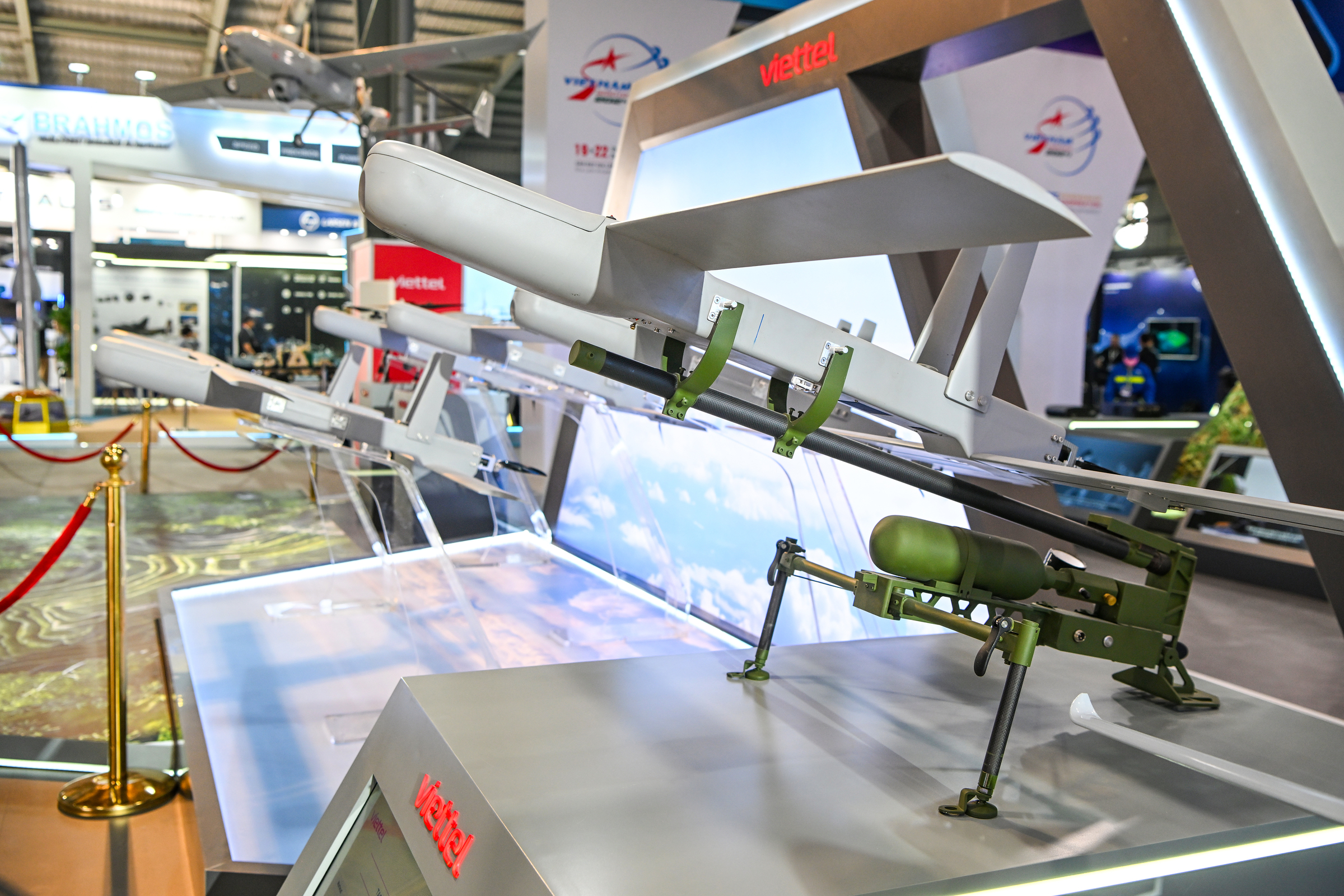 |
Reconnaissance and kamikaze Unmanned Aerial Vehicles (UAVs) displayed at the International Defense Exhibition 2024. Photo: Giang Huy
**A holistic view of defense industry self-reliance**
While many associate self-reliance with merely producing weapons and equipment, from a professional perspective, defense industry self-reliance must encompass the entire value chain. This includes idea generation, basic research, design, manufacturing, production, technical assurance, and the upgrading and improvement of military equipment. Limiting self-reliance to just production without mastering design would maintain technological dependence. Similarly, without self-reliance in technical assurance, the long-term combat readiness would be constrained.
Therefore, the requirement is to master foundational technologies such as information technology, artificial intelligence, big data, and automation, alongside new materials and precision engineering. These are prerequisites for developing products with a "Made in Vietnam" brand. Weapons can only be truly effective when Vietnam is self-reliant in their maintenance, repair, and upgrade, ensuring suitability for modern combat conditions and warfare methods.
The transition from procurement to independent production necessitates significant changes in organization and resources. Five key areas require focus: First, perfecting the institutional framework towards modernity, unlocking resources, and prioritizing specific mechanisms for the defense industry, particularly in high-tech fields. Second, building a team of intelligent, courageous, and innovative officers who dare to think and act, forming leading experts and chief engineers for key sectors. Third, achieving breakthroughs in science and technology, innovation, and digital transformation, implementing key projects to master foundational, core, and strategic technologies.
Another important task is to effectively mobilize national industrial potential, building sufficiently strong defense industry enterprises to lead and foster overall capabilities for the entire system. Finally, selective international cooperation and diversification of partners are essential, alongside promoting the export of defense industry products. However, any strategy can only succeed with a clear roadmap and commensurate financial resources.
 |
XCB-01 infantry fighting vehicle researched and developed by the General Department of Defense Industry, displayed at the 80 years of national achievements exhibition, August 2025. Photo: Nguyen Dong
**Dual-use products, technology transfer, and long-term impacts of self-reliance**
Developing a dual-use orientation is a strategic step for Vietnam. Dual-use is not only a global trend but also a way to connect scientific and technological potential between the military and civilian sectors. It facilitates sharing technology platforms, standardizing designs, and integrating research, production, and application. In this scenario, the defense industry becomes an integral component of the national industrial ecosystem, rather than being separate. Modern technologies can then diffuse into civilian sectors, enhancing national technological competitiveness.
In practice, the defense industry has played a pivotal role in researching and producing dual-use products, deploying large-scale and super-large data centers, and semiconductor chip factories. Many scientists have published international articles and hold patents both domestically and internationally. This simultaneously strengthens national defense capabilities and promotes national technological development.
In the context of integration, technology transfer must aim at knowledge transfer, not just the import of finished products. Vietnam must participate in the design phase, train experts, acquire processes, technical documentation, and the right to customize according to specific requirements. Diversifying partners is also crucial to avoid dependence. Technology transfer should only be a stepping stone towards independent design, production, and upgrading.
If the self-reliance orientation is effectively implemented, the military will first be equipped with modern weapons suitable for new combat methods, ensuring long-term combat readiness. Furthermore, independent research and production will facilitate the development of new fighting strategies and military art. At the national level, this will be a foundation to boost science and technology, train high-quality human resources, and build a modern dual-use industrial ecosystem, contributing to strengthening national defense and promoting rapid, sustainable national development in the new era.
Son Ha