Specifically, Vietnam Airlines canceled four flights: VN578 on the Hanoi - Taipei route on 10/7, VN579 on the Taipei - Hanoi route on 10/7, VN570 on the TP HCM - Taipei route on 11/7, and VN571 on the Taipei - TP HCM route on 11/7.
The airline adjusted the operating times for some flights to Kaohsiung. Two flights, VN586 from Hanoi to Kaohsiung and VN580 from TP HCM to Kaohsiung on 10/7, departed one hour earlier than scheduled.
Conversely, flights VN587 from Kaohsiung to Hanoi and VN581 from Kaohsiung to TP HCM, originally scheduled for 11/7, were moved to operate earlier on 10/7.
To meet the travel needs of affected passengers, Vietnam Airlines announced plans to deploy wide-body Airbus A350 and Boeing 787 aircraft on flights between Vietnam and Taipei on 11-12/7, thereby increasing service capacity and assisting passengers.
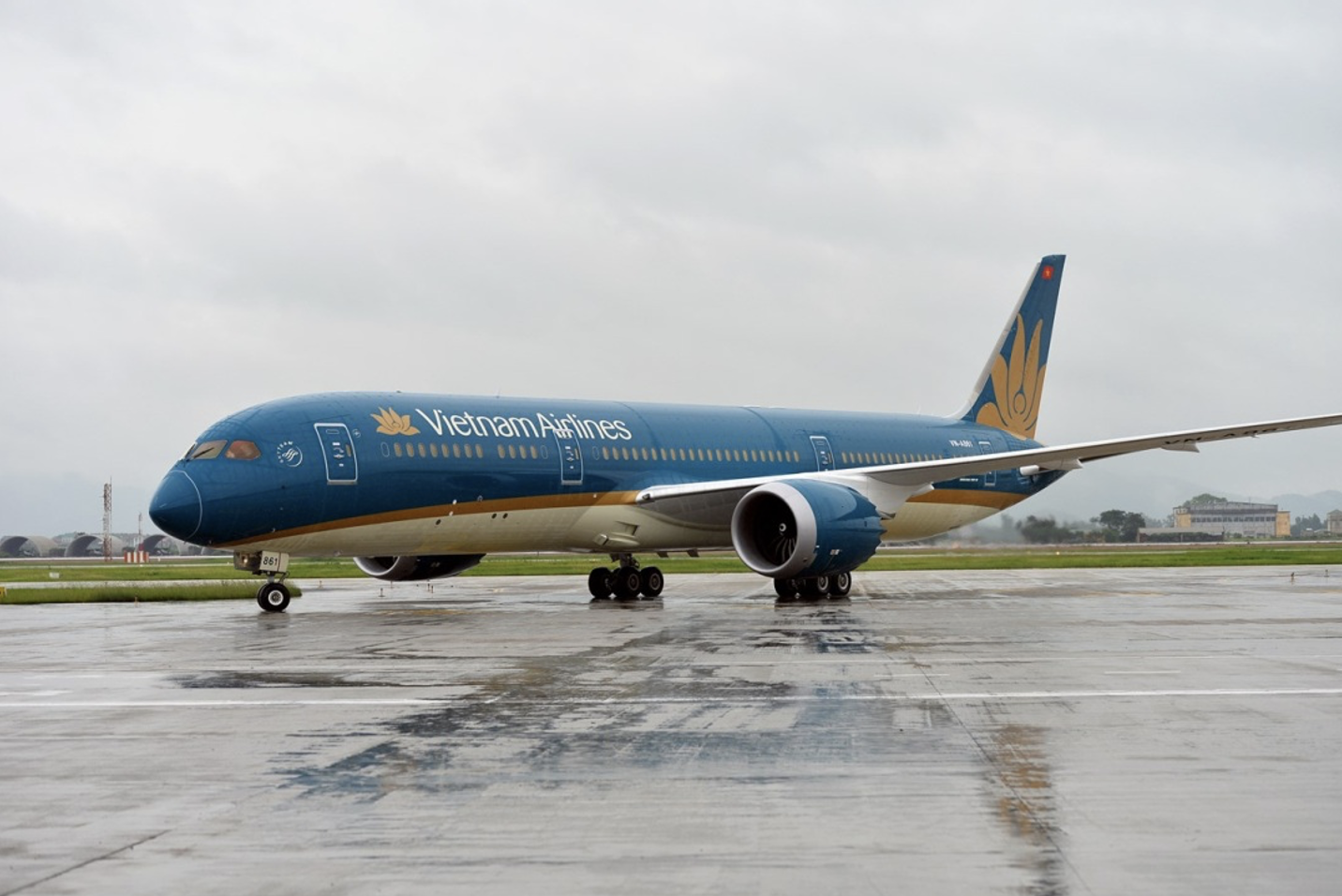 |
A Vietnam Airlines aircraft affected by Typhoon Ba Vi. *Photo: VNA*
In addition to routes to Taiwan, Vietnam Airlines stated that some flights to and from Japan, South Korea, and China could also be affected as flight schedules may require adjustments due to weather conditions.
The airline advised passengers to follow crew instructions, particularly to fasten seatbelts when the signal is illuminated and throughout the flight when recommended, to ensure safety.
For passengers planning to travel to or from airports in Taiwan and the Northeast Asia region during this period, the airline recommended regularly monitoring and updating flight information on official channels to proactively arrange travel plans.
The National Center for Hydro-Meteorological Forecasting reported that at 7 a.m. on 10/7, the eye of Typhoon Ba Vi was approximately 650 km southeast of Taiwan island (China) and about 1,000 km southeast of Fujian province (China).
Maximum wind speeds reached 166 km/h, category 14, with gusts up to category 16. Compared to yesterday, the typhoon had weakened by two categories and was no longer a super typhoon. Over the next 24 hours, the typhoon is expected to continue moving northwest at about 25 km/h and tend to weaken further.
Anh Duy