On the afternoon of 10/7, the Minister of Agriculture and Environment issued an official dispatch instructing the Director of Hoa Binh Hydropower Company to open one bottom spillway gate from 11:00 on 11/7. This action aims to regulate water levels, ensure structural safety, and proactively manage potential floods.
At 13:00 today, the upstream water level of the reservoir was 104 m, while the downstream level was 12,1 m. The inflow into the reservoir reached 4.377 m3/s, with a total outflow to the downstream area of 2.840 m3/s.
The decision to open the spillway gate comes amidst prolonged heavy rainfall in the Da River and Red River basins, influenced by a low-pressure trough. From the evening of 8/7 to the evening of 9/7, meteorological agencies recorded widespread rainfall of 70-100 mm in the northern mountainous region. Several areas experienced over 200 mm, including: My Bang (Tuyen Quang) with 211 mm, Thac Ba hydropower plant (Lao Cai) with 208 mm, and Phuc Luong (Thai Nguyen) with 208 mm.
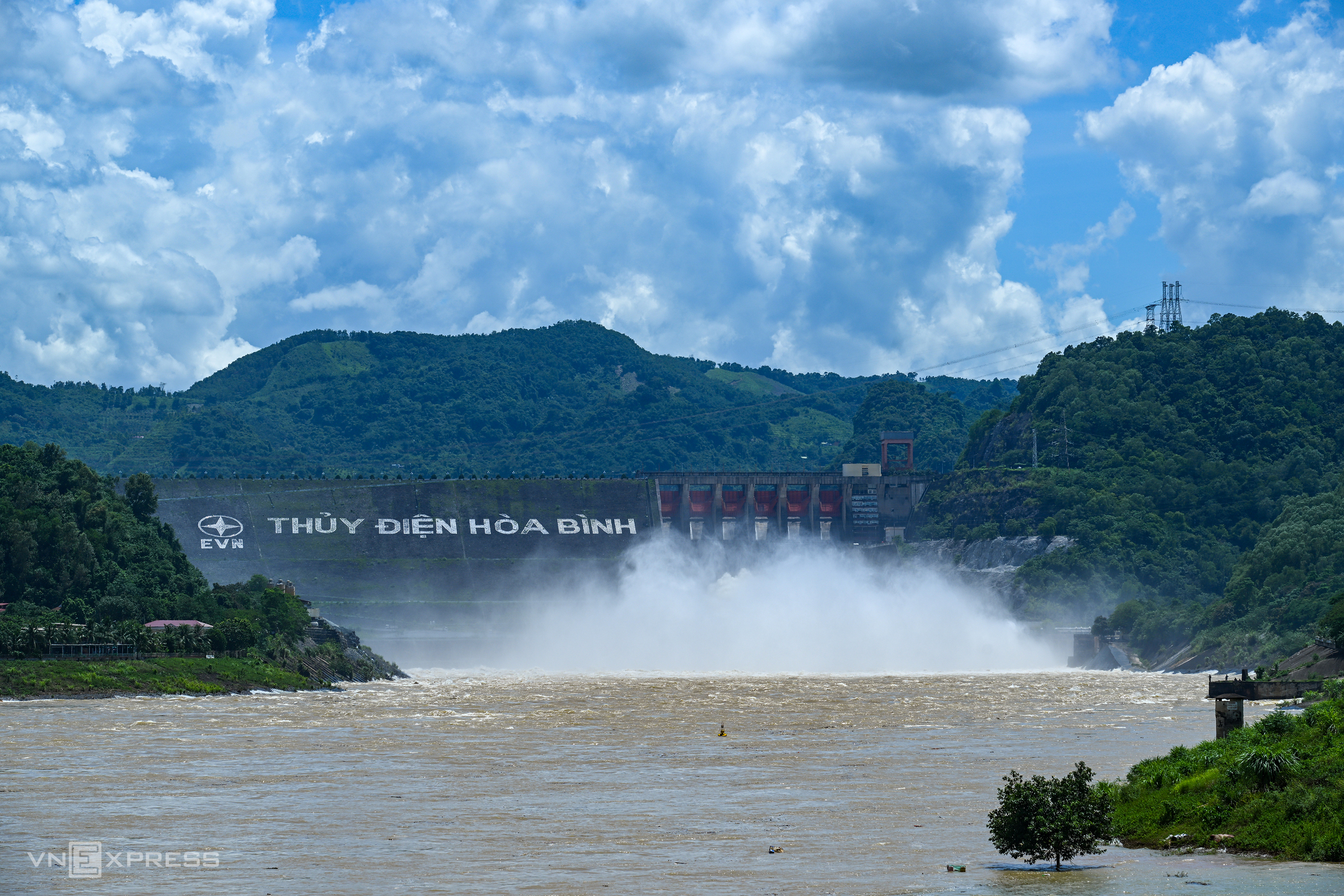 |
_Hoa Binh hydropower plant discharges water in 2024. Photo: Giang Huy_
Cumulatively from the evening of 6/7 to the morning of 10/7, many areas in the northern mountainous region received over 300-400 mm of rain. The highest recorded amounts were in Quang Lam (Quang Ninh) with 420 mm, Quat Dong (Quang Ninh) with 393 mm, Binh Thanh (Thai Nguyen) with 382 mm, and Minh Tien (Thai Nguyen) with 371 mm.
The National Center for Hydro-Meteorological Forecasting predicts that on the night of 10/7, the Northern region and Thanh Hoa will continue to experience 20-40 mm of rain, with some localized areas receiving over 100 mm.
Hoa Binh hydropower plant has a capacity of 1.920 MW with 8 generator units. The largest water discharge event occurred in 10/2017 when the plant had to open 8 of its 12 bottom spillway gates. This action did not affect critical points of the dike system but resulted in the death of 170 tons of fish from local cage farms, causing over 30 billion VND in damages.
The Ministry of Agriculture and Environment has requested the People's Committees (PC) of downstream provinces and cities to promptly inform residents, businesses, aquaculture facilities, waterway transport vehicles, ferry terminals, riverside structures, and sand and gravel mining units. This notification is crucial for them to proactively implement safety measures. When the reservoir discharges water, the water level and flow velocity on the Da River and downstream Red River can rise rapidly, posing risks to people and vehicles operating on the rivers.
Recent floods and landslides have led to significant damage: 4 houses collapsed, 141 houses were damaged, 45 houses required emergency relocation due to landslide risks, and 36 houses were inundated or affected by landslides. Over 243 ha of rice and crops were submerged and damaged. Additionally, 24 livestock and 350 poultry either died or were swept away, according to the Department of Dyke Management and Disaster Prevention.
The floods also caused landslides and inundation at 17 locations on National Highways 6, 4H, 12, and 32, and at 75 locations on provincial roads, disrupting traffic in many mountainous areas. Furthermore, 137 m of irrigation canals were damaged.
Gia Chinh