On the morning of 10/8, Standing Deputy Prime Minister Pham Gia Tuc worked with the Ministry of Public Security on a project for the production, assembly, and pilot registration and use of electric three-wheeled vehicles.
The Ministry of Public Security states that the proposal for electric three-wheeled vehicle production stems from the need to mechanize certain urban activities that currently rely on manual methods. Specifically, in many narrow city alleys, existing waste collection vehicles have limited carrying capacity and efficiency.
In postal services and logistics, the growth of e-commerce and delivery services also necessitates vehicles that are agile and capable of transporting goods, while remaining suitable for cramped urban infrastructure.
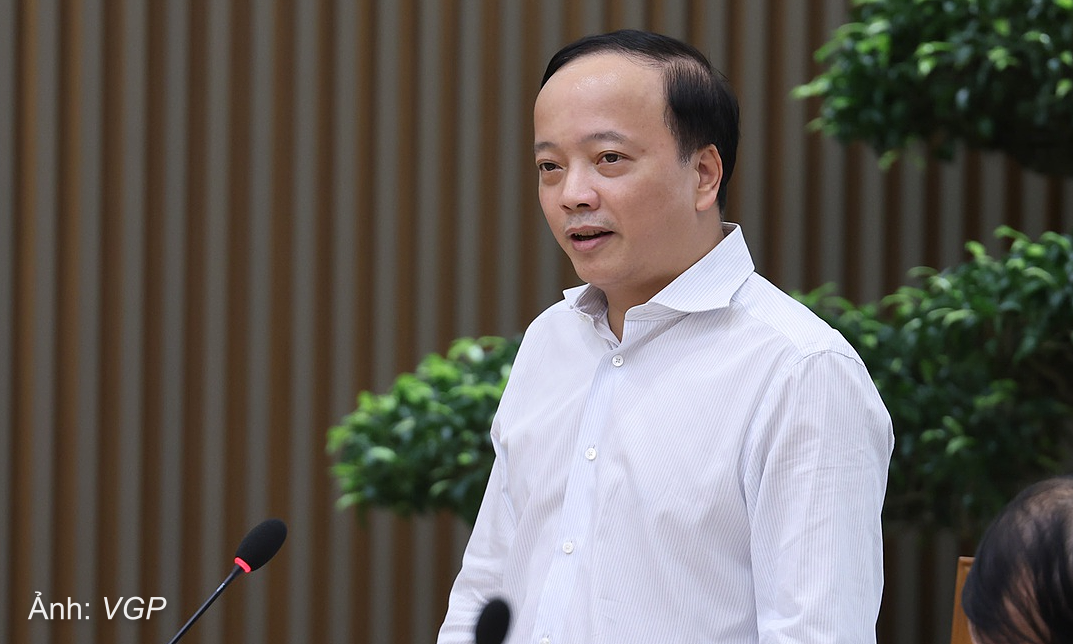 |
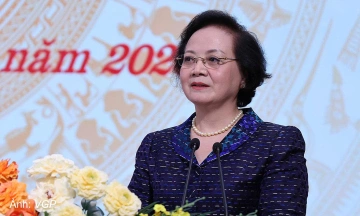
Senior Lieutenant General Dang Hong Duc, Deputy Minister of Public Security, speaks at the working session with Deputy Prime Minister Pham Gia Tuc on the morning of 10/8. *Photo: VGP*.
For fire prevention and fighting support, electric three-wheeled vehicles will provide mobile assistance in densely populated residential areas, deep alleys, and narrow lanes where specialized fire trucks may struggle to access scenes. These vehicles are designed to carry equipment for firefighting, rescue, and initial incident response.
The Ministry of Public Security emphasizes that this research into electric three-wheeled vehicles does not aim to revive the model of previously self-made three-wheelers. Instead, it seeks to develop a new type of vehicle that meets technical safety and environmental protection requirements, and is managed and used within appropriate contexts.
The project plans a pilot implementation in large cities, densely populated areas with many narrow alleys and streets. It also explores application in island regions, eco-tourism zones, and green tourism development areas. Following this, agencies will assess operational capabilities, usage efficiency, safety levels, environmental impact, and management feasibility. Resources for research, production, assembly, and operation of electric three-wheeled vehicles are expected to be socialized (funded by private entities and the community).
At the meeting, representatives from the Ministry of Finance, Ministry of Industry and Trade, Ministry of Science and Technology, Ministry of Agriculture and Environment, and Ministry of Justice all agreed in principle to research and pilot electric three-wheeled vehicles. These agencies believe the vehicles can address several practical urban needs, particularly for waste collection, postal services, logistics, fire prevention and fighting support, and urban beautification activities. However, the ministries requested clarification on vehicle classification, technical standards and regulations, registration and circulation conditions, and driver requirements.
Standing Deputy Prime Minister Pham Gia Tuc stated that deploying electric three-wheeled vehicles for certain activities is essential, with a priority on waste collection and transport. Their use in postal services and logistics requires assessing actual demand and development trends, along with considering their potential for fire prevention and fighting support.
Mr. Tuc noted the importance of clarifying the feasibility and sustainability of socialized production for electric three-wheeled vehicles, which must include not only investment and manufacturing but also operational costs, maintenance, and overall efficiency. The project also needs to address its feasibility in areas where localities already have other waste collection and transport solutions.
The Deputy Prime Minister assigned the Ministry of Public Security to complete the project in august for submission to the government.
Vu Tuan