A resolution on specialized supervision and questioning, passed by National Assembly delegates on the morning of 11/12, mandates the Bo Noi vu to review and standardize all job position catalogs. This standardization aims to align with the newly streamlined government apparatus.
In addition to accelerating the salary reform roadmap, the National Assembly also called for budget allocation to support localities. This funding would help those unable to balance resources to provide benefits for redundant cadres, civil servants, and public employees following administrative unit restructuring.
Since 2018, Central Committee Resolution 27 outlined a salary reform plan to base salaries on job positions, replacing the previous coefficient mechanism. This change was initially slated for 1/7/2021 but was postponed due to the Covid-19 pandemic and budget limitations.
The National Assembly later set 1/7/2024 as the implementation date for salary payments based on job positions. However, numerous challenges arose during this process, making it impossible to abolish the base salary and salary coefficient mechanism. Consequently, from 1/7/2024, the National Assembly approved a 30% increase in the base salary, raising it from 1,8 million to 2,34 million VND per month.
By late 2025, the Bo Chinh tri instructed the Bo Noi vu to finalize a unified salary scheme for the entire political system. This scheme aims to establish a foundation for replacing the coefficient mechanism once conditions permit. The Bo Noi vu is currently drafting a decree on civil servant job positions, slated for 1/3/2026. This decree will introduce a mandatory competency framework for all civil servants, from central to communal levels, to guide recruitment, appointment, evaluation, and salary determination.
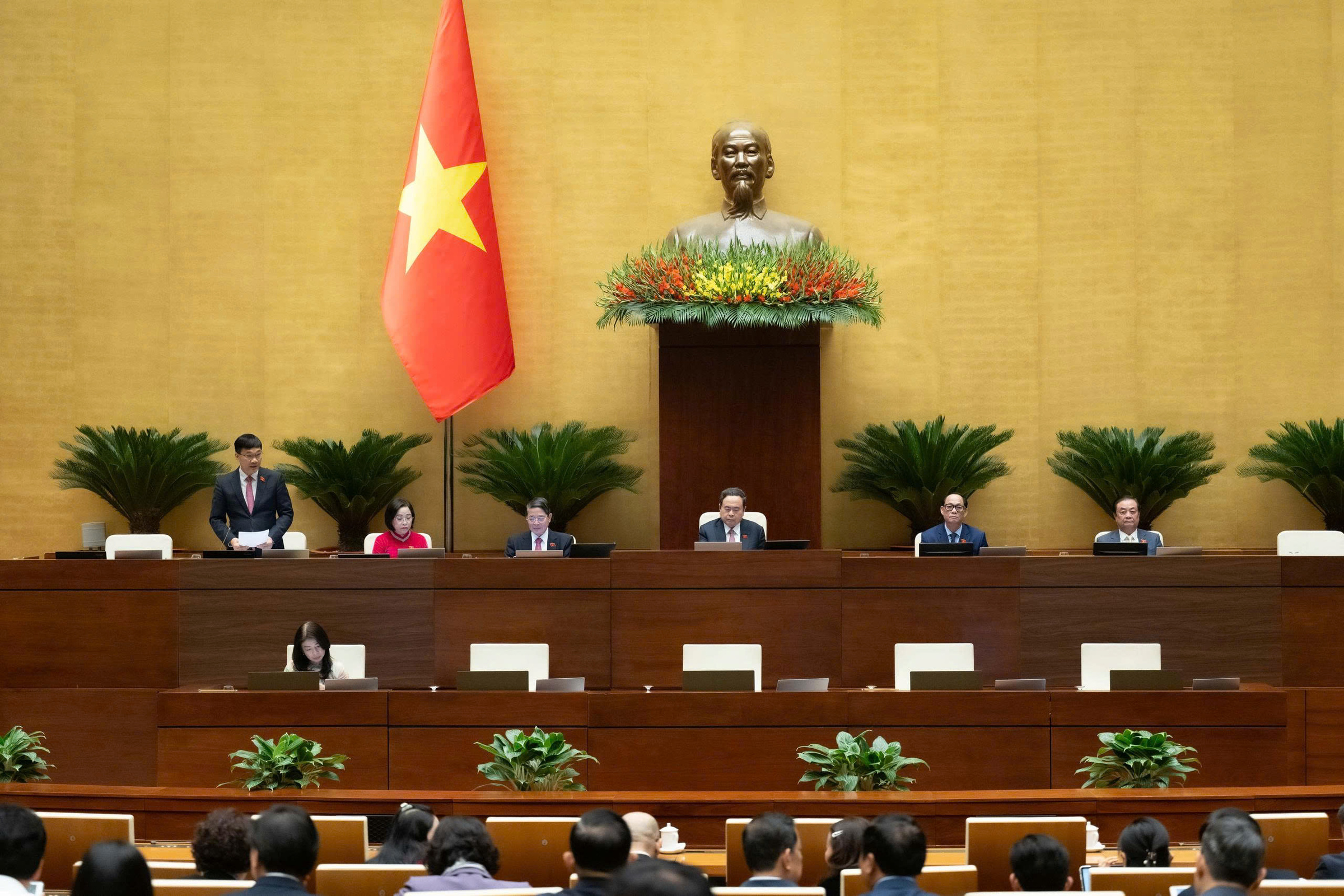 |
National Assembly session on the morning of 11/12. *Photo: Quoc hoi Media* |
Addressing environmental concerns, the National Assembly mandated sufficient resource allocation to relocate residents from areas prone to flash floods and landslides. It also called for the completion of environmental technical standards, enhanced waste sorting at source, and improved wastewater and solid waste treatment in major urban centers.
For culture, sports, and tourism, the National Assembly proposed revising remuneration policies for artists and performers in traditional art forms. Other directives include reforming administrative procedures in tourism and definitively resolving the issue of "journalification" of magazines and general information websites by 2026.
In the science and technology sector, agencies are tasked with developing a shared catalog of national, sectoral, and field digital platforms. They must also finalize traceability standards and standardize and authenticate subscriber information against the national population database by 2026.
Regarding education, the National Assembly urged localities to recruit their allocated teacher quotas and comprehensively resolve issues of teacher surplus and shortage.
By Vu Tuan