The Ho Chi Minh City Management Board of Urban Railways (MAUR) recently submitted a plan for the route alignment and facility locations of the first phase of metro line 6, the Tan Son Nhat - Phu Huu section, to Hanh Thong ward for review before implementation.
The city prioritizes this project for investment, with construction expected to commence late this year and conclude in 2030, increasing the total metro network length to approximately 200 km.
According to the mid-term feasibility report, the line stretches nearly 23 km, with about 19 km underground and the remainder elevated. It will feature 17 stations: 13 underground and 4 elevated. The depot will be located in the Binh Trieu area of Thu Duc City. Compared to previous plans, the route alignment and some station areas have been adjusted to synchronize infrastructure and optimize future investment and operational efficiency.
The line originates at Ba Queo station (ST01), near the Tan Ky Tan Quy - Truong Chinh intersection, connecting with the Ben Thanh - Tham Luong metro line. From there, the railway turns eastward, proceeding underground into Tan Son Nhat airport.
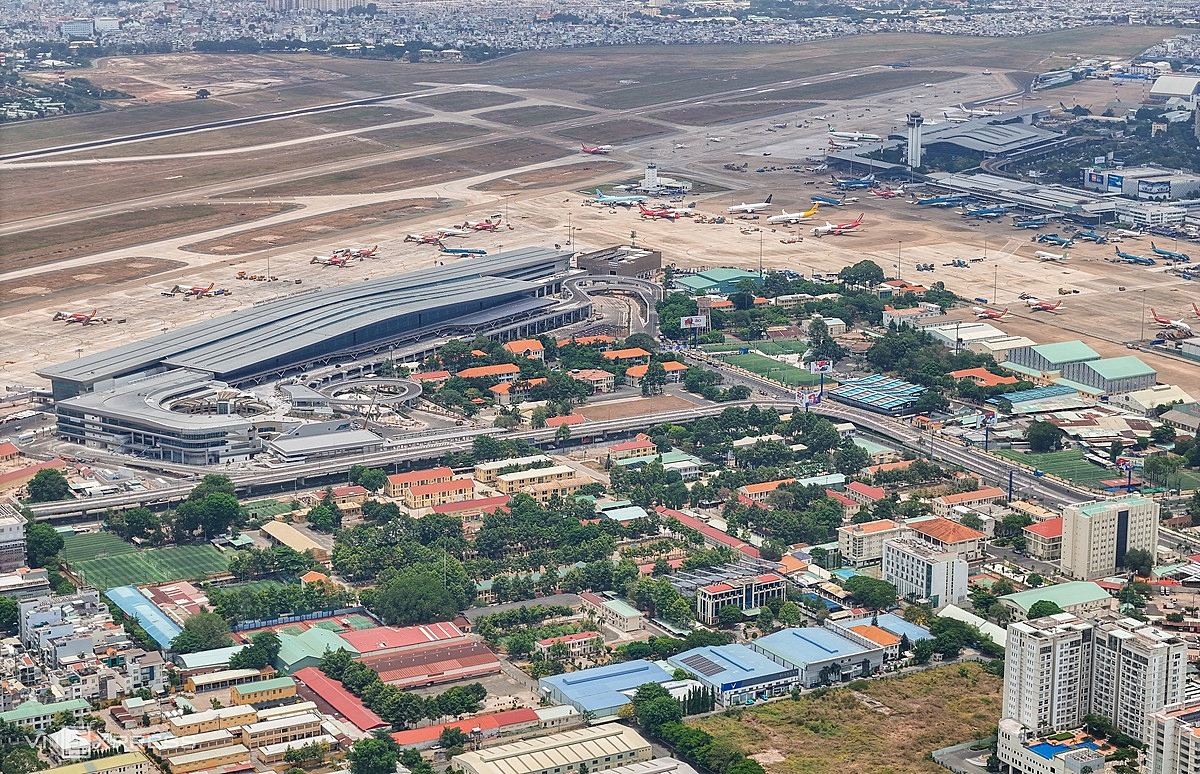 |
The T3 Tan Son Nhat terminal area, where metro line 6’s underground station will be located. *Photo: Quynh Tran* |
Station ST02 will be located west of terminal T3, featuring two underground levels and covering a total area of over 12,500 sqm. Compared to previous plans, the route through the airport area has been straightened, and the station’s position moved closer to the passenger terminal for easier passenger pick-up and drop-off.
Station ST02 resulted from the merger of two stations from the old plan. According to the consultant, the two previous stations were only about one km apart but both were far from T3, leading to overlapping service areas and limited connectivity efficiency.
Leaving terminal T3, the metro line will continue underground beneath the aircraft parking apron to the T1 and T2 terminal areas. Station ST03 is planned for the parking lot between the two terminals, near the Truong Son - Hong Ha intersection flyover.
This station is envisioned as a transfer point for metro line 4, which runs from Dong Thanh to Hiep Phuoc Industrial Park. Consequently, station ST03 is projected to have three underground levels, covering an area of approximately 18,600 sqm, making it larger than station ST02.
This plan ensures that stations ST02 and ST03 will connect all T1, T2, and T3 terminals at Tan Son Nhat, enabling passengers to access the airport by metro and reducing reliance on road transport.
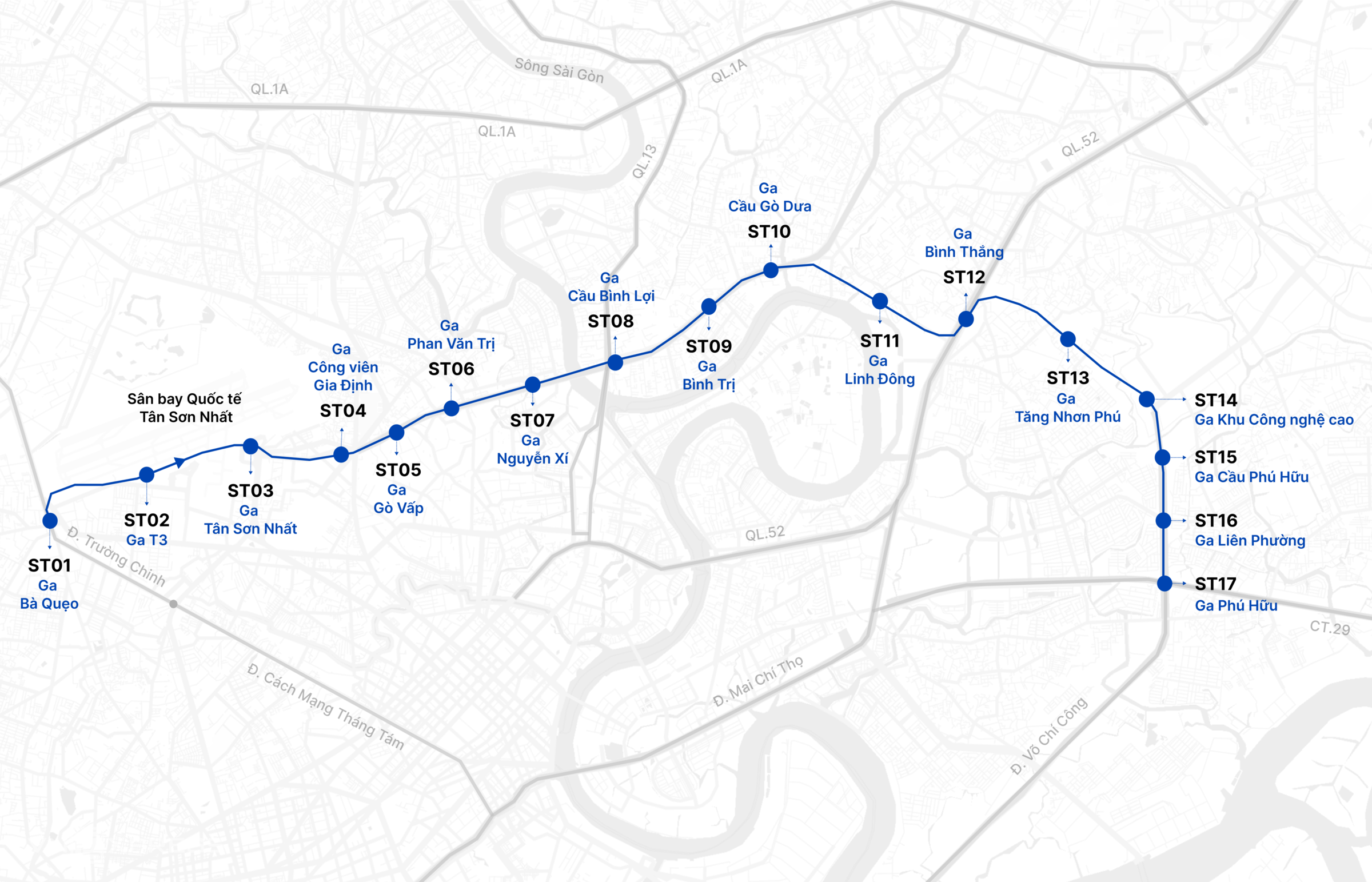 |
Locations of the 17 stations on metro line 6 (Tan Son Nhat - Phu Huu). *Graphic: Tam Thao* |
After exiting the airport, the line will run along Hong Ha street, with station ST04 located near the Nguyen Thai Son - Nguyen Kiem intersection. The metro then shifts to Pham Van Dong boulevard, where stations will be sequentially placed near the North-South railway, Phan Van Tri, and Nguyen Xi intersections.
The line will continue underground across the Saigon River, returning to the Pham Van Dong axis and heading towards the Thu Duc area. At Vo Nguyen Giap boulevard, station ST12 will connect to the Ben Thanh - Suoi Tien metro line.
From the Ring Road 2 area, the line gradually transitions from underground to elevated, passing the Vo Chi Cong intersection, Phu Huu bridge, and Lien Phuong street. After station ST16, the railway splits into two branches: one leading to the final station, ST17, and the other connecting to the Thu Thiem - Long Thanh railway.
The consultant proposes that the line use technical standards similar to metro line 2, specifically the Tham Luong - Ben Thanh - Thu Thiem section. Trains will operate at a maximum speed of 80-110 km/h depending on the segment, initially comprising three cars, with the potential to increase to 6 cars later.
The Tan Son Nhat - Phu Huu metro is positioned as a key axis connecting Tan Son Nhat airport with the eastern part of Ho Chi Minh City. Once linked with the Thu Thiem - Long Thanh railway, the line will establish a high-capacity transport corridor between the two airports, facilitating passenger transfers and easing road traffic congestion.
Giang Anh