On 17/3, General Secretary To Lam signed and promulgated Politburo Resolution 02 on the construction and development of Hanoi in the new era. The resolution defines Hanoi as the national political and administrative brain, as well as a growth pole and spreading driver for the Capital Region, the Red River Delta, and the entire country. This comes with a mandate for rapid, sustainable development and enhanced international competitiveness.
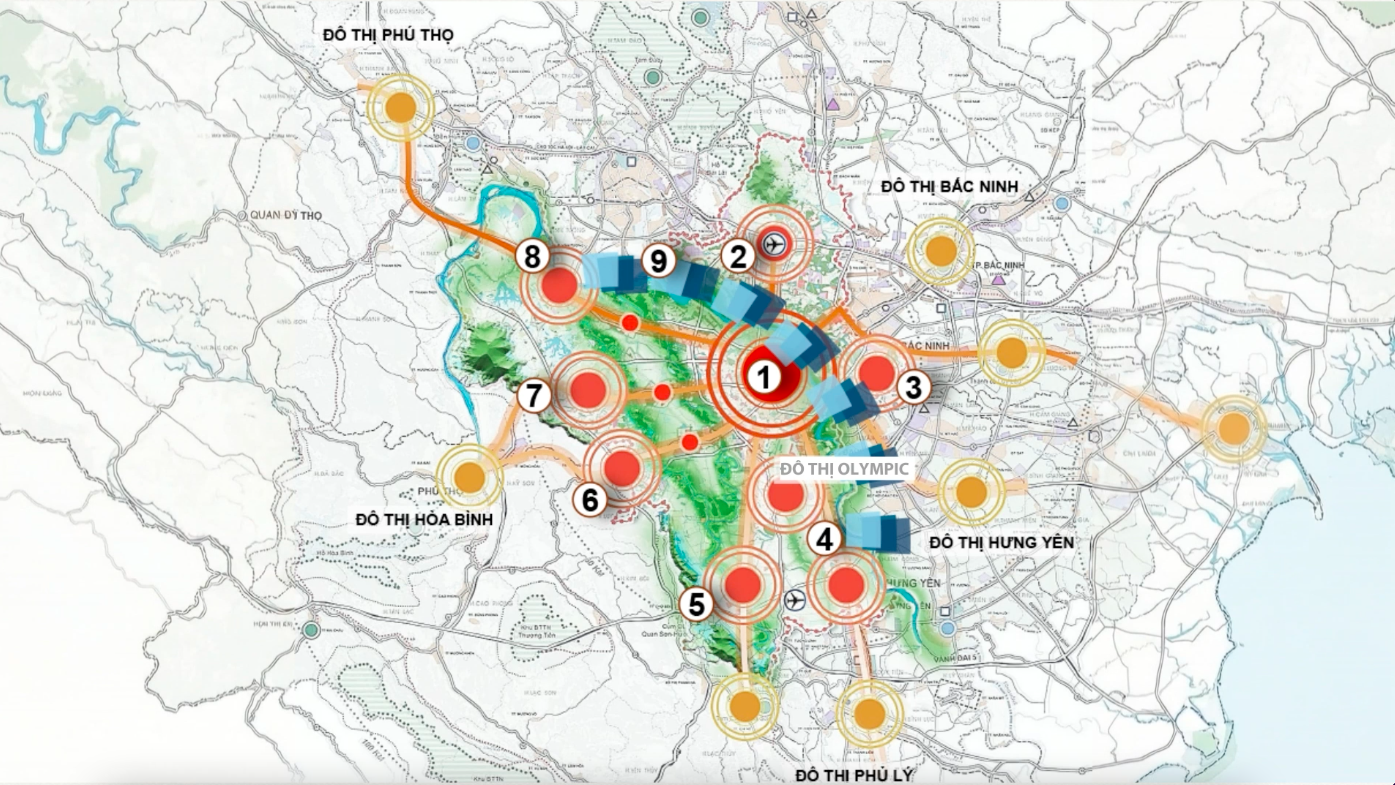 |
Inter-regional urban development diagram in the Hanoi Capital Master Plan with a 100-year vision |
The Politburo assessed that over recent years, Hanoi has achieved many positive results, leading in the implementation of Party policies and State laws, gradually building a "Cultured - Civilized - Modern" capital. However, these achievements are not yet commensurate with the capital's position, role, potential, and advantages. Growth has been lower than some other localities in the region for many years. Urban planning and management remain inadequate and inconsistent. Persistent issues such as traffic congestion, flooding, air and environmental pollution, urban order, and food safety have been slow to improve.
The resolution identifies a key breakthrough as establishing special, superior institutions for Hanoi. This ensures the capital possesses sufficient authority, tools, and resources to proactively decide, implement, and bear comprehensive responsibility for development issues. The city will be significantly decentralized and empowered, while also permitted to pilot new mechanisms and policies, differing from current regulations in some areas, to address bottlenecks and create room for development.
Additionally, Hanoi is required to modernize its governance model, based on data and digital transformation, shifting from an administrative management mindset to one of developmental creation. The resolution also emphasizes the need to build a clean and strong Party Committee and political system for the capital, enhancing leadership capacity and management effectiveness.
The Politburo outlined a long-term development roadmap with specific milestones. By 2035, Hanoi aims to become a green, smart, and modern city with high competitiveness, political and social stability, and a safe, friendly, and attractive destination. The city will establish several high-quality education, training, and healthcare centers among the leaders in the Asia-Pacific region, alongside financial, commercial, and innovation hubs playing significant national, regional, and international roles.
By 2045, Hanoi is envisioned as a major innovation hub in the Asia-Pacific region, a convergence point for knowledge and technology, with modern urban infrastructure and governance, a high quality of life for residents, and a civilized, safe, and livable society.
Looking towards the 100th anniversary of the capital's liberation and by 2065, Hanoi will become a global city with a high level of sustainable development, ranking among capitals with the highest quality of life and per capita income globally.
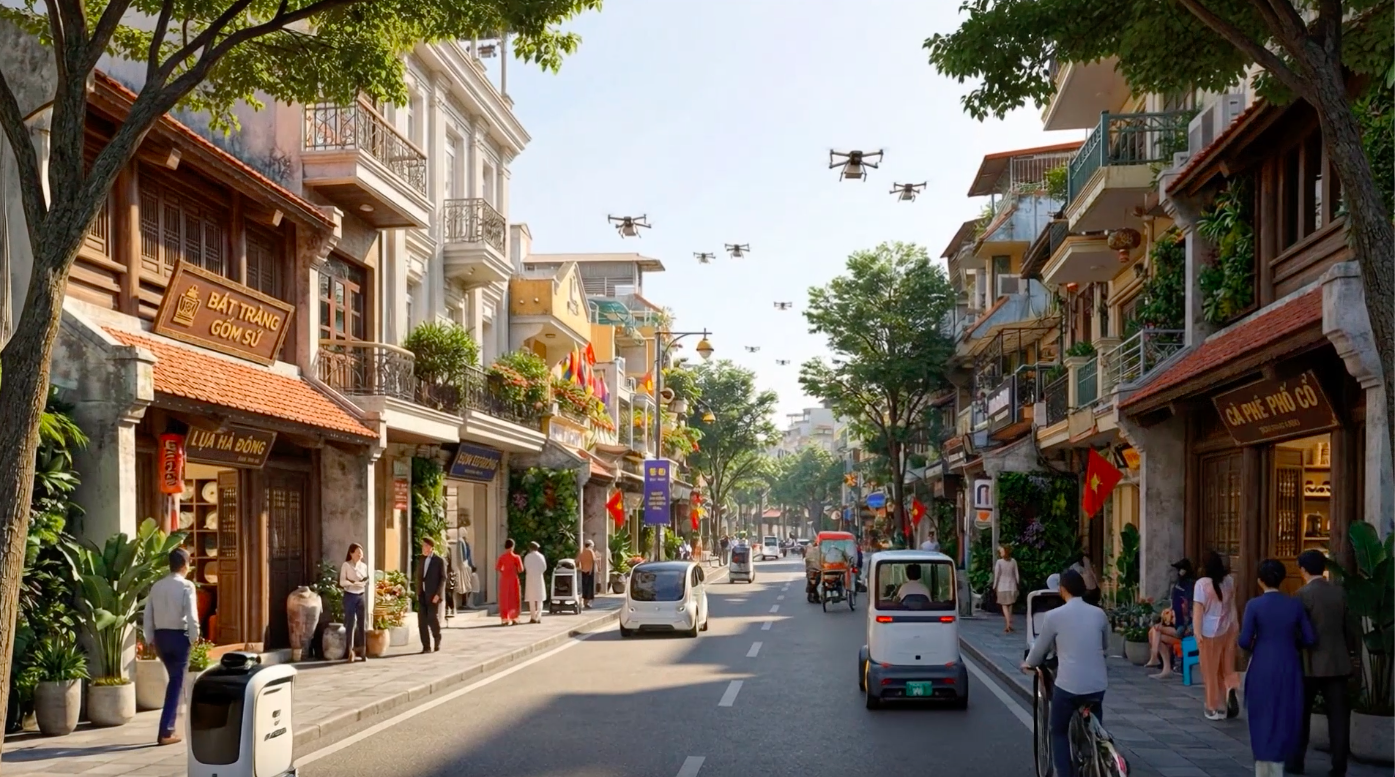 |
Development orientation perspective for Hanoi's central area, according to the Hanoi Capital Master Plan with a 100-year vision. |
Economic indicators are set for each phase. For the 2026-2030 period, GRDP is projected to grow by over 11% per year on average, reaching a scale of over 113 billion USD, with a minimum per capita income of 12,000 USD. In the 2031-2035 period, GRDP is estimated at approximately 200 billion USD, with a minimum per capita income of 18,800 USD. The digital economy's contribution to growth will reach around 50%, and cultural industries will contribute 10% or more.
By 2045, GRDP is projected to be around 640 billion USD, with a minimum per capita income of 42,000 USD. By 2065, GRDP is expected to reach approximately 1,920 billion USD, with a minimum per capita income of 95,000 USD, placing it among the highest globally.
Clustered urban planning, shifting from unipolar to multi-centered
The resolution mandates the development of a long-term, 100-year comprehensive capital plan. This plan will be stable, feature an open development space, and transition from "static planning" to "dynamic and open planning," integrating digital data and smart urban simulation platforms.
Hanoi is oriented to develop a clustered urban model that is multi-layered, multi-tiered, multi-polar, and multi-centered. This shifts from a "unipolar concentrated" structure to a multi-centered, multi-polar structure that is interconnected and expansive. Each development pole will function as a distinct driving center, both autonomous and integrated within the overall Capital Region and the entire country.
Urban space will be organized along ecological and cultural axes, with the Red River as the primary axis. The Duong, Day, Nhue, and To Lich rivers, along with the Ba Vi area, will form the ecological foundation. Planning will be closely linked with the Capital Region, the Red River Delta, the Northern Midlands and Mountainous region, and national and international economic corridors.
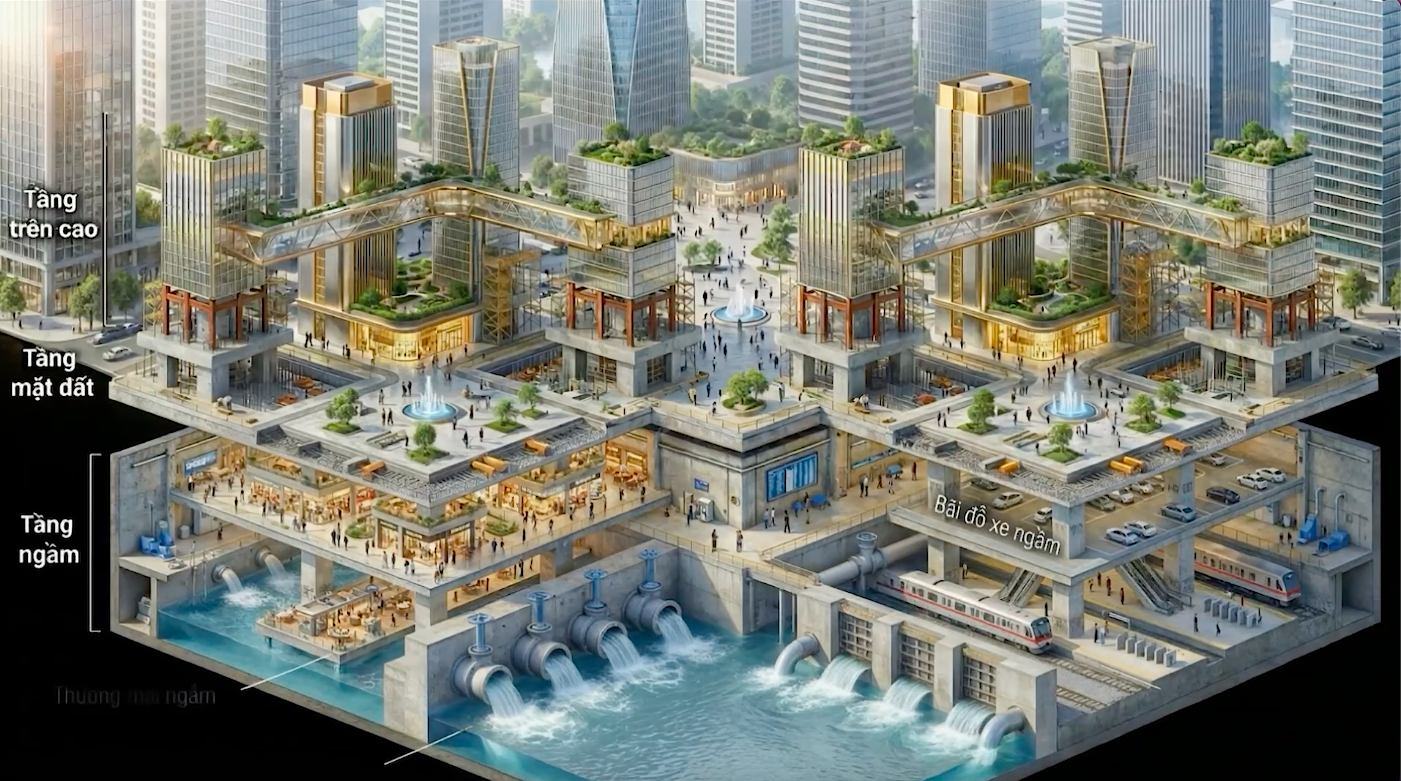 |
Perspective of Hanoi's multi-layered development model, according to the Hanoi Capital Master Plan with a 100-year vision. |
Major infrastructure investment to form new growth poles
The resolution requires synchronized development of strategic infrastructure systems, especially high-capacity public transport. Hanoi aims to complete approximately 100 km of urban railway by 2030, gradually mastering technology and enhancing investment, management, and operational capabilities.
The city will also develop high-speed rail connecting the region, river ports, and airports. It will utilize Gia Lam and Hoa Lac airports for dual purposes and research building a second international airport for the Capital Region in the southern area.
Alongside infrastructure, Hanoi is guided to establish financial, commercial, and business centers, free economic zones, and free trade zones linked to international transport infrastructure. This will attract multinational corporations to set up headquarters. The city will develop "technology valleys," and science, technology, and innovation centers linked with high-quality education, training, and healthcare, creating new growth poles.
Urban restructuring, improving residents' quality of life
Beyond economic development, the resolution calls for accelerated urban restructuring, renovating and redeveloping urban areas with weak infrastructure, and old apartment buildings, in conjunction with smart urban development. The city is tasked with implementing breakthrough social housing policies and flexibly adjusting housing types such as social housing, resettlement housing, rental housing, public housing, and commercial housing to meet residents' needs and contribute to stabilizing the real estate market.
The resolution also outlines other key tasks, including strengthening regional linkages, developing the capital's culture and people, establishing a new growth model based on science, technology, and innovation, developing strong economic sectors, mobilizing, exploiting, and effectively utilizing resources, ensuring national defense and security, enhancing foreign affairs effectiveness, and improving the leadership capacity of the capital's Party Committee.
Vo Hai