A directive strengthening work for the elderly to adapt to an aging population was signed by the prime minister on 23/12. The head of government assigned the Ministry of Health to provide guidance on elderly care at home, within communities, and at nursing facilities. This includes developing daytime care models based on a "morning pick-up, evening drop-off" approach. The directive also emphasizes promoting elderly clubs and intergenerational self-help clubs, and creating opportunities for the elderly to participate in digital transformation and entrepreneurship.
The Ministry of Health is also tasked with promptly drafting amendments and additions to the Law on the Elderly. This aims to leverage the role, potential, knowledge, and experience of the elderly across various social sectors, aligning with the context of an aging population.
The prime minister noted that the current network of elderly care facilities, daytime care centers, and community activity centers remains insufficient, with quality and effectiveness yet to reach high standards. Many businesses, organizations, and individuals face challenges when investing in this sector, particularly regarding access to land, resources, and preferential policies. Additionally, agencies lack comprehensive policies to fully utilize the role of the elderly in an aging society.
Government leaders have assigned various ministries and sectors to implement integrated solutions: The Ministry of Construction will support storm and flood-resistant housing for poor and near-poor households, prioritizing those with elderly members. The Ministry of Foreign Affairs will advocate for the United Nations to develop an International Convention on the Elderly, in line with the Vietnamese government's policy, and mobilize foreign resources to support the elderly. The Ministry of Industry and Trade will research and develop a "silver economy" model adapted to an aging population. The Vietnam Association of the Elderly will organize forums on the "silver economy".
Localities are urged to promptly issue policies that encourage socialized investment and attract private sector involvement in developing non-public elderly care facilities. These facilities should integrate care, medical services, and rehabilitation. Any surplus office buildings will be prioritized for use as elderly care centers and clubs.
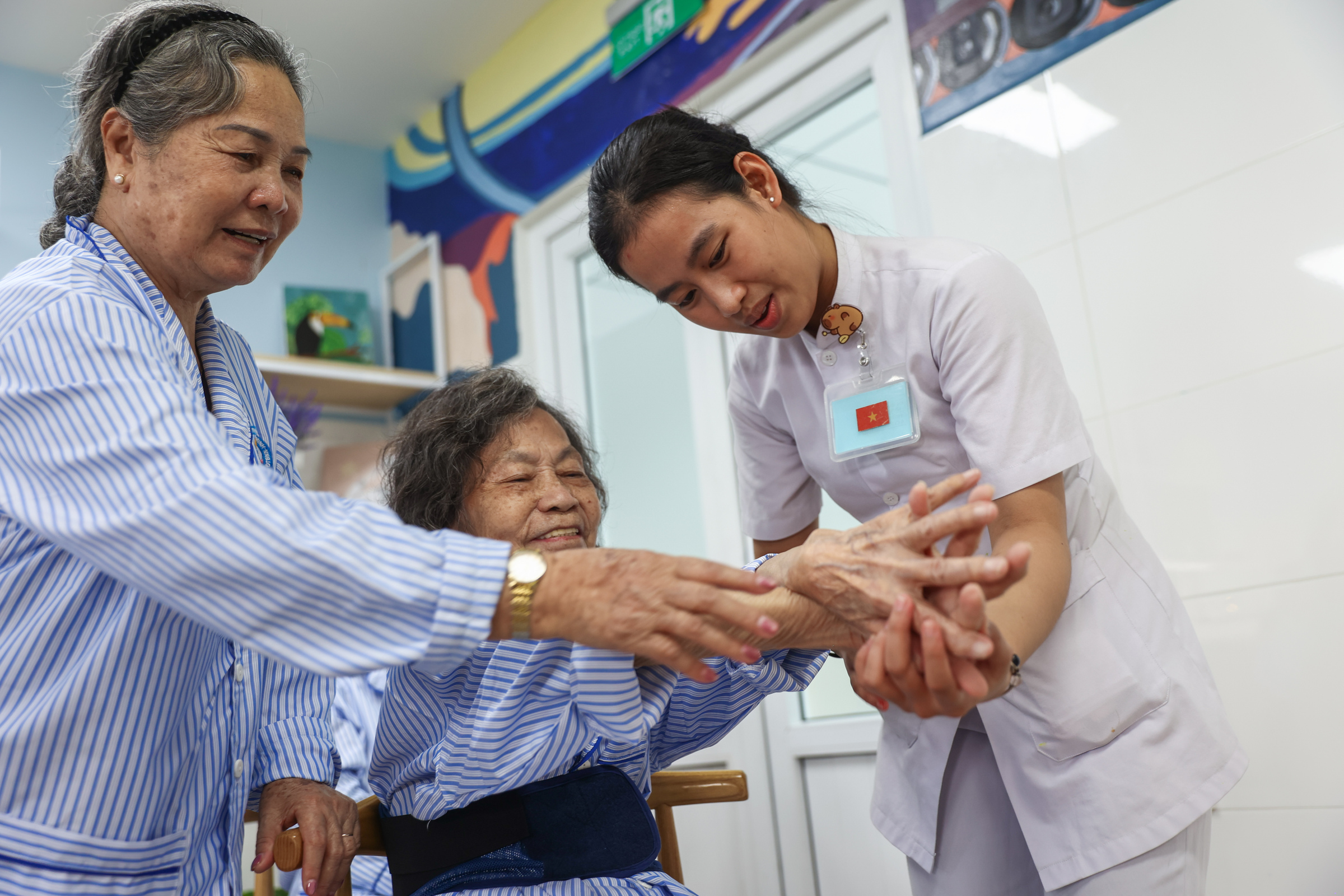 |
Elderly participate in semi-residential nursing services at Ho Chi Minh City Hospital for Rehabilitation - Occupational Disease Treatment, 10/2025. Photo: Quynh Tran
The prime minister's directive concretizes General Secretary To Lam's statement in september, which called for solutions to "combat loneliness" among the elderly. According to the General Secretary, the daytime nursing home model is a correct approach, but its implementation has been slow despite repeated discussions. He emphasized the need to encourage private sector participation in establishing elderly care centers, as many elderly individuals experience loneliness at home during the day while their children and grandchildren are at school or work.
The General Secretary further stated that these centers could organize transportation services using automobiles, enabling the elderly to meet friends and former colleagues. They could also participate in social activities, sports, music, and cultural events. He stressed that elderly care merits significant attention, as these solutions contribute to extending longevity and enhancing the quality of life.
Vu Tuan