This information is detailed in the study results on areas with potential for transit-oriented development (TOD) along the Ho Chi Minh City - Can Tho railway line, recently reported by My Thuan Project Management Board to the Ministry of Construction.
The railway line spans over 175 km, traversing Ho Chi Minh City, Tay Ninh, Dong Thap, Vinh Long, and Can Tho. It originates at An Binh station in Di An ward, Ho Chi Minh City, and concludes at Can Tho station in Hung Phu ward, Can Tho City.
In Ho Chi Minh City, 8 TOD zones are proposed for study within a one km radius of 6 stations: An Binh, Vinh Phu, Thanh Xuan, Tan Chanh Hiep, Tan Tao, and Tan Kien. The preliminary study area for each zone is approximately 24-115 ha. Specifically, Thanh Xuan and Tan Tao stations each have two proposed TOD zones, while the other four stations each have one.
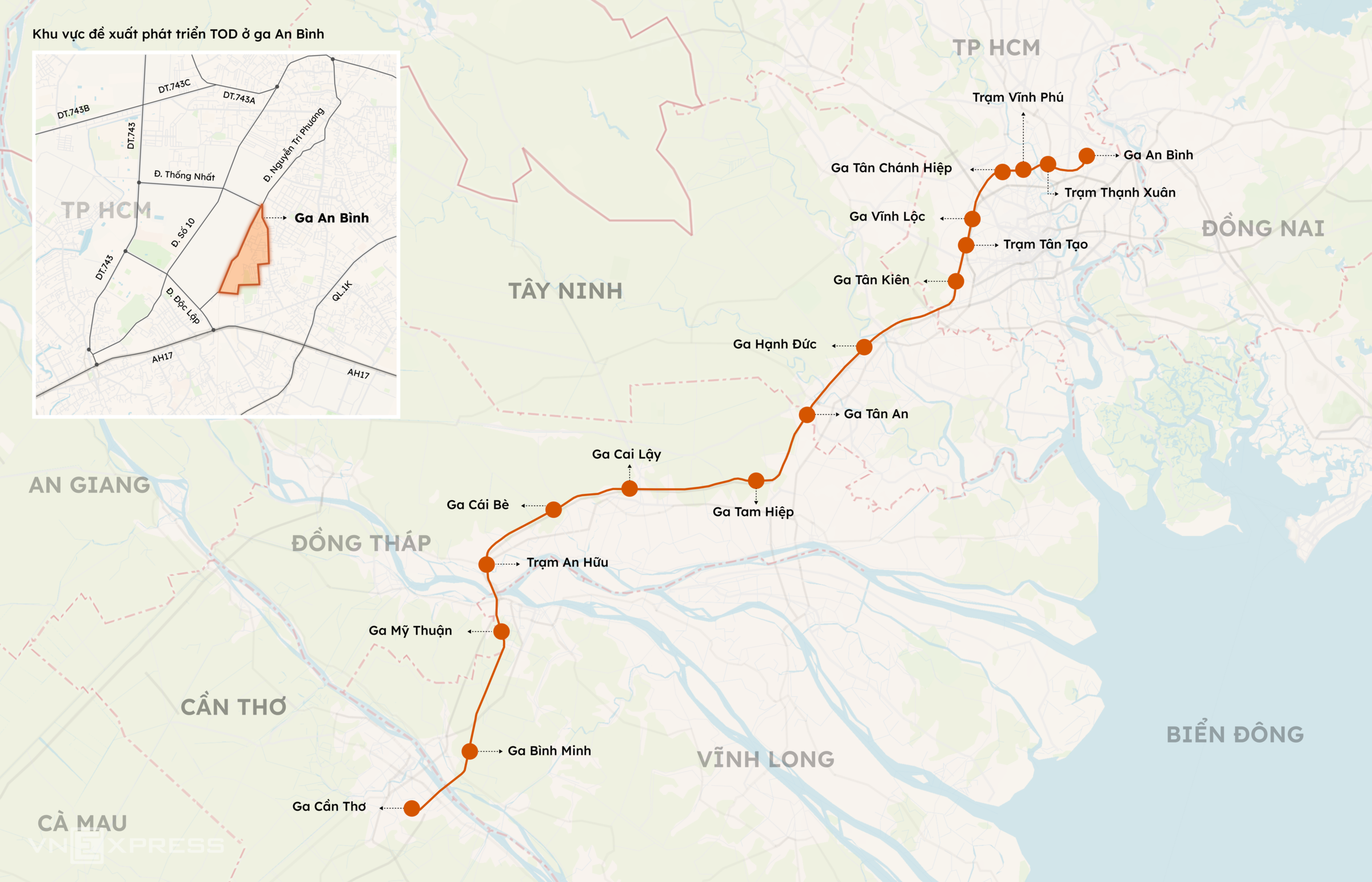 |
Ho Chi Minh City - Can Tho railway alignment and planned TOD stations. Graphics: Tam Thao |
In Tay Ninh, Thanh Duc and Tan An stations are each expected to feature two TOD zones, with areas ranging from approximately 7,9-418 ha per zone.
Dong Thap is proposed to have 7 TOD zones around Tam Hiep, Cai Lay, Cai Be stations and An Huu stop, with each zone spanning approximately 51-486 ha. Vinh Long will feature two zones, covering about 398-664 ha, around My Thuan and Binh Minh stations.
At the end of the line, the area around Can Tho station is proposed for 7 TOD zones, with each zone ranging from approximately 16 ha to over 1.238 ha.
According to My Thuan Project Management Board, all localities along the proposed route agree to study TOD development in conjunction with the railway project. However, certain aspects require further clarification: the scope of study, implementation mechanisms, infrastructure connectivity, and land fund exploitation plans.
The board recommends that the Ministry of Construction work with local authorities to finalize plans, complete documentation, and ensure synchronized implementation with the railway project.
TOD is an urban development model centered around public transportation. Areas around stations are planned with high density, integrating residential, commercial, and office spaces with educational, healthcare, and sports facilities. This model helps to efficiently utilize land, increase access to public transport, and reduce traffic congestion and pollution.
The Ho Chi Minh City - Can Tho railway project is currently undergoing a pre-feasibility study report for submission to competent authorities for investment policy approval. According to the phase one study plan, the project has a total investment exceeding 171 trillion VND, involving the construction of a single 1.435 mm standard gauge track for passenger and freight transport.
Passenger trains will have a design speed of 160 km/h, while freight trains will operate at 120 km/h. The project is expected to be submitted to the National Assembly for investment policy consideration in August, with construction commencing in 2028 and substantial completion by 2035.
Once operational, the railway line will establish a high-volume transport axis connecting Ho Chi Minh City with the Mekong Delta, while also opening new economic and urban development corridors along its route.
Giang Anh