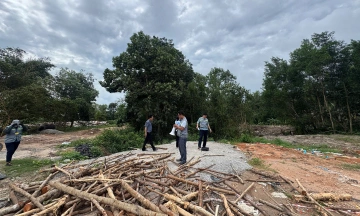
On 6/7, Colonel Truong Nhu Y, deputy political commissar of the Quang Tri Provincial Military Command and a member of the Provincial Steering Committee for the Search, Collection, and Identification of Fallen Soldiers' Remains, led a delegation to inspect the Cau Nhi area in Nam Chanh hamlet, Nam Hai Lang commune.
 |
The Quang Tri Provincial Military Command's delegation inspects and surveys information on fallen soldiers' graves in Cau Nhi area on 6/7. Photo: Minh Anh
The survey aimed to verify witness accounts, forming the basis for workshops and developing search and collection plans for fallen soldiers' remains.
The delegation studied the terrain, marking areas already searched, those not yet searched, and suspected burial sites. Authorities also surveyed the land, crops, and residents' property that might be affected during operations. They also worked with relevant parties to agree on compensation plans.
The delegation urged units to coordinate with local authorities, witnesses, and other forces to verify information, complete records, and prepare personnel and equipment for safe, effective searches.
 |
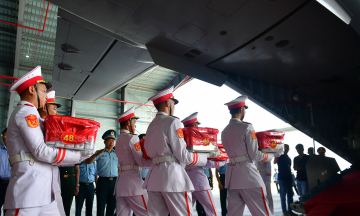
Collection Team 584, Political Department, Quang Tri Provincial Military Command, searches for and collects fallen soldiers' remains in Cau Nhi area, on 6/7. Photo: Minh Anh
According to the Quang Tri Provincial Military Command, from 24/5 to 25/6/1972, Regiment 88, Division 308 fought in the Ho Lay - Cau Nhi area. In the early morning of 26/5/1972, the 6th Battalion of this regiment suffered heavy losses in a battle at Cau Nhi. A list provided by Division 308 recorded 83 casualties, while other documents stated 93.
Witnesses stated that about 4-5 days after the battle, as the soldiers' bodies began to decompose, the enemy used bulldozers to bury them in this area.
From 1992 to the present, authorities and residents have collected 19 fallen soldiers' remains in Cau Nhi. Based on records, aerial photo interpretation from 1972, and ground-penetrating radar survey results, authorities identified 9 suspected areas containing fallen soldiers' remains. Some locations showed abnormal geological signals, providing a basis for future search operations.
Dac Thanh