On the morning of 4/12, Hoang Duc Cuong, Deputy Director of the Department of Meteorology and Hydrology under the Ministry of Agriculture and Environment, announced that a tropical depression is currently located approximately 1,000 km from central Philippines. Moving slowly northwest, this system is forecast to cross the Philippines and enter the South China Sea between 6/12 and 7/12, with the potential to strengthen into the 16th storm of the year.
Cuong anticipates the storm could interact with cold air, directly impacting Vietnam's Central and South Central regions. This interaction may bring moderate to heavy rain from Thua Thien Hue to Khanh Hoa. Meteorological agencies in Hong Kong and the US have begun monitoring the depression but have not yet issued specific forecasts.
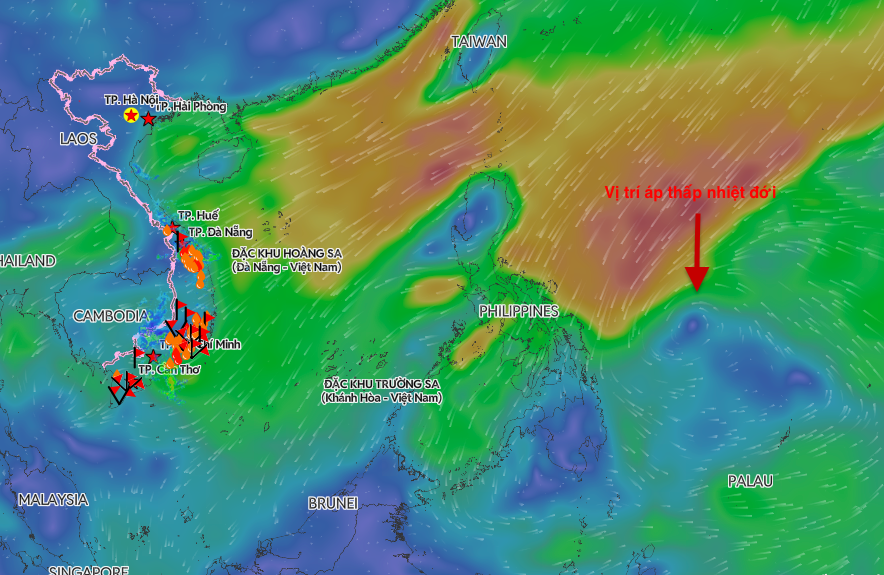 |
Position of the tropical depression off the Philippines. *Photo: Disaster Monitoring System* |
For December 2025, the Central and South Central regions are likely to experience one or two widespread heavy rain events. Rainfall from southern Quang Tri to the northern South Central coast is forecast to be higher than the multi-year average, maintaining a high risk of flash floods and landslides. The ENSO phenomenon (climate oscillation in the Pacific) is expected to continue in a La Nina phase – a condition that increases rain and cold air – until 2/2026, before returning to normal from 3/2026 to 5/2026.
In December, the South China Sea could see one or two storms or tropical depressions. From 1/2026 to 5/2026, this likelihood is low.
By the end of November, the South China Sea had recorded 15 storms and tropical depressions, making 2025 the year with the highest number of cyclones since observations began in 1961. Recently, typhoon Koto, despite weakening at sea, still caused heavy rain and landslides in the South Central region.
This year's storm season has seen several extreme events: typhoon Wutip emerged in June, marking its first appearance in over 40 years; typhoon Ragasa reached level 17, with gusts above level 17, making it the strongest ever recorded in the South China Sea; and a tropical depression in late November originated from typhoon Senyar, which traveled from the Indian Ocean to the Northwest Pacific – a movement never before observed in the reverse direction.
The year 2025 also witnessed severe widespread flooding, with peak water levels on many rivers exceeding historical marks in the Northern, Central, and Central Highlands regions, as well as the lower Mekong Delta. It is rare for exceptionally large floods to occur simultaneously across 20 rivers. Cuong stated that these abnormal storm and flood developments demonstrate the trend of increasingly extreme weather due to climate change.
Natural disasters since the beginning of the year have caused over 97,000 billion VND in damages and resulted in 409 deaths and missing persons.
Gia Chinh