In late September, Bui Van Nhan, 35, director of Anh Duc Food Co., Ltd. in Quyet Thang commune, Hai Phong, received the Luong Dinh Cua award in 2026 for his outstanding achievements in rural economic development.
Born into a farming family, Nhan could not pursue higher education after high school. After working for one year at a restaurant, he enlisted in the military, then returned home to work as a factory employee in an industrial park.
Unsatisfied with his factory salary, Nhan ventured into sales for food and confectionery products. "This was a valuable period that helped me understand market operations, learn retail and wholesale business methods, and build many relationships," Nhan said.
After two years in sales, he borrowed over 100 million VND to import a newly launched chili sauce product for distribution. However, the venture failed due to a flawed business plan. He liquidated all remaining inventory, raising 6 million VND to restart his entrepreneurial journey. "At that time, no one believed I could achieve anything significant. Even those closest to me strongly objected, suggesting I should settle for a salaried job," he recalled.
In 2022, while selecting products for distribution, Nhan observed that many instant nut products on the market lacked transparent origin information and exhibited inconsistent quality. He proactively conducted in-depth research into the harvesting, preservation, and processing of nutritional nuts.
Despite lacking a degree in business administration or specialized agricultural knowledge, Nhan sought information on the Internet, studied existing food processing models, visited raw material regions, and subsequently established a company specializing in nutritional nuts.
During the initial phase, Nhan's biggest hurdle was financial. With approximately 6 million VND in capital in 2022, he adopted a "rolling capital" business strategy: importing small quantities of goods, selling them completely, and then reinvesting the capital into the next order. "Every day I imported 6 million VND worth of products, sold them all to fund the next day's imports. This meant I imported up to 180 million VND in goods within one month," he calculated.
 |
Bui Van Nhan recently received the Luong Dinh Cua award. Photo: Le Tan |
While securing suppliers, Nhan directly contacted the Hai Phong Food Safety and Hygiene Sub-Department for guidance on legal procedures, workshop operation, and food preservation standards. As he accumulated cash flow, he gradually invested in electric roasting machines, a heat drying system, and automatic packaging machines.
Nhan's primary concern was ensuring products had clear origins and stable quality. He sourced cashews from Binh Phuoc, macadamia nuts from Dak Lak, and imported walnuts from the US. He always believed that selling food meant prioritizing consumer health. Building customer trust was vital for long-term success.
The next major challenge was market penetration, as his business lacked an established reputation and commercial relationships. Nhan transported goods by motorbike to various grocery stores and mini-supermarkets in Hai Phong to introduce products and provide samples for customers to try. To build confidence, he implemented a return policy for products that did not meet quality standards.
This persistent approach, combined with quality products, helped the facility gradually secure fixed wholesale contracts. Today, Anh Duc Food Co., Ltd. operates two production and packaging facilities in Quyet Thang commune and An Hai ward, providing stable employment for four regular workers and eight seasonal workers. He prioritizes hiring middle-aged and elderly women from the local community, offering them incomes of 5-10 million VND per month.
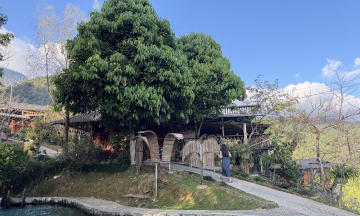
After the nutritional nut processing operation stabilized, Nhan expanded into circular organic agriculture on a 5,000 square meter plot in Quyet Thang commune. He designed ponds for local snails and frogs, using natural ingredients like garlic and spent grain to boost their immunity, thereby avoiding antibiotics.
Biological waste from the snail and frog ponds, after passing through a sedimentation and filtration system, is circulated as nutrients for the hydroponic vegetable growing area. The water from the vegetable growing process is further treated and returned to the ponds, creating a circular system that conserves costs and minimizes environmental waste.
According to Nhan, this farming method requires longer care periods and higher labor costs compared to industrial farming, resulting in lower commercial yields. However, it ensures output quality meets clean standards and protects the surrounding soil and water ecosystems of the farm.
"I am perfecting the process and developing an ordering app to deliver products directly from the farm to consumers, reducing intermediary costs," he said.
By 2026, the combined revenue from Nhan's nutritional nut and circular agriculture farm businesses reached approximately 4 billion VND annually, yielding a profit of about 500 million VND.
In addition to his business ventures, Bui Van Nhan currently serves as a Commissioner of the Youth Union Committee of Quyet Thang commune. Throughout his entrepreneurial journey, he received support from the local Youth Union through trade connection programs, product exhibitions, and specialized training courses.
He regularly provides gifts to policy beneficiary families and sponsors the commune's youth union movements. Notably, Nhan directly supported a local disabled youth in starting a business with herbal soap products. This partnership involved consulting on business plan development, standardizing packaging design, and sharing market access channels.
Pham Hoang Hai, Secretary of the Quyet Thang Commune Youth Union, commended Bui Van Nhan as an exemplary rural youth for applying innovative production methods, creating jobs for local workers, and actively participating in social welfare activities.
Le Tan