On March 20, a representative from the Traffic Police Department (Cuc CSGT), Ministry of Public Security, announced that the department will advise the Ministry of Public Security to establish stricter regulations for driving test content in the coming time.
The department's proposed content will align with current traffic and transportation realities. This initiative aims to ensure licensed drivers possess driving ethics, deter reckless driving and disregard for the law, and equip them with proficient skills for operating vehicles on the road.
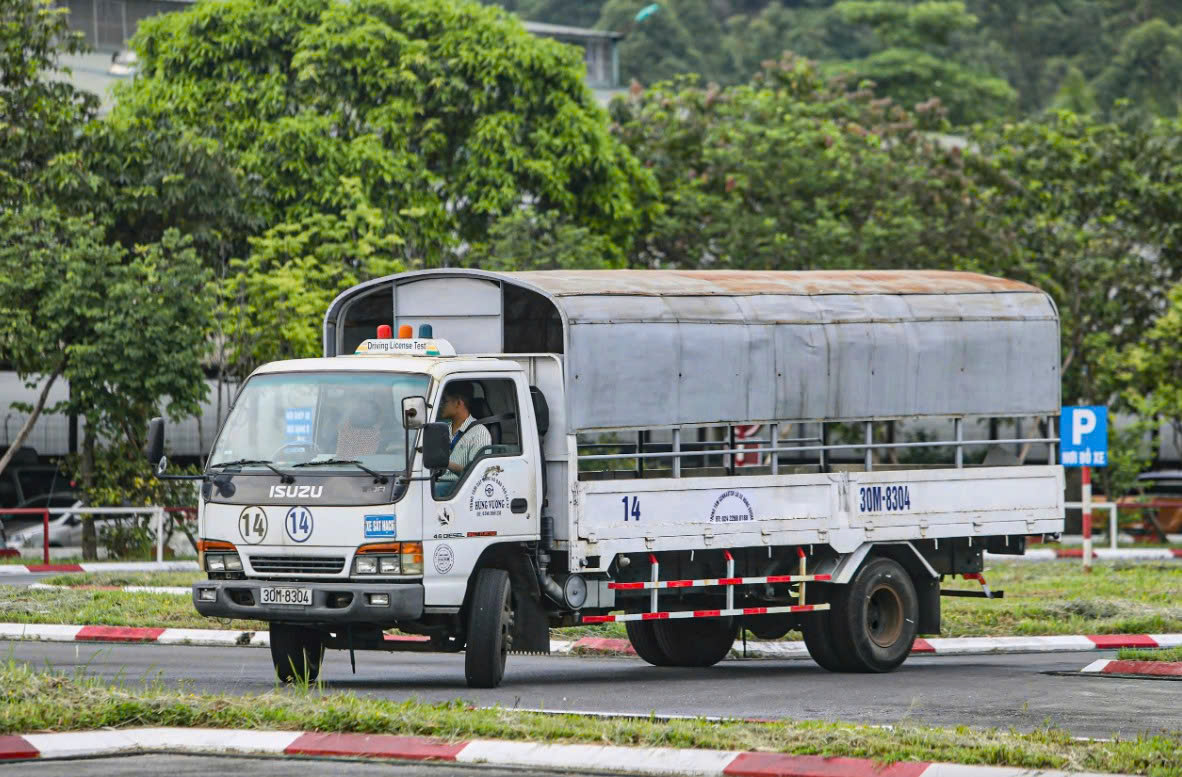 |
Students taking a driving test on a closed course in Hanoi. Photo: Quang Hong
According to a Cuc CSGT representative, current driving tests focus solely on technical driving skills, neglecting driver ethics and situational handling skills. This narrow focus creates a gap between testing and real-world driving demands.
An analysis of driving test data, when compared to actual traffic safety violations and accident causes on the road, reveals a lack of synchronization and consistency. This discrepancy highlights the inadequacy of current testing methods in predicting and preventing real-world driving risks.
For example, for drivers of B, C1, C, D1, and D license categories, the department notes that during on-road tests, students only need to drive about 2 km. This distance is barely sufficient for basic actions like signaling, accelerating, and decelerating, offering a limited assessment of driving competency.
In reality, however, a lack of focused observation for handling situations at intersections or when changing direction, and driving in the wrong direction, lane, or road section, are leading causes of traffic accidents. These critical factors are often not adequately addressed or emphasized in current training and testing.
While the current driving training curriculum includes comprehensive content such as technical skills, law, ethics, and social responsibility, training often prioritizes practical aspects. During tests, students are examined on theory, simulation, closed-course practice, and on-road driving. The challenge lies in ensuring that these assessments adequately reflect the comprehensive curriculum and real-world driving scenarios.
Viet An