Nguyen Viet Hung, who lives near Do Muoi Street, stated that truck air horns blare from morning until late night. "Many nights, I just doze off only to be startled awake by the piercing horns. My elderly mother frequently suffers from insomnia," Hung said.
More than 10 kilometers away, in an apartment building on Thang Long Avenue, Thai Minh Hang often has to keep her windows closed all day, unable to tolerate the truck air horns. The already loud horns become "horrific" when modified. Drivers honk repeatedly, and some horns even play short melodies.
Recently, Hanoi began banning trucks from many roads during the day. These vehicles have shifted to night operations, becoming a "nightmare for residents." Hang mentioned instances where drivers, startled by a horn, swerved and fell off their motorbikes.
Similarly, Dinh Hieu, living in an apartment on Phuc La Street near National Highway 21C, stated that after a tiring day at work, he only wants to sleep but is "tortured" by the air horns. Young children cry from being woken by the excessive noise.
Many other Hanoi streets, including Khuat Duy Tien, Hoang Tang Bi, Le Trong Tan, National Highway 32, and the Southern Hanoi truc road, also report modified air horns. Drivers use these loud, modified horns to clear the way and speed.
According to Vietnam's National Technical Regulations, car horn volume should be between 90 dB (A) and 115 dB (A) when measured 2 meters in front of the vehicle; anything exceeding this fails to meet standards. While some large truck models come equipped with air horns, most vehicles use standard electric horns. However, many drivers remove these original horns and install louder, more resonant air horns that exceed legal limits.
Modified horns are typically mounted on truck roofs, some reaching 1.2 meters in length with speaker diameters of 20-30 centimeters. E-commerce sites sell various air horns, mainly from Thailand and South Korea, priced from 200,000 VND to tens of millions of VND, depending on power and features. Some models have 3-6 pre-installed melodies, use 12V/24V voltage, and feature 2-4 speakers, producing very loud sounds. Most modified air horns require the compressed air system already present in trucks.
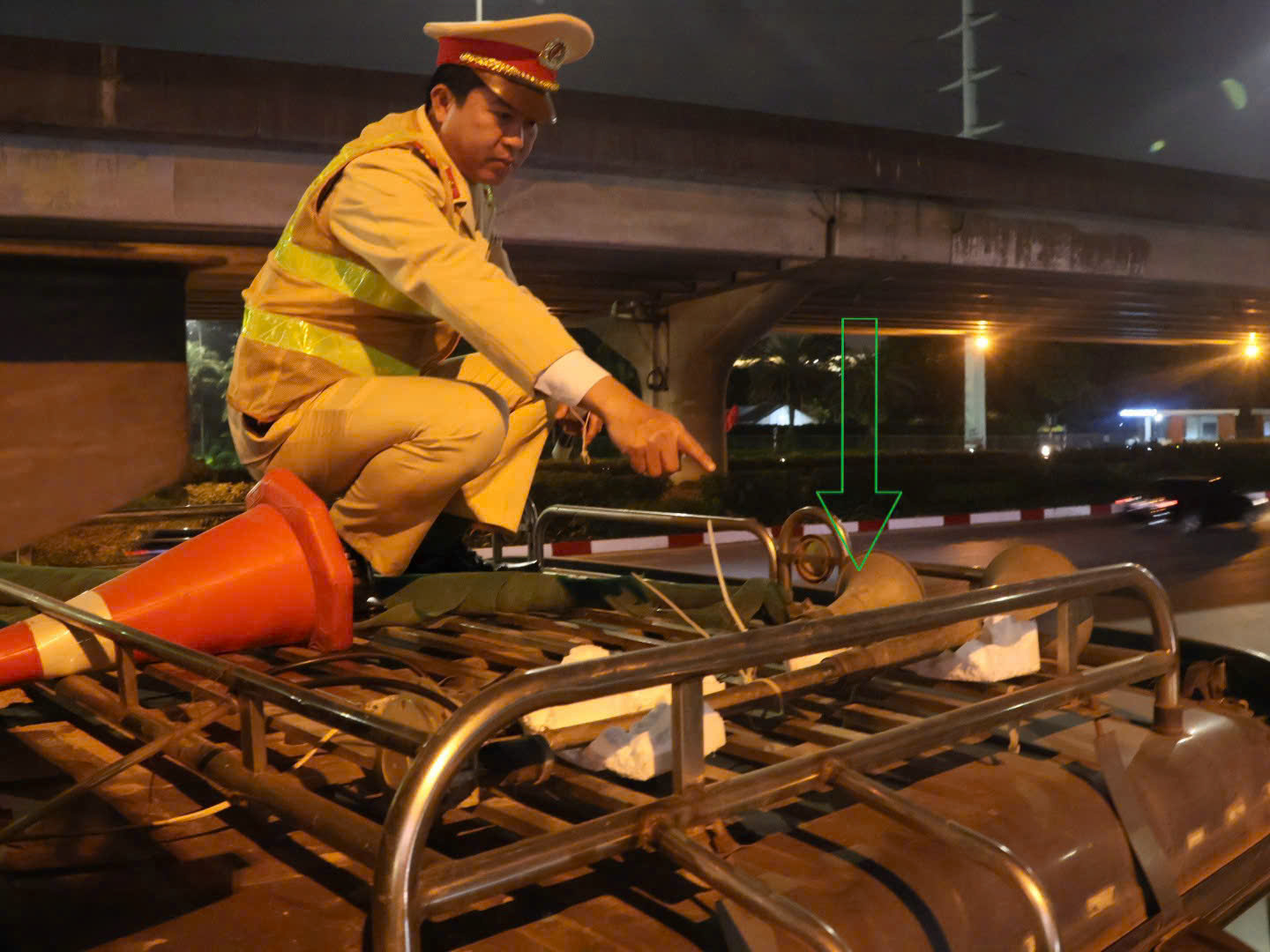 |
Modified air horn mounted on a truck roof. Photo: *Traffic Police* |
Recently, the Hanoi Traffic Police Department has intensified patrols to address the late-night use of air horns, which impacts residents' lives. Specifically, during a two-hour period on the night of 21/1, at the Pham Hung - Thang Long Avenue intersection in Tu Liem Ward, Road Traffic Police Team 6 fined five drivers for "using horns between 10 p.m. and 5 a.m. the next morning in densely populated areas or near medical facilities."
Traffic police must climb onto the truck roofs where the horns are installed for inspection. Some drivers were asked to honk multiple times to provide grounds for enforcement. One male dump truck driver explained that the factory-installed horn lacked sufficient power to warn other road users, prompting him to "modify" it.
Lieutenant Colonel Pham Van Chien, leader of Team 6, commented that modified air horns reflect reckless and disrespectful driving habits, posing a risk to traffic safety. The piercing horns not only affect patient health, children's and elderly people's sleep but also disrupt the calm and concentration of other road users.
According to some experts, the persistent issue of vehicle horns stems from lenient penalties that lack deterrence, and law enforcement faces difficulties in addressing violations due to a lack of sound level measuring equipment.
Currently, Decree 168/2024 stipulates that for cars, using a horn between 10 p.m. and 5 a.m. in densely populated areas or near medical facilities, except for priority vehicles on duty, will incur a fine of 400,000-600,000 VND. Drivers using continuous or air horns will face a fine of 800,000-1 million VND. Furthermore, operating a vehicle with a horn installed or used at a volume exceeding regulations will result in a fine of 3-4 million VND.
Viet An