The national artificial intelligence (AI) strategy until 2030, with a vision to 2045, approved by the Prime Minister on 28/8, outlines a significant shift in approach: from integrating AI into products, services, processes, and systems, to leveraging AI as a core competency from problem identification, design, organization, and operation.
AI is poised to become a vital driver for redesigning governance, production, business, and service delivery methods, thereby boosting productivity, enhancing national governance effectiveness, improving business competitiveness, fostering innovation, and creating new products, services, and business models.
The strategy targets developing high-quality AI human resources, AI talent, and elite AI personnel. It also focuses on training and upskilling the workforce in AI and popularizing AI skills across society. Vietnam plans to attract and utilize top AI experts, including overseas Vietnamese and foreign professionals.
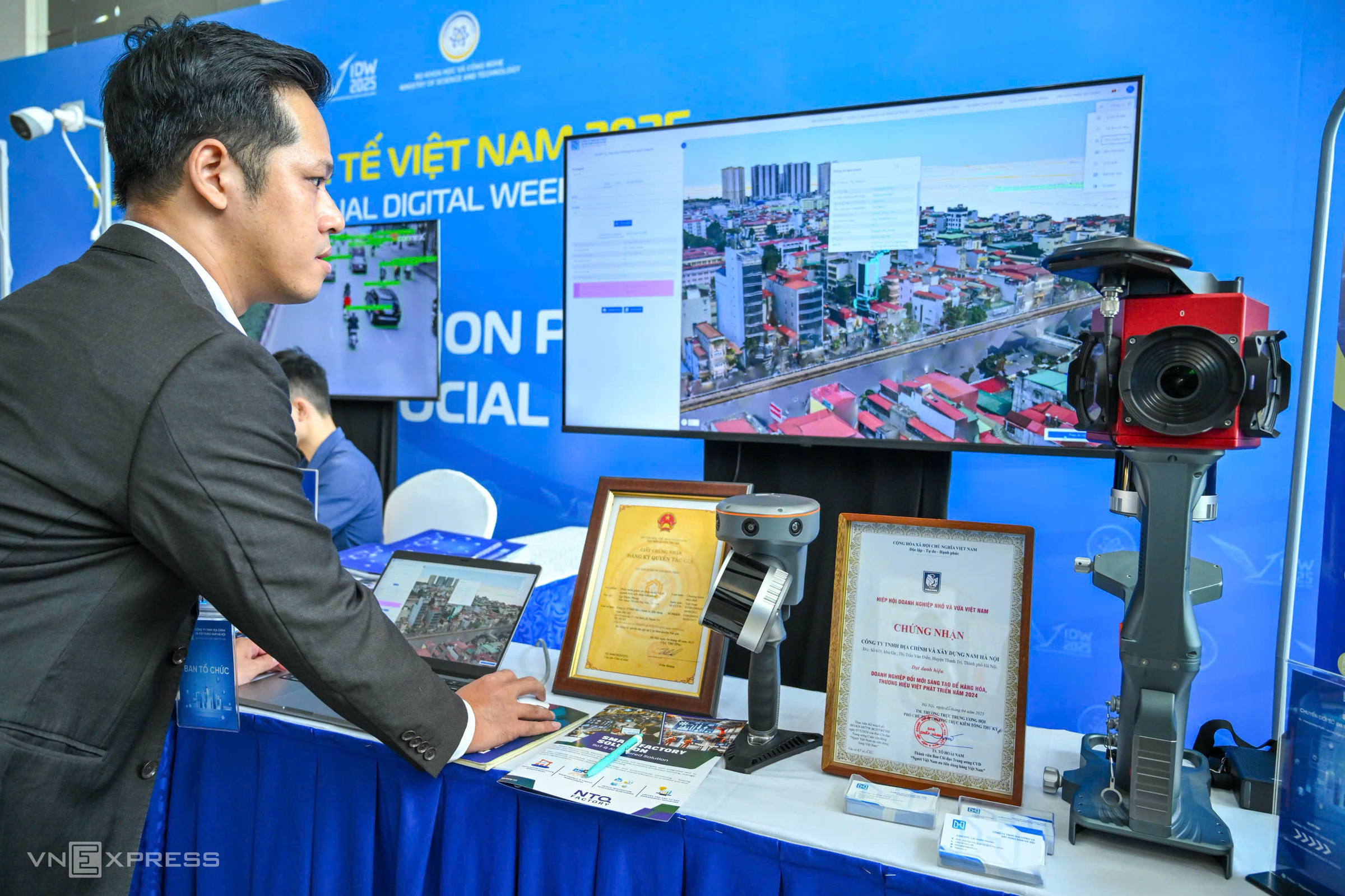 |
Vietnam international digital week 2025 themed "artificial intelligence governance", 10/2025. Photo: Giang Huy
By 2030, Vietnam strives to be a leading center for AI research, development, application, and co-creation in the ASEAN and Asian regions. The goal is to establish robust national capabilities in AI research, development, mastery, deployment, and governance.
AI will become a core competency, deeply and comprehensively integrated into national governance, public service delivery, production, business, scientific research, innovation, and social life. This integration will significantly boost productivity, quality, efficiency, national competitiveness, and foster new products, services, and growth models.
Over the next four years, Vietnam aims to be among the top three Southeast Asian nations in AI research and development. The country also targets 100% of online public services to be integrated and supported by AI, and 100% of administrative procedure records to be processed with AI assistance.
Vietnam plans to develop 5 national shared AI platforms, establish 10 Vietnamese AI brands competitive in regional and international markets, and develop a minimum of 8 Vietnamese AI models.
By 2045, Vietnam aims to be among the top 10 Asian nations in AI research, development, mastery, and national AI transformation. AI will serve as a crucial strategic driver, enhancing productivity, innovation capabilities, and national value creation, ultimately helping Vietnam overcome the middle-income trap and become a high-income developed country.
Vietnam will cultivate an ecosystem of AI and AI-native businesses with regional and international competitiveness, positioning itself as a significant regional and global hub for AI research, development, production, and the provision of AI products, services, and solutions.
To achieve these objectives, the strategy outlines nine key pillars. The first focuses on developing high-quality AI human resources, popularizing AI skills across society, and ensuring the workforce is capable of researching, developing, deploying, and utilizing AI.
Data, data infrastructure, and AI models will be developed to serve as the foundation for AI research, development, training, testing, evaluation, and deployment. Concurrently, computing infrastructure and cloud computing will be advanced alongside AI and dedicated AI data centers.
Vietnam will promote the research, development, and mastery of AI technology, leading to the creation of "make in Vietnam" AI products and services, and fostering core technological capabilities to address the nation's significant challenges.
AI will also be integrated into national governance to build a modern, proactive, and rapidly adaptive administration in the AI era. Comprehensive AI transformation will be accelerated across various sectors, with a focus on key industries that significantly impact productivity, growth, national competitiveness, social welfare, and people's lives.
Small and medium-sized enterprises, business households, and cooperatives will gain access to, implement, and continuously utilize AI products, services, and solutions, with their real-world effectiveness measured.
Concurrently, Vietnam's AI ecosystem will be developed to possess capabilities in research, development, commercialization, and the export of AI products, services, and solutions. AI governance will be ensured to be safe, reliable, and responsible.
Vu Tuan