The Civil Aviation Authority of Vietnam (CAAV) recently conducted a preliminary assessment of the Middle East conflict's impact on the aviation industry. According to the authority, the complex and ongoing hostilities are placing significant pressure on air transport, trade, and tourism.
Among domestic carriers, Vietnam Airlines is experiencing the most direct impact. Although no Vietnamese airlines operate direct routes to the Middle East, Vietnam Airlines' flights from Vietnam to europe must alter their routes to avoid the airspace over Iran, Iraq, and the surrounding conflict zone.
These flights are currently adjusted via two main corridors: a northern route through Central Asia or Trung Quoc, or a southern route through South Asia and the Saudi Arabia peninsula. These detours extend each flight by 10-15 minutes, increasing operational costs by approximately 2,000 USD per trip.
Should the conflict escalate further, Vietnam Airlines may also face additional war risk insurance fees. These fees are estimated to increase by 10-15% for aircraft operating intercontinental routes that pass near the conflict region.
The Middle East conflict also impacts regional airlines operating in Vietnam. Currently, three airlines—Qatar Airways, Emirates, and Etihad Airways—operate six routes from Abu Dhabi, Jebel Ali, Dubai, and Doha to Hanoi, TP HCM, and Da Nang, with a frequency of about 12 flights daily. In 1/2026, these airlines transported around 141,000 passengers and 11,000 tons of cargo to and from Vietnam.
 |
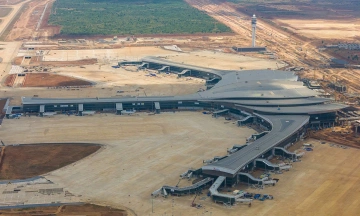
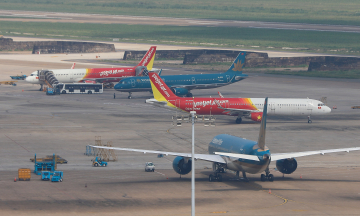
Aircraft at Noi Bai International Airport. Photo: Giang Huy |
Since 28/2, many flights operated by these airlines have been canceled, affecting tens of thousands of passengers. The reduction in flights also leads to a decrease in revenue for aviation service providers in Vietnam. The Vietnam Air Traffic Management Corporation (VATM) anticipates a loss of nearly 1 million USD each month, while the Airports Corporation of Vietnam (ACV) estimates a reduction of approximately 10,9 million USD monthly from passenger service fees and other airport services.
The tourism sector is also affected, with many tours from Vietnam to the Middle East being canceled. Concurrently, cargo transportation between Vietnam and europe faces delays and increased costs, impacting key export items such as electronic components and garments.
The Middle East serves as a transit point for an estimated 25-30% of electronic components and high-tech goods traveling from europe to Vietnam. Flight cancellations could lead to localized component shortages for some northern industrial zones, including Bac Ninh and Thai Nguyen.
The Civil Aviation Authority of Vietnam stated it will continue to closely monitor the conflict's developments to support airlines in their operations and consider measures to mitigate damages. The authority is exploring reducing parking fees for affected airlines and coordinating with aviation businesses to propose fuel surcharges if oil prices rise due to prolonged conflict.
The Middle East conflict erupted on 28/2 after America and Israel conducted airstrikes on iranian intelligence and defense facilities. Iran subsequently retaliated with missiles and unmanned aerial vehicles (UAVs). By 6/3, the fighting resulted in over 1,000 fatalities in Iran and casualties in Israel and at American bases.
Many Middle Eastern countries have closed their airspace, forcing regional airlines to cancel numerous flights. Turkish Airlines continues to operate normally from Vietnam, Emirates partially resumed flights on 5/3 with reduced frequency, while Qatar Airways and Etihad Airways remain temporarily suspended.
Doan Loan