Ho Chi Minh City (TP HCM) generates 14,000 tons of waste daily. This enormous volume, originating from households, markets, and businesses, undergoes a complex journey through the city's waste management system. Despite numerous collection and transfer points, a significant portion—around 8,300 tons daily—is still sent to landfills, highlighting a persistent challenge in waste treatment.
At 6 a.m., members of the Tai Dung informal waste collection group in Thoi An ward, former District 12, begin their workday. They divide into teams, navigating narrow alleys to collect waste from over 500 households. Bags filled with food scraps, vegetables, plastic bags, cans, and foam containers quickly pile up on their tricycles. The collected waste is then transferred to trucks and transported to the An Phu Dong transfer station, where it is compacted before continuing its journey of tens of kilometers to the Da Phuoc integrated waste treatment complex in Hung Long commune, former Binh Chanh district.
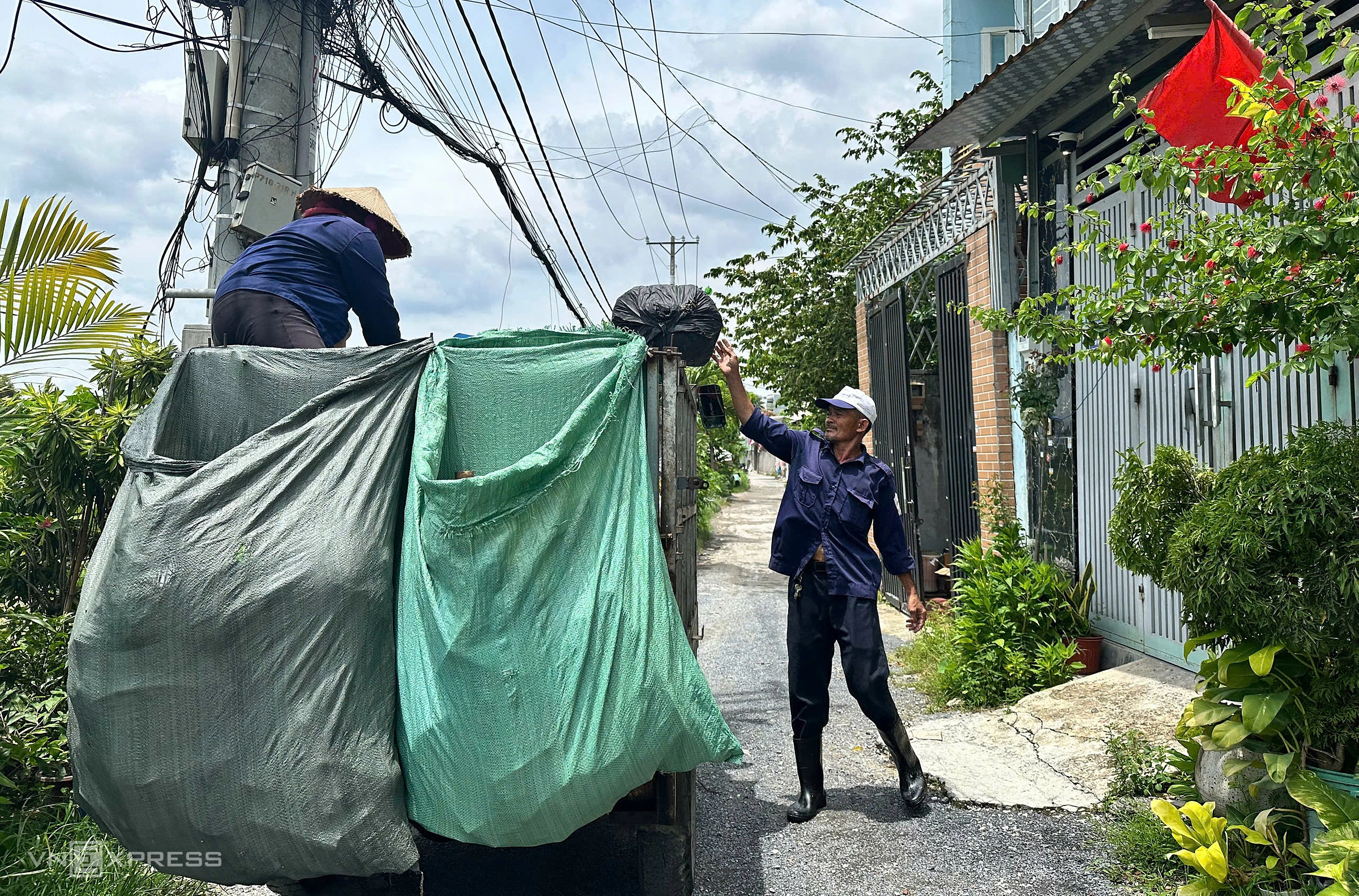 |
Ms. Dung and colleagues collect waste in Thoi An ward, 7/2026. Photo: Le Tuyet |
Ms. Kim Dung, who owns the collection group, started this work in 1993 when the area's population was sparse. At that time, waste was taken to the Dong Thanh landfill in former Hoc Mon district. This landfill closed after more than ten years due to pollution, and waste trucks were subsequently redirected to Go Cat, Phuoc Hiep, and currently Da Phuoc.
"The dumping site is getting further away, and the amount of waste increases with the number of households, but the way people put everything into one bag hasn't changed," Ms. Dung said.
According to the plan registered with the ward, Tai Dung is responsible for collecting about 5.5 tons of waste daily. This volume comes not only from over 500 households, averaging four people per family, but also from eateries and businesses along their routes. On weekends, the amount of waste can reach 5-6 tons, while it decreases during weekdays. Despite fluctuating volumes, the team must collect all generated waste to ensure that streets and alleys remain clean.
Mixed in with old clothes, mattresses, tree branches, bricks, stones, and glass fragments, collectors salvage cans and cardboard that can be sold to recycling facilities. The remaining waste continues to be transported for treatment.
The Tai Dung group's operations represent just one small link in TP HCM's vast network, which collects approximately 14,000 tons of domestic waste daily. This figure accounts for over 20% of the country's total waste.
With a population of nearly 14 million people, the average resident of TP HCM generates about one kg of waste per day. Based on current generation rates, the city must collect and treat over 5.1 million tons of domestic waste annually.
Waste from households, markets, schools, commercial areas, and eateries is collected by informal groups, public utility companies, and cooperatives, then transported to about 750 collection points and 43 transfer stations. There, waste is compacted and loaded onto specialized vehicles for transport to centralized treatment zones.
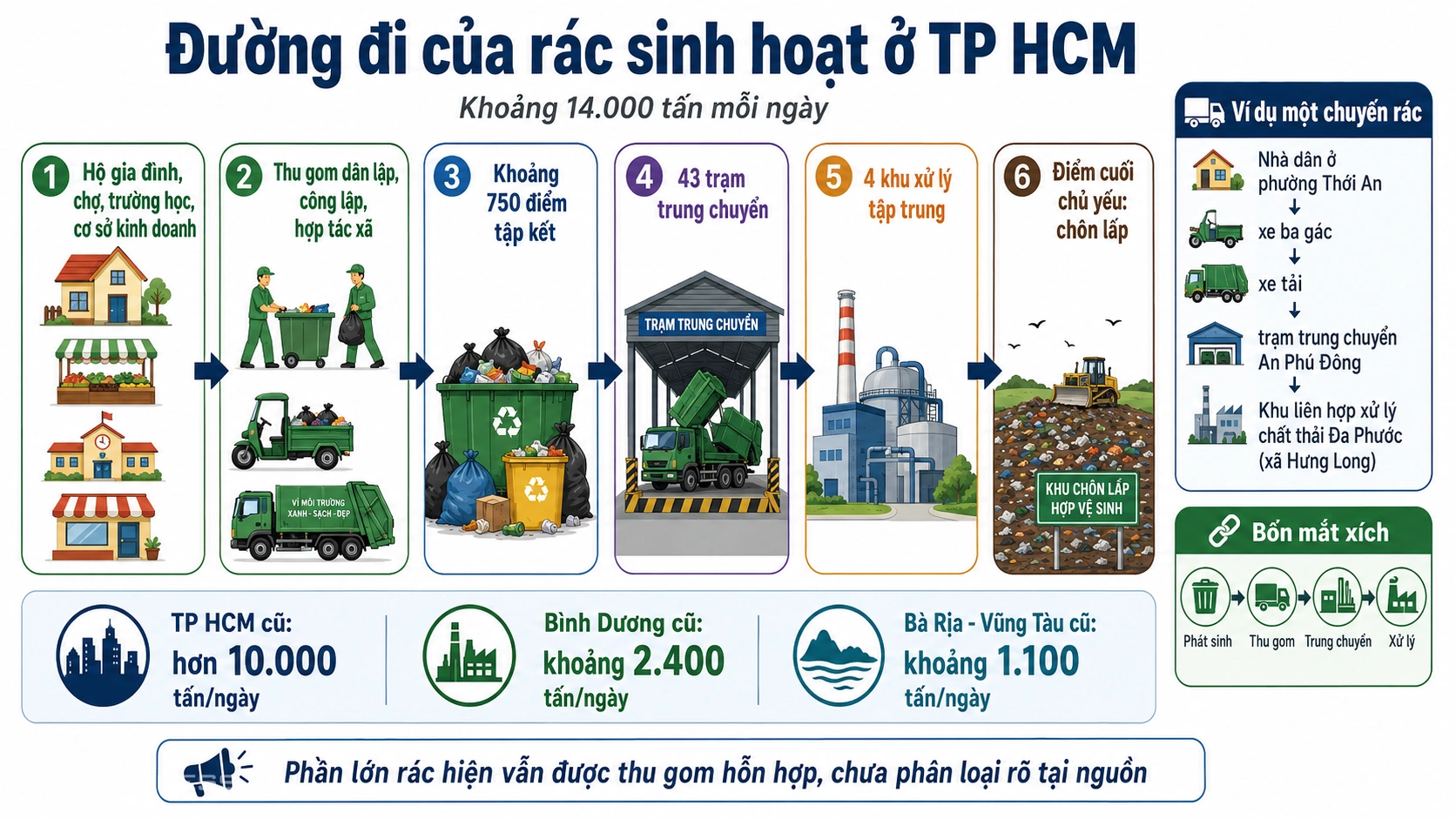 |
AI-assisted graphic. |
Three treatment models in one city
According to the post-merger master plan, TP HCM has four integrated solid waste treatment complexes, totaling about 1,673 ha. These include the Northwest complex covering 822 ha, Da Phuoc nearly 614 ha, South Binh Duong about 100 ha, and Toc Tien (formerly in Ba Ria - Vung Tau) at 137 ha.
Following the merger with Binh Duong and Ba Ria - Vung Tau, TP HCM generates approximately 14,000 tons of domestic waste daily. Of this, the area previously known as TP HCM accounts for 10,500 tons, Binh Duong 2,400 tons, and Ba Ria - Vung Tau 1,100 tons.
Mr. Tran Anh Duc, Deputy Head of the Solid Waste Management Department at the Ho Chi Minh City Department of Agriculture and Environment, stated that the three pre-merger regions developed different waste treatment models.
Waste from the former TP HCM area was primarily sent to the Da Phuoc integrated waste treatment complex and the Northwest integrated solid waste treatment complex in former Cu Chi district. Facilities here employ various methods, including landfilling, compost production, and incineration.
Waste generated in the Ba Ria - Vung Tau area is transported to the Toc Tien centralized waste treatment zone, which still primarily uses landfilling.
In contrast, Binh Duong has embraced a circular economy approach. Waste is brought to the South Binh Duong integrated waste treatment complex, where it is sorted to recover recyclable materials. Organic waste is used for compost production, and the remainder is incinerated for energy recovery. Only inert waste that cannot be recycled, incinerated, or composted is landfilled.
Consequently, Binh Duong is the only region among the three pre-merger localities that no longer directly landfills domestic waste.
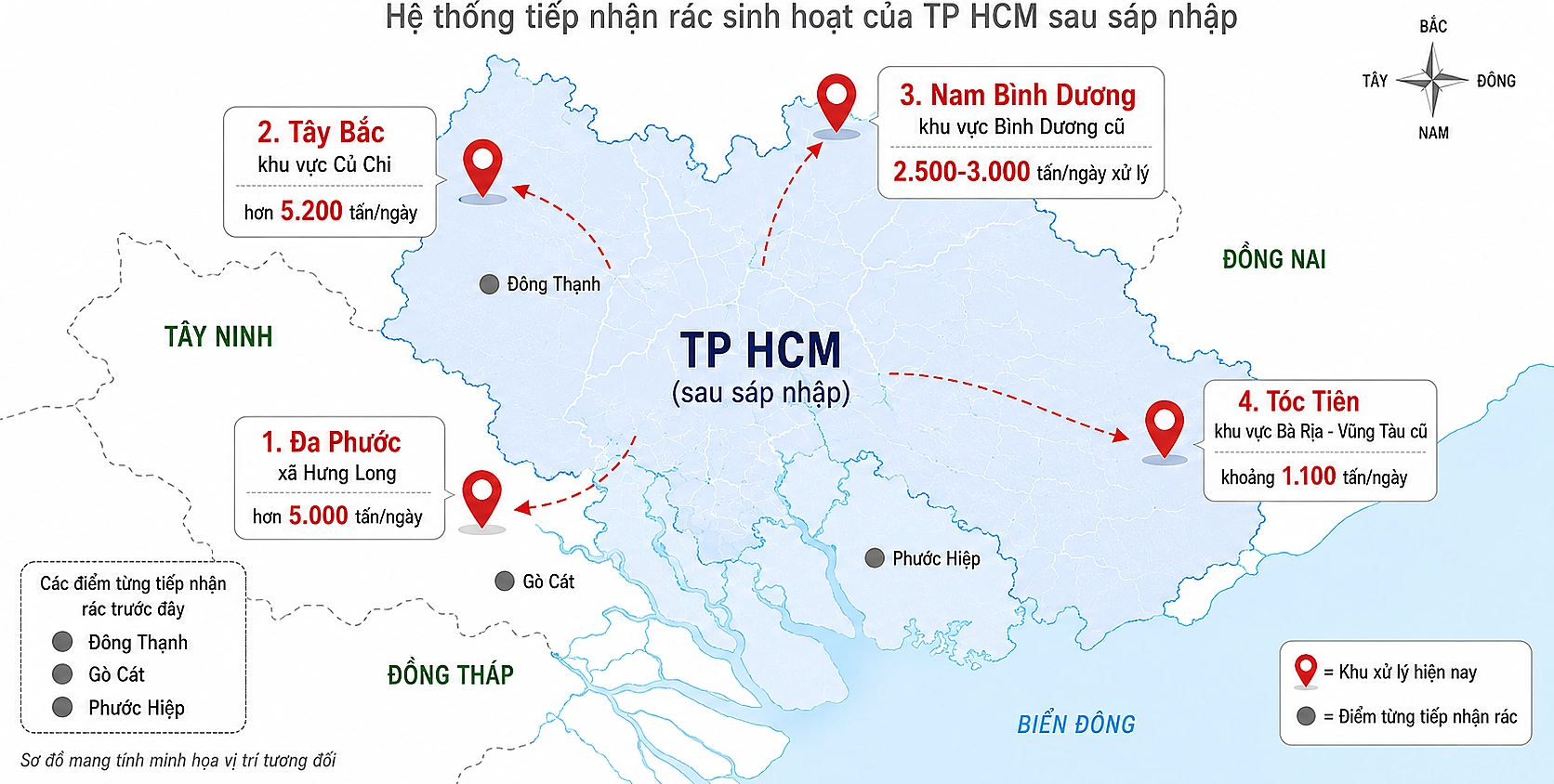 |
Locations of TP HCM's main waste treatment zones after the merger. AI-assisted graphic |
According to Master Nguyen Trung Duy from the Institute of Construction Planning under the Ho Chi Minh City Department of Planning and Architecture, the city currently operates three waste treatment systems, developed from localities with different conditions, policies, and resources. These systems maintain continuous waste treatment operations but lack consistency in technology and development orientation.
Nearly 60% of waste ends up in landfills
As of 3/2026, about 5,700 tons of waste daily, or 41%, is treated using waste-to-energy incineration and compost production technologies. The remaining 8,300 tons, accounting for 59%, are sent to landfills.
According to Associate Professor, Doctor Nguyen Hong Quan, Director of the Institute for Circular Economy Development Research, Vietnam National University Ho Chi Minh City, if waste is considered a "material flow", the journey of most waste currently follows a linear path from households to final treatment sites, instead of re-entering the economy as raw materials, energy, or new products.
Domestic waste in Vietnamese urban areas has a high proportion of organic matter, alongside paper, plastic, metal, and glass. However, most is collected as mixed waste due to inefficient source separation. When different types of waste are mixed, the potential for recycling, compost production, and resource recovery all decrease.
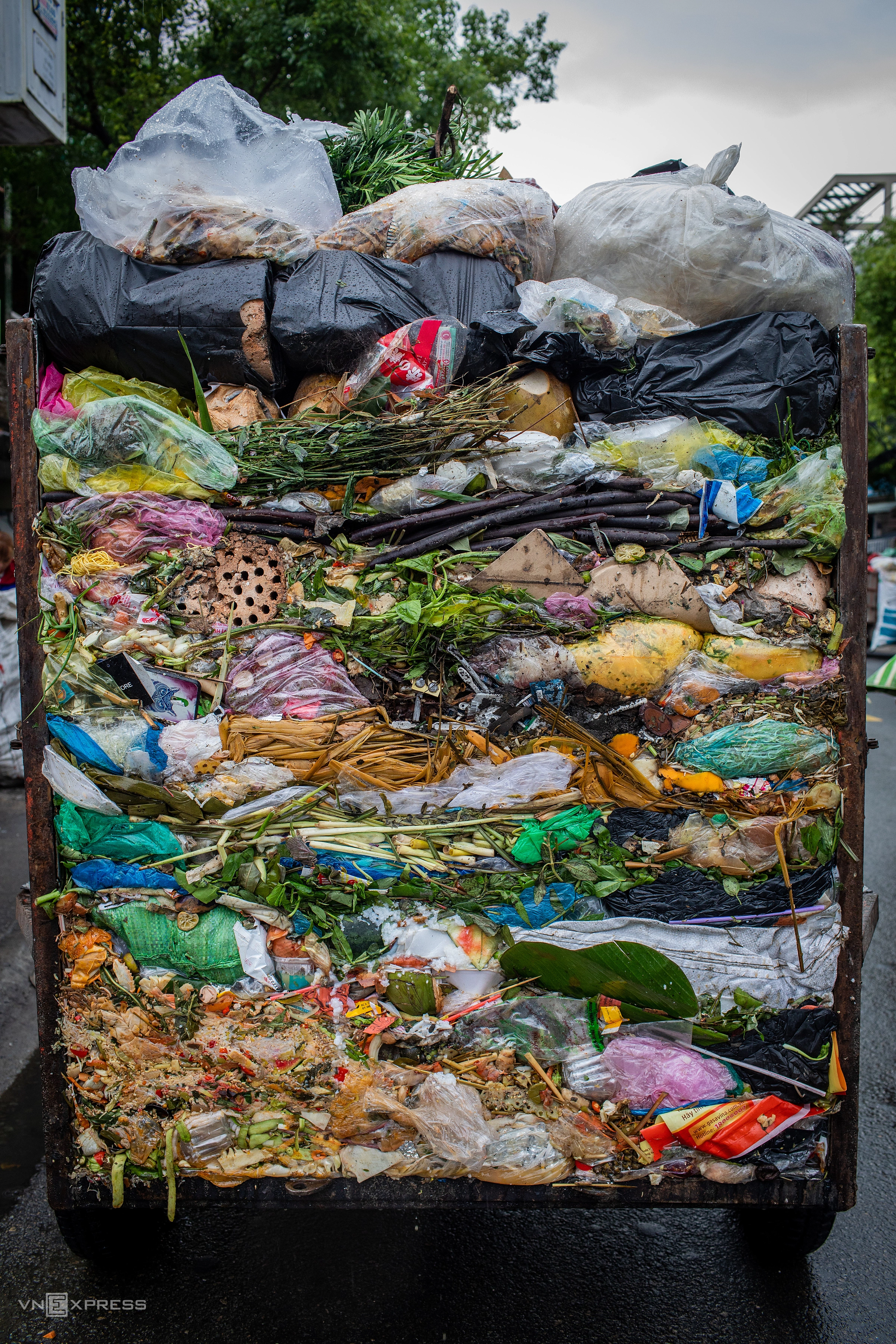 |
Waste at a collection point on Hoang Hoa Tham street, former Binh Thanh district. Photo: Thanh Nguyen |
According to the latest statistics from the Ministry of Agriculture and Environment, the country generates approximately 67,100 tons of domestic waste daily. The landfilling rate has decreased from 70% in 2019 to about 64%, but it remains the predominant treatment method. About 16% of waste is composted, and 9.3% is incinerated for energy recovery.
Mr. Quan argues that environmental risks appear at every link in the chain, from scattered waste, odors, and leachate during collection and transport, to greenhouse gases generated at landfills. As waste volumes continue to rise while recycling and resource recovery capabilities remain low, pressure on the treatment system will intensify.
Doctor Ngo Huynh Thien, General Director of ARC-V Environmental Technology Joint Stock Company, noted that landfilling has the advantage of low investment capital and ease of implementation if land is available, but it only addresses immediate needs.
"The price to pay will be felt decades later," he said, referring to the risks from leachate, methane gas during decomposition, and the continuous need to expand land for waste treatment.
According to the adjusted General Planning Project for TP HCM before the merger, the population of this area is projected to reach about 16.5 million people by 2040. The standard for domestic waste generation is set at 1.3 kg per person per day in central areas and one kg in districts. Based on this population size and generation rate, waste volume in the 2031-2036 period is estimated to be about 18,000-22,000 tons daily, depending on the pace of urbanization and population distribution.
If the entire post-merger TP HCM continues to increase its average waste volume by 6.2% annually from the current 14,000 tons, the generated volume could reach approximately 19,000 tons daily after five years and nearly 26,000 tons after ten years. This calculation is based on growth trends and is not an official forecast by management agencies for the new city area.
The "waste security" challenge
The concentration of most waste in a few large treatment complexes makes the system vulnerable to disruption if one facility experiences an issue.
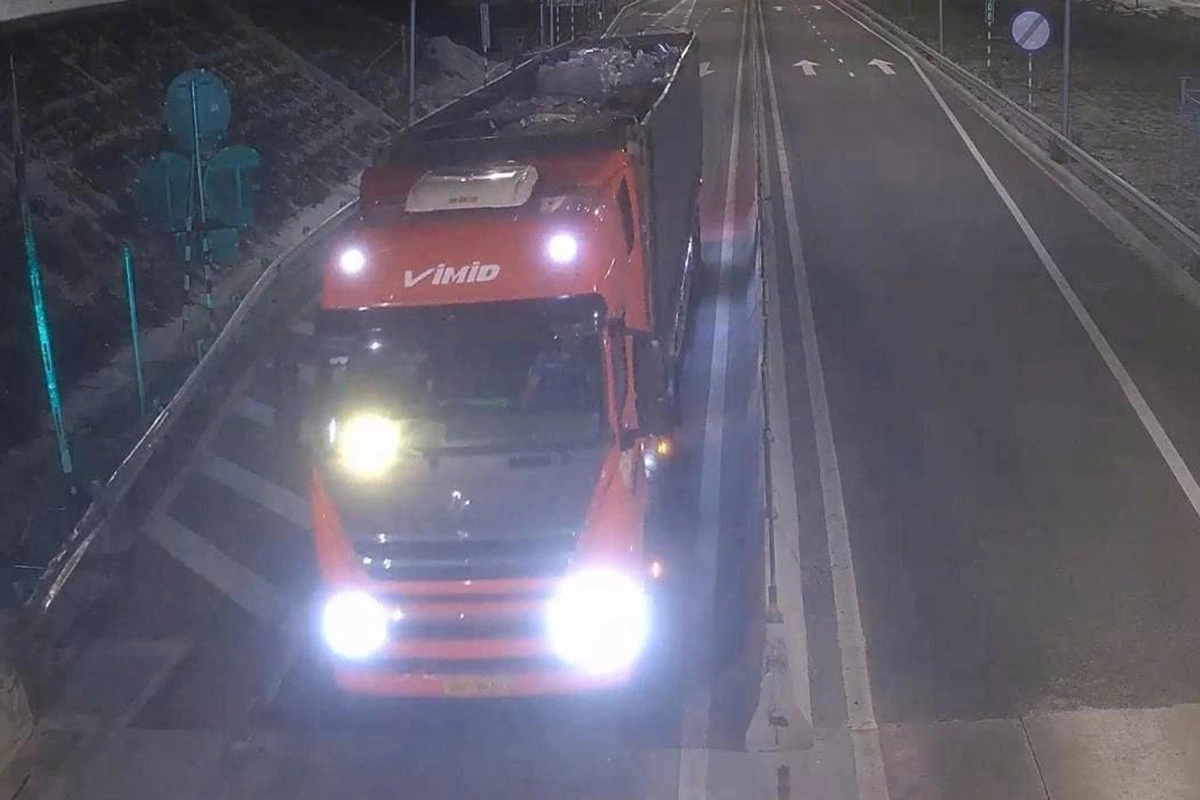
On the night of 23/1/2025, nearly 100 waste collection vehicles queued outside the Da Phuoc integrated waste treatment complex when it temporarily stopped receiving waste due to a collective worker stoppage. At that time, Da Phuoc processed about half of TP HCM's domestic waste before the boundary expansion, so its cessation of operations immediately affected the collection and transport chain across a wide area.
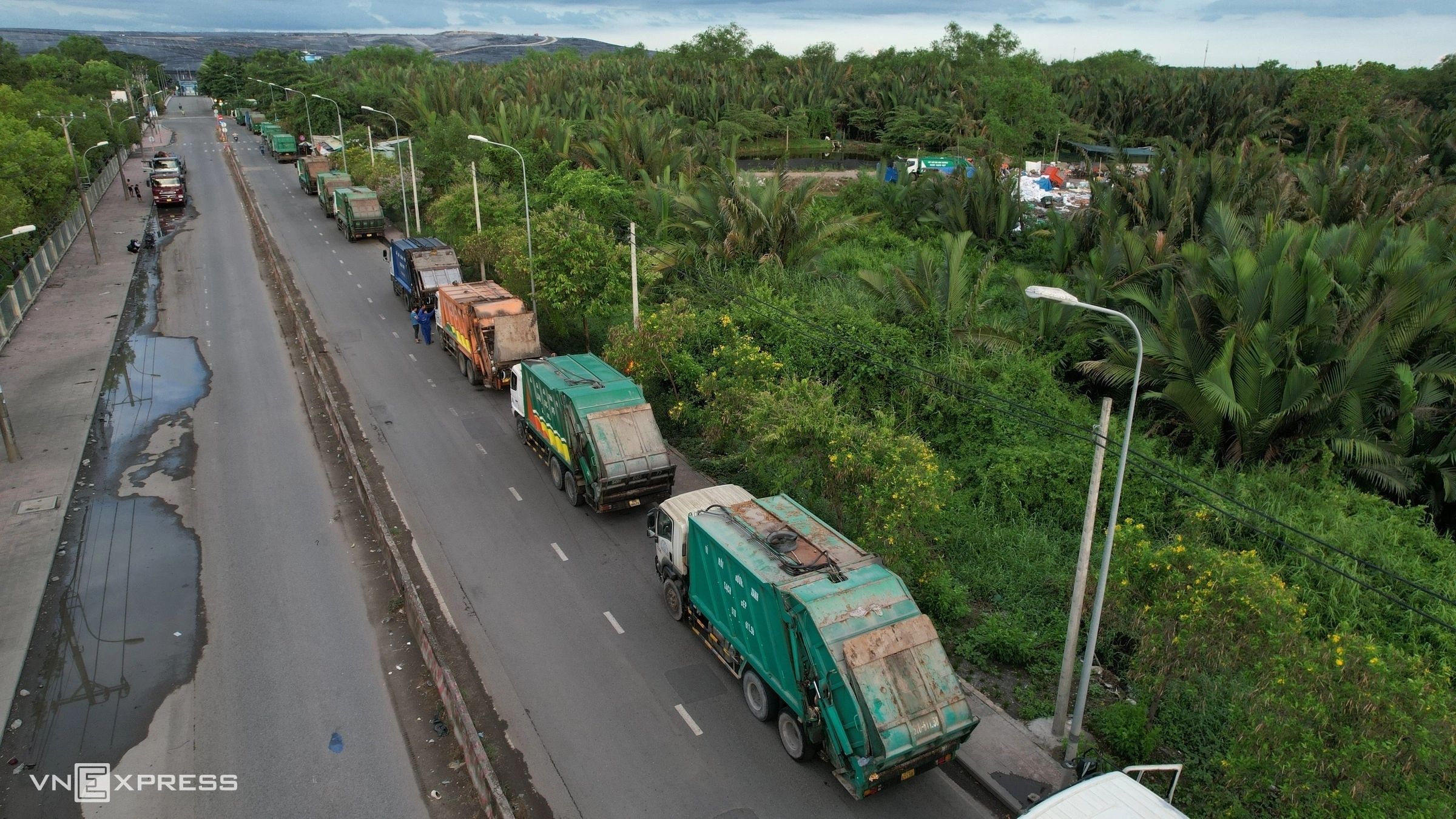 |
A convoy of vehicles transports waste to the Da Phuoc landfill, TP HCM, 5/2026. Photo: Dinh Van |
That same night, the city had to activate an emergency plan, diverting waste intended for Da Phuoc to the Northwest integrated solid waste treatment complex, about 40 km away. Environmental units also increased vehicles and personnel to prevent waste accumulation during the days leading up to Tet (Lunar New Year). Da Phuoc subsequently resumed operations.
Master Nguyen Trung Duy refers to this as the "waste security" challenge. When the system relies on a few receiving sites, an incident at one facility can escalate into a risk for the entire city.
According to him, alongside technological transformation, TP HCM needs to build backup capacity and distribute treatment facilities more rationally. This would prevent the system from being caught off guard if one link malfunctions, potentially leading to thousands of tons of accumulated waste.
While waste volumes continue to grow, TP HCM's challenge is not just expanding receiving sites, but also reducing the amount of waste that reaches the end of the line through source separation, recycling, and converting treatment technologies. However, the question of which technology to replace landfilling with, and at what cost and effectiveness, remains a significant challenge for a city of nearly 14 million people.
Le Tuyet - Giang Anh
Article two:
Two decades of Ho Chi Minh City struggling to reduce waste landfilling