Hoang was diagnosed with azoospermia, a condition characterized by the absence of sperm in his semen, leading to infertility. He previously underwent two testicular sperm extraction (TESE) procedures at another hospital, but the samples were not viable. Doctors advised him to consider donor sperm for in-vitro fertilization (IVF), but Hoang declined, opting instead for various traditional herbal remedies and folk medicines, all without success.
Mid-this year, Hoang and his wife visited Tam Anh General Hospital TP HCM to register for sperm from a sperm bank. Dr. Nguyen Quang Vinh, from the Andrology Unit at the Center for Assisted Reproduction, conducted a comprehensive assessment of Hoang's health and reproductive function, including genetic testing. The results revealed Hoang had an AZFbc deletion, a genetic anomaly linked to spermatogenesis.
Dr. Vinh explained that the AZF region, located on the long arm of the Y chromosome, contains critical genes for sperm production and maturation. In Hoang's case, the simultaneous deletion of both AZFb and AZFc regions prevented germ cells from developing into mature sperm.
"The prognosis for finding sperm through conventional surgery was almost zero", said Dr. Vinh. He added that the patient's male hormone testosterone levels were critically low, measuring only 6 nmol/L, significantly below the standard level of over 12 nmol/L. Instead of testicular intervention to retrieve sperm, Dr. Vinh implemented a medical treatment regimen to rebalance Hoang's endocrine system and stimulate any remaining spermatogenesis.
After two months of treatment, Hoang's testosterone levels rose to 18 nmol/L, and sperm began to appear in his semen. 5 samples were cryopreserved for future assisted reproduction. The sperm were then used to fertilize his wife's eggs via intracytoplasmic sperm injection (ICSI), resulting in seven day-3 embryos, which were cultured to become five day-5 embryos.
Currently, Hoang's wife is preparing her uterine lining for an upcoming embryo transfer. Hoang requires scheduled follow-up appointments to monitor his testosterone levels and mitigate risks such as osteoporosis or depression associated with hypogonadism.
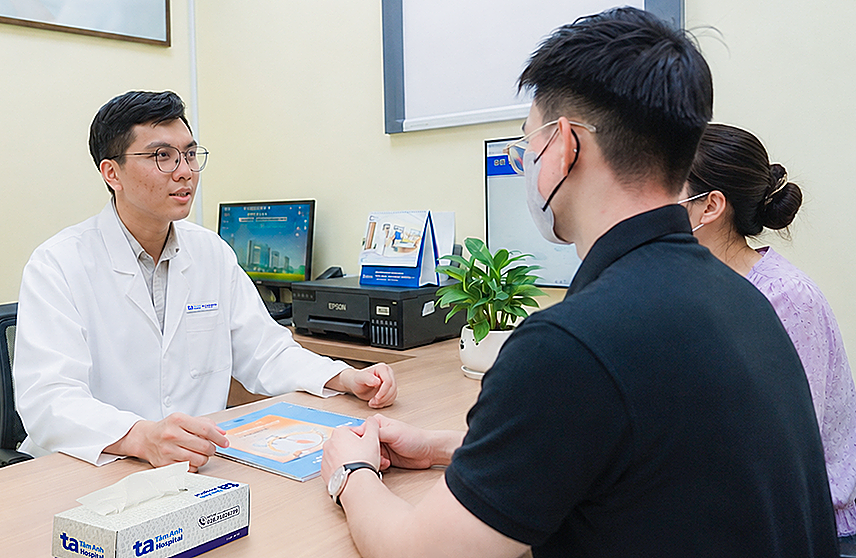 |
Hoang and Tram during a follow-up visit with Dr. Vinh. Photo: Tam Anh General Hospital |
Hoang and Tram during a follow-up visit with Dr. Vinh. Photo: Tam Anh General Hospital
According to Dr. Vinh, Y chromosome deletions occur in approximately 10-15% of men with azoospermia and 5-10% of those with severe oligozoospermia (low sperm count). In men with AZFbc deletions, spermatogenesis can be severely disrupted. Patients typically present with azoospermia, and testicular tissue examination may reveal only Sertoli cells, which nourish and support germ cells. Compared to an isolated AZFc deletion, complete AZFb or AZFbc deletions carry a significantly lower prognosis for sperm retrieval.
Dr. Vinh advises men diagnosed with sperm abnormalities to avoid self-treating with unverified remedies or delaying specialist consultation. Genetic testing helps identify the cause of azoospermia, enabling the selection of appropriate and minimally invasive assisted reproductive techniques that preserve the patient's physiological function.
Dinh Lam
*Character names in this article have been changed.