Hai and her husband had been married for six years without conceiving, experiencing two failed intrauterine insemination (IUI) attempts and two failed in vitro fertilization (IVF) cycles. Doctors at the Center for Reproductive Support, Tam Anh General Hospital Hanoi (IVF Tam Anh), performed hysteroscopy combined with laparoscopy, discovering multiple polyps within Hai’s uterine cavity. These lesions, formed by abnormal endometrial tissue growth, created protrusions that hindered embryo attachment and implantation. Even after conception, large polyps can increase the risk of early miscarriage.
Doctors surgically removed the polyps. Following this, Hai underwent successful in vitro fertilization, leading to the birth of her first child. Two day-5 embryos were cryopreserved for future use.
Five years later, Hai returned to IVF Tam Anh for further treatment to have more children. Doctors identified a significant recurrence of uterine polyps. Doctor Le Duc Thang, a specialist level one, explained that polypectomy only removes existing lesions. New polyps can form because factors promoting abnormal endometrial proliferation often persist. In some cases, very small lesions or the base of a polyp may be difficult to identify and can continue to grow over time.
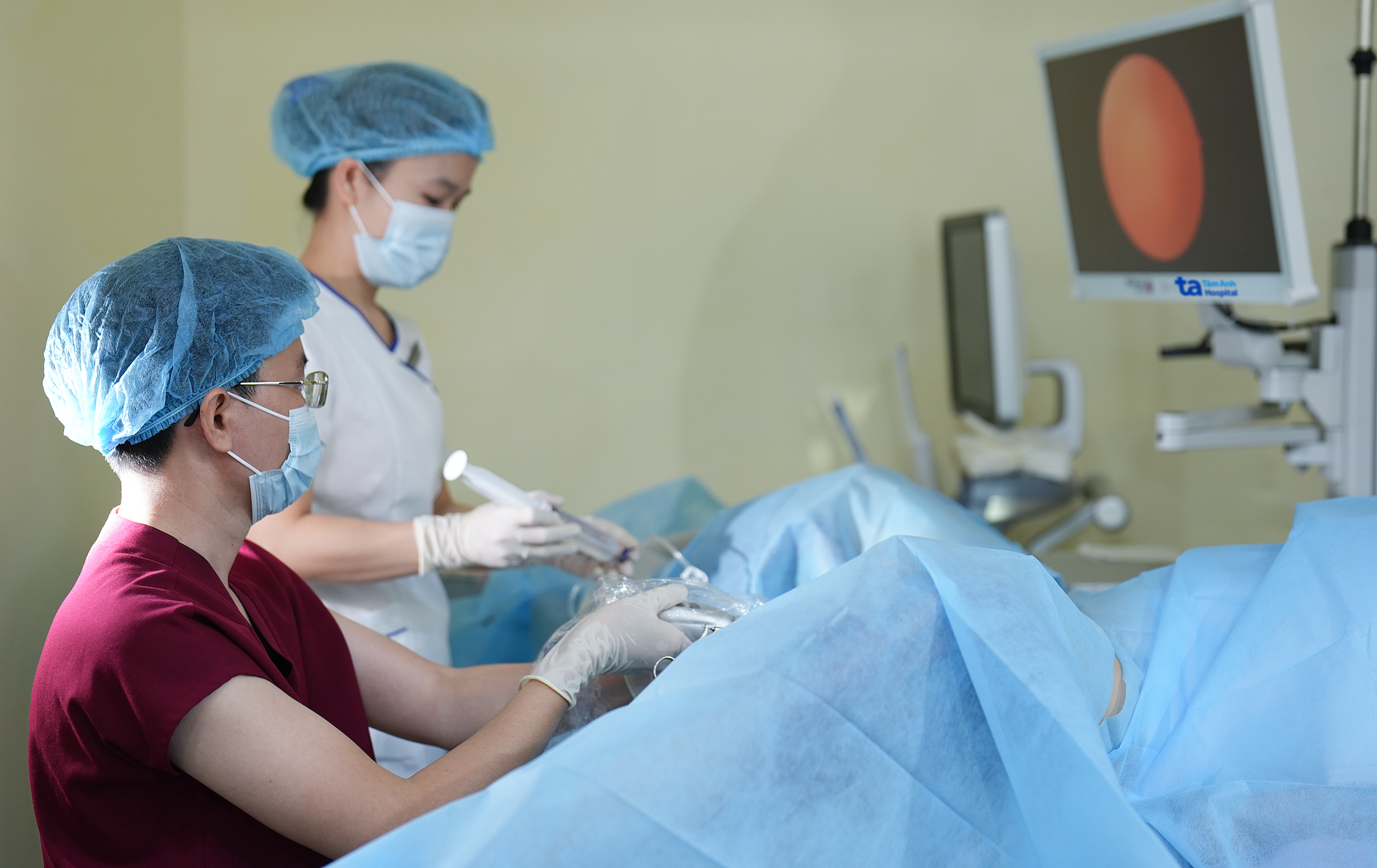 |
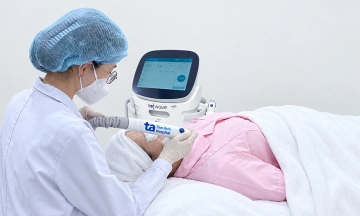
A doctor at IVF Tam Anh Center performs a hysteroscopy on a patient. *Photo: Vu Hoang* |
Hai underwent hysteroscopy to remove all polyp masses, minimizing damage to her uterine cavity. A tissue biopsy confirmed chronic endometritis. Prolonged inflammation can be linked to changes in the endometrial environment and abnormal proliferation of endometrial tissue, contributing to polyp formation.
The patient received antibiotic treatment for chronic endometritis for two months. The two cryopreserved day-5 embryos were thawed for preimplantation genetic screening. One embryo was found to have chromosomal abnormalities, and the remaining embryo showed an abnormality rate of 45%. The couple then decided to undergo a new IVF cycle to create high-quality embryos for a healthy child.
Hai’s husband received medication to support sperm production and improve his sperm quality, which was characterized by weakness, low count, and high rates of immotility and morphological abnormalities. Embryologists then processed and selected suitable sperm samples for intracytoplasmic sperm injection.
Embryos were cultured and continuously monitored in a time-lapse incubator system integrated with artificial intelligence (AI). This process resulted in four high-quality day-5 embryos, with no abnormalities detected during preimplantation genetic screening. Once Hai’s uterine lining reached a thickness of 10 mm and exhibited a suitable structure, doctors proceeded with the embryo transfer. Hai conceived immediately and subsequently gave birth to a healthy second child via C-section, weighing 3,5 kg.
Doctor Thang noted that approximately 15-25% of female infertility cases are associated with uterine polyps. The standard treatment is hysteroscopic polypectomy, a minimally invasive procedure with a short duration, allowing most patients to be discharged on the same day. Hysteroscopy also aids in detecting other abnormalities, such as uterine adhesions or signs of suspected endometritis.
The risk of polyp recurrence depends on endometrial characteristics, the number of polyps, a patient's medical history, and factors related to endocrine disorders or chronic inflammatory conditions. Estimates suggest that the recurrence rate for polyps is about 15-30% after one year and can increase to 30-50% after three to five years.
Women who have undergone polyp treatment, particularly those receiving infertility care or planning a pregnancy, should schedule follow-up examinations and uterine cavity assessments as advised by their doctors. If polyps or other abnormalities that could impact implantation are detected, doctors will consider intervention and treatment before proceeding with embryo transfer.
Trinh Mai
| Readers can submit questions about infertility here for doctors to answer. |