Debates about foreign tourist behavior during Japan's cherry blossom season escalated in the first week of April, following reports of "disorderly crowds" at many viewing spots. This intensified after the Sankei newspaper published an article describing inappropriate conduct by foreign visitors during hanami (cherry blossom viewing) events across Japan. The article urged tourists to show more respect for local customs, stating that noise, rule-breaking actions, and overtourism are "pushing local residents to their limits."
A notable incident occurred in Dazaifu city, Fukuoka prefecture, where residents complained about a group of "Chinese-speaking, noisy people" at a popular viewing spot. Some women in the group reportedly danced to music from mobile phones, while others filmed videos. The group also brought mini gas stoves and pots to cook on site, an activity prohibited by local regulations.
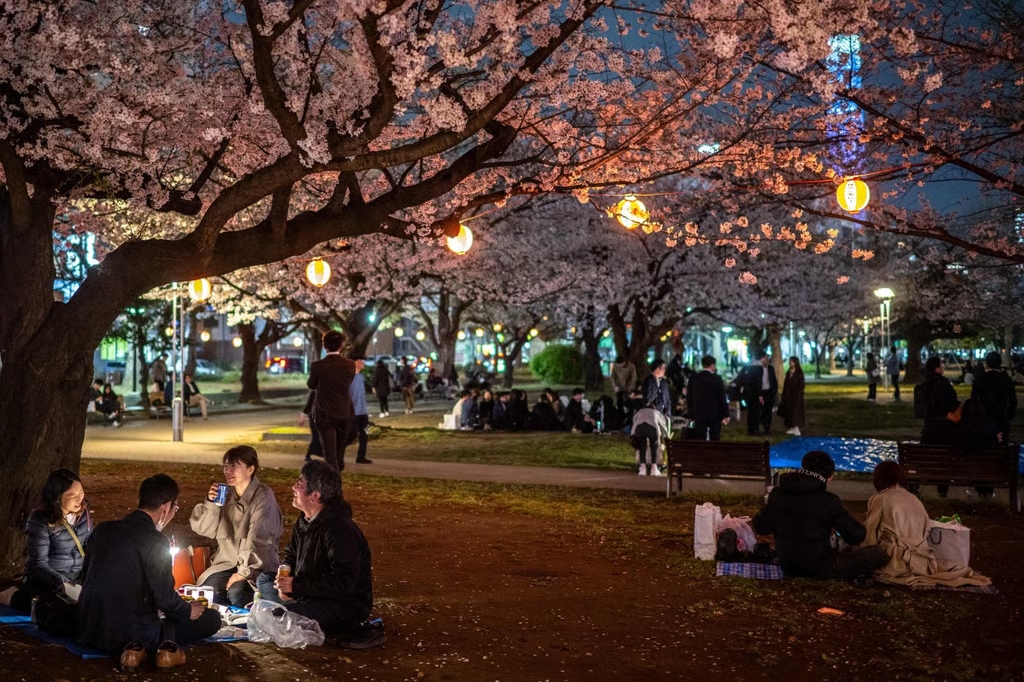 |
Locals and tourists admire cherry blossoms at Kinshi Park in Tokyo on 30/3. *Photo: AFP* |
When confronted, the group explained, "Singing and dancing is how Chinese people enjoy cherry blossoms," suggesting hanami events in China are often "more lively" with activities like karaoke and tai chi. Local authorities subsequently intervened, informing the tourists that using gas stoves was prohibited. The group stated they were unaware of the rule and agreed to stop.
This incident quickly sparked reactions on social media, with many criticizing the "disrespectful behavior towards public spaces and local culture." Some argued that tolerating such conduct under the guise of "cultural diversity" is unfair to local residents, highlighting growing tensions.
Reports of conflicts between locals and tourists are increasing across Japan. A European business owner reported police were called to his hanami party in Yokohama recently. Hiromi Murakami, a Professor of Political Science at Temple University's Tokyo campus, offered a nuanced perspective, noting that "blaming foreign visitors entirely is not objective." She pointed out that Japanese individuals also frequently get drunk, sing mobile karaoke, and vie for seating at hanami parties each year.
Further illustrating these escalating clashes, a European tourist recounted being asked to speak with police during a hanami party in Yokohama in late March. "I just tied a flag to a tree branch so my friends could easily spot our group's location, but two police officers unexpectedly arrived and asked me to take it down because they had received a complaint," the tourist stated.
In a more extreme case, the cherry blossom festival in Fujiyoshida town, Yamanashi prefecture, was canceled in March due to concerns about "nuisance behavior" from foreign tourists. Reported issues included trespassing into private homes and even urinating in local residents' gardens.
Experts believe Japan faces a difficult challenge: balancing the economic benefits of tourism with protecting residents' living spaces. Enhanced guidance on etiquette for tourists is seen as a necessary solution to reduce future cultural conflicts and ensure a harmonious experience for all during the cherry blossom season.
Mai Phuong (According to SCMP, Sankei)