Jellied eels were listed among the "10 worst dishes in the world" in a ranking updated late March 2026, compiled from over 483,000 valid global reviews. A TasteAtlas representative stated that the ranking's purpose is not to deliver a "final verdict" on world cuisine but to introduce local dishes, foster cultural pride, and encourage diners to explore new flavors.
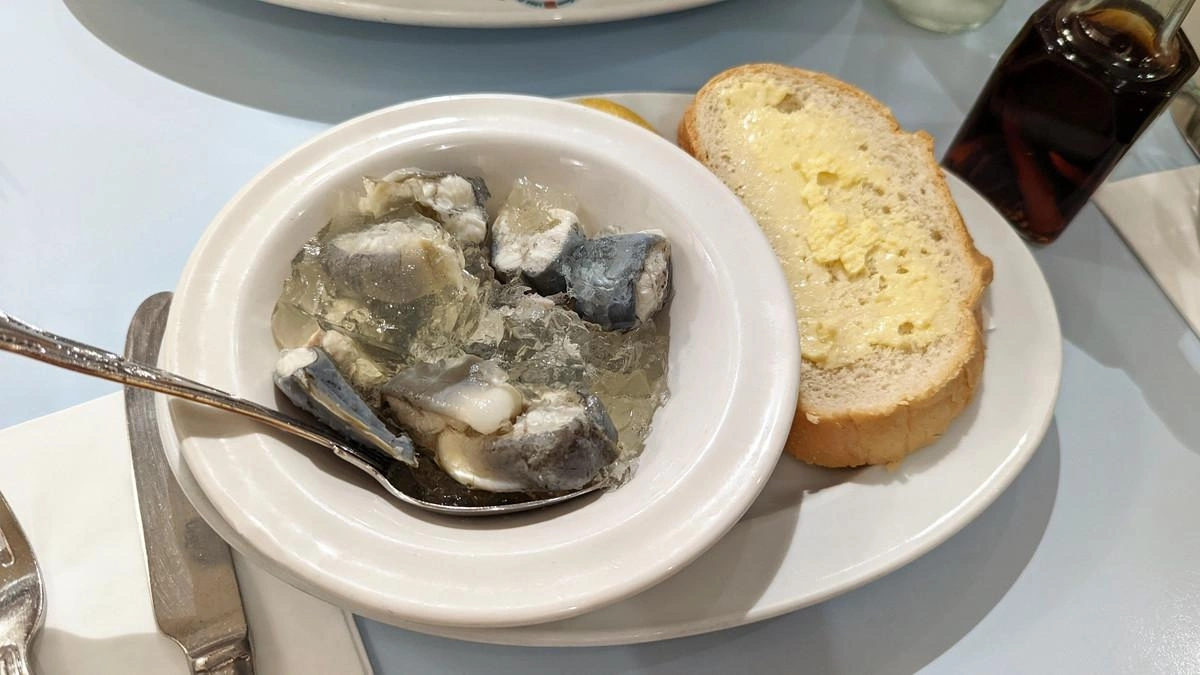 |
Jellied eels. Photo: Gigazine |
Jellied eels are a traditional Cockney dish from London, originating in the 18th century when eels were abundant in the River Thames. At that time, it was considered an inexpensive yet nutritious meal for the working class.
The dish is prepared by cutting eels into pieces, then boiling them with water, vinegar, and spices such as pepper, bay leaf, nutmeg, or lemon. During cooking, natural collagen from the eel's skin and bones releases into the broth. When cooled, this liquid solidifies into a jelly layer surrounding the eel pieces.
Jellied eels can be served hot or cold, often accompanied by pie, mashed potatoes, malt vinegar, and a sprinkle of white pepper for flavor. Some diners describe the dish as slightly salty with a fish jelly-like texture. Many culinary experts suggest it tastes best when served with chili vinegar.
Shops specializing in eels, pies, and mashed potatoes began appearing in London in the 18th century. Among them, M. Manze, which opened in 1902, is considered one of the oldest establishments still in operation.
 |
Jellied eel shop opened in 1902 in England. Photo: The Guardian |
After World War II, London once boasted around 100 jellied eel shops. However, their numbers sharply declined in subsequent decades as public interest waned and eel populations in the River Thames severely depleted due to pollution.
In 1957, the Natural History Museum declared the River Thames "biologically dead". British newspapers at the time described the river as "a poorly managed open sewer".
Despite this, traditional shops sustained the dish by sourcing eels from other locations. River Thames water quality significantly improved from the 1960s, allowing eels to return. However, European eels are currently classified as critically endangered.
Currently, jellied eels are still available at some traditional eateries and supermarkets in London. However, many first-time visitors find the dish challenging due to its strong fishy smell and cold, soft texture.
Tuan Anh (According to TasteAtlas, The Guardian)