Vietnam welcomed over 6.7 million international visitors in the first quarter, marking the highest number of arrivals ever recorded for a single quarter, according to data released by the General Statistics Office on 3/4.
Among the top 10 largest source markets for Vietnam, Russia secured the third position, following mainland China and South Korea. This is the highest ranking Russia has achieved in history, with over 367,000 visitors, nearly three times more than in the same period in 2025.
Doctor Pham Ha, CEO of Lux Group, identified four key reasons for the significant growth in Russian tourist numbers during Q1.
Firstly, Vietnam and Russia share a strong relationship, and for many years, Vietnam has been a traditional and favored destination for Russian travelers. Vietnamese tourism products, such as beautiful coastlines, diverse cuisine, and luxurious resorts at competitive prices, align with Russian preferences.
Secondly, the destination is easily accessible. Russian citizens can visit Vietnam without a visa for 45 days, and numerous direct flights connect the two countries.
Finally, Vietnam has established itself in the minds of international tourists as a friendly and politically stable destination, especially amid global instability.
"Vietnam is one of the most optimal destinations for Russian tourists today," Mr. Ha commented.
According to data from the Vietnam National Authority of Tourism over the past 10 years, current Russian arrivals are 1.6 times higher than the peak period of 2018-2019. In fact, the number of Russian tourists to Vietnam in the first three months of this year is 1.5 times the total for the entire year 2024 and accounts for 53% of the total for 2025.
Laurent Myter, General Manager of The Anam group, which owns two resorts, Anam Cam Ranh and Anam Mui Ne, shares Mr. Ha's perspective. According to him, a crucial factor contributing to the record number of Russian visitors is the rapid restoration and expansion of direct flights after the pandemic.
Since the first direct charter flight from Moscow to Cam Ranh began operating in March 2025, followed by charter flights to Phu Quoc in October 2025, the frequency of both charter and commercial flights has increased. These advantages have made Vietnam more accessible to Russian tourists, opening up significant opportunities for hotels and resorts in Cam Ranh, Nha Trang, and Phu Quoc.
Currently, Russian and Russian-speaking guests account for about 15% of bookings at The Anam resorts. "This demonstrates the growing importance of this customer segment for our hotel business," Mr. Myter stated.
According to The Anam's representative, Vietnam is particularly appealing to the Russian market due to its mild climate, suitable for year-round beach holidays. Compared to extended stays in other Southeast Asian destinations, such as Thailand, the cost of a trip to Vietnam is lower, while still ensuring quality overall resort experiences.
"Vietnam offers better value for money," Mr. Myter said.
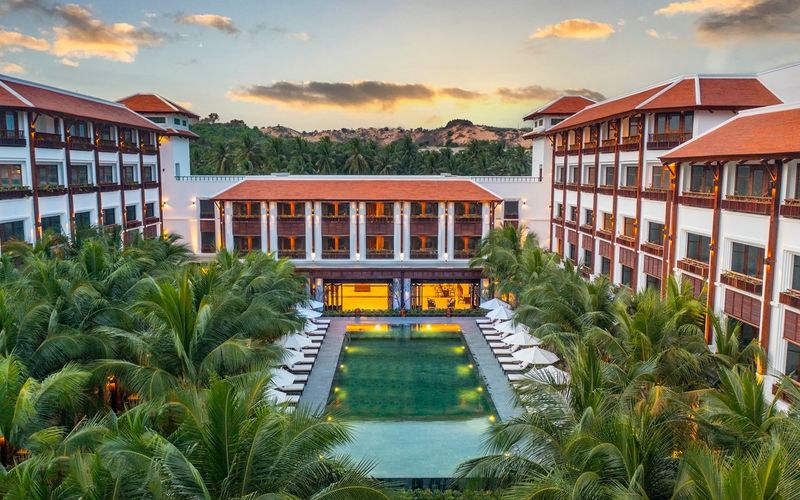 |
The Anam Mui Ne resort, which welcomes 15% of Russian and Russian-speaking guests. Photo: Booking |
Regarding travel behavior, Russian tourists typically prefer beach holidays and tend to stay for longer periods, often from 7 to 21 nights. This makes them a valuable segment for resort destinations.
They have high spending on additional services, especially food and spa. Based on Myter's experience, this group of guests is friendly, polite, and values comfort and a complete holiday experience.
A quick survey by Lux Group indicates that Russian guests arriving in Phu Quoc or Cam Ranh on charter flights often stay in 5-star hotels and book additional tours to explore other Vietnamese destinations. Instead of rushing, they typically prefer to check into one to two destinations, such as Ha Noi or Quang Ninh, for extended stays.
Many Russian guests opt for tailor-made programs, including cultural, historical, and culinary exploration. The luxury yacht segment has seen notable growth, with demand for private charters or 3-6 night itineraries connecting two to three bays (Ha Long - Lan Ha) in a single trip doubling compared to last year. This signals a clear trend towards "slow tourism", with longer stays and deeper experiences.
 |
Russian tourists propose on a yacht during a sunset cruise off Cam Ranh beach. Photo: Lux Group |
Furthermore, demand for specialized services has risen sharply. Tour operators report a significant increase in demand for Russian-speaking guides, along with specific requirements for cuisine, services, and communication tailored to this market. This necessitates upgrading operational systems towards personalization and multilingual support.
"Essentially, Russian tourists are no longer a mass market segment as before; they are shifting towards mid-to-high-end guests, willing to pay for unique, private, and culturally immersive experiences," Mr. Ha explained.
Phuong Anh