Thailand's Geographic Information and Space Technology Development Agency (GISTDA) issued a nationwide warning on 1/12 regarding a surge in PM2.5 fine dust levels. Five provinces were categorized as "red zones," significantly exceeding safe thresholds and posing a serious risk to respiratory health. Additionally, 41 provinces fell into "orange zones," indicating pollution levels that are beginning to affect sensitive groups.
In Bangkok, GISTDA reported that 48 districts recorded PM2.5 levels surpassing the red threshold. Concurrently, the city administration's air quality information center noted an average PM2.5 concentration of 45 µg/m3 at 7:00 a.m. on 1/12, which exceeds the national standard of 37,5 µg/m3. The center also cautioned that fine dust concentrations could continue to rise.
The Pollution Control Department (PCD) began utilizing a mobile phone alert system to warn Bangkok residents about the high PM2.5 levels.
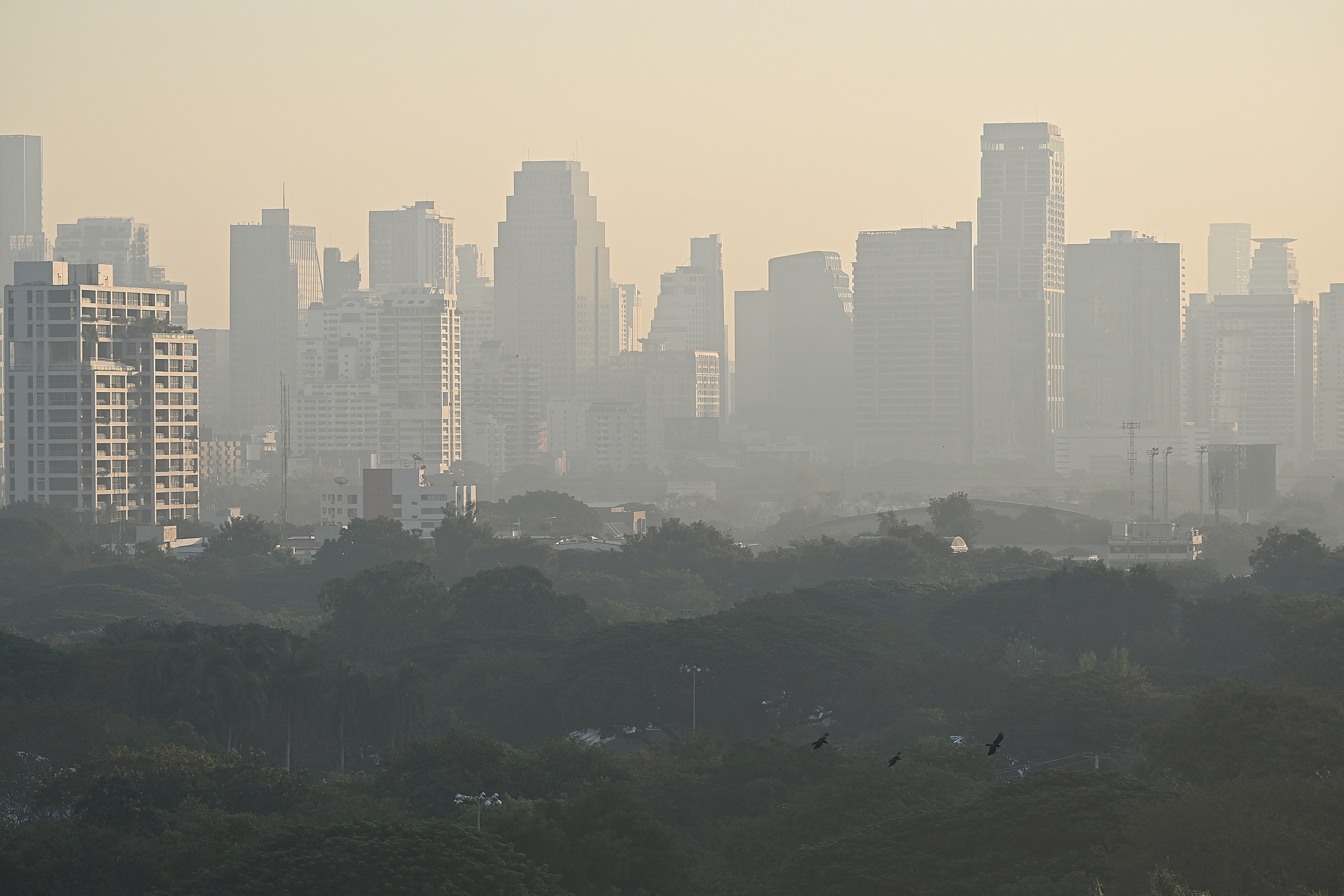 |
The sky was hazy with dust in Bangkok, Thailand, on the morning of 2/12. Photo: AFP |
Bangkok authorities anticipate the fine dust situation will persist until 3/12. They advise residents to wear face masks when outdoors, and individuals with underlying health conditions should remain indoors and suspend outdoor activities.
Some southern and northern Thai provinces, including Phuket, Krabi, Mae Hong Son, Chiang Mai, and Phatthalung, reported better air quality, with levels between 20-24,9 µg/m3.
Deputy government spokesperson Lalida Persvivatana stated that fine dust levels are expected to increase due to a high-pressure system from China weakening winds. Furthermore, extensive stubble burning in central and northeastern regions is contributing to the smoke and dust drifting into the capital.
Some "orange zone" areas may experience more severe pollution if weather conditions do not improve. Thai officials hope that air quality will improve with a change in wind direction and increased atmospheric circulation.
By Thanh Danh (Source: Nation, Bangkok Post)