The Iran-Iraq War, which erupted in 1980, ignited the "Tanker War," as Tehran targeted neutral oil tankers, particularly those from Kuwait, which were transporting oil for Iraq through the Strait of Hormuz.
This incident spurred Middle Eastern oil-exporting nations to seek ways to mitigate risks associated with the Strait of Hormuz. They implemented pipeline systems, sought alternative transport routes, and planned large-scale canal projects to reduce their reliance on this strategic chokepoint.
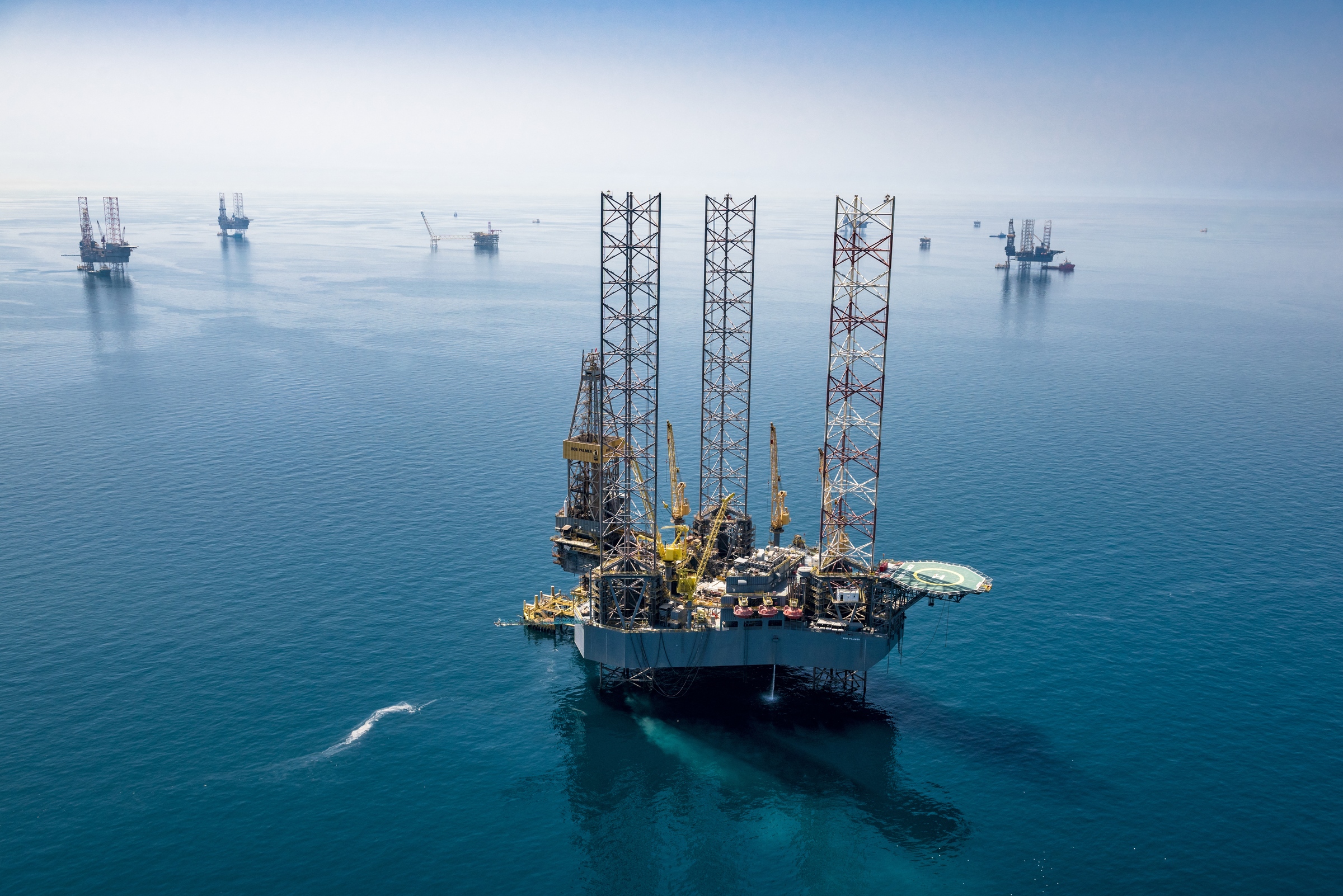 |
An oil rig belonging to state-owned oil company Aramco in an offshore field in Eastern province, Saudi Arabia, 5/2020. Photo: AFP |
Building pipelines
In 1981, Saudi Arabia began constructing the 1,200 km East-West Crude Oil Pipeline (Petroline) across the nation. Petroline consists of two pipelines, 1,2 m and 1,4 m in diameter, connecting the Abqaiq refining complexes in Eastern province to the Yanbu export gateway on the Red Sea.
Petroline initially had a capacity of 5 million barrels per day (bpd). By 2019, after Houthi groups in Yemen attacked oil refining facilities in Abqaiq with unmanned aerial vehicles (UAVs), Saudi Arabia converted parallel natural gas pipelines along Petroline into oil pipelines, increasing emergency capacity to 7 million bpd.
Records show Saudi Arabia built Petroline as a "pressure relief valve," not to fully replace oil transport via Hormuz. The reason was that building a pipeline system to completely replace tankers through the Strait of Hormuz was not economically efficient. Saudi Arabia also believed then that the risk of a complete disruption to oil and gas flows through the Strait of Hormuz would "never materialize."
The United Arab Emirates (UAE) had similar calculations. The country built the 380 km Abu Dhabi Crude Oil Pipeline (ADCOP), also known as the Habshan - Fujairah pipeline, connecting the inland Habshan oil field to Fujairah port on the Gulf of Oman.
ADCOP cost 4,2 billion USD and began operations in 6/2012, with a nominal capacity of 1,5 million bpd, equivalent to 60% of UAE's oil exports. This meant that 40% of UAE's remaining oil exports still had to pass through Hormuz.
Both Saudi Arabia and UAE based their arguments on the premise that Iran, located on the northern shore of the strait, also had an interest in keeping Hormuz open, as they too exported oil via this route. They also believed that in any scenario of the strait being closed, this situation would only last for a few days, at worst a few weeks. The global market could absorb short-term disruptions by drawing oil from strategic reserves.
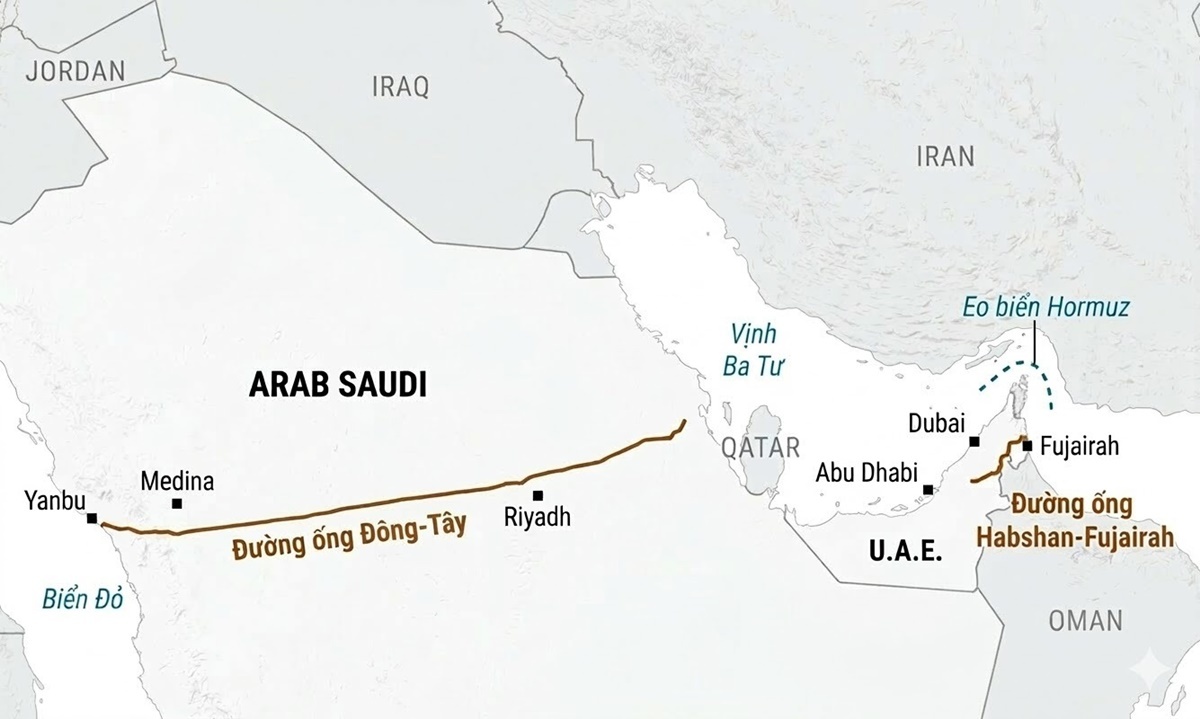 |
Location of the East-West pipeline and the Habshan-Fujairah pipeline. Graphic: WSJ |
However, analysts argue this reasoning only holds if parties act purely on economic logic. Geopolitical realities have shown the opposite, as countries can accept economic losses to achieve larger strategic goals, a fact Iran is clearly demonstrating.
After being attacked by the US and Israel on 28/2, resulting in the deaths of many political and military leaders, Iran announced a blockade of Hormuz in retaliation, attacking cargo ships linked to Washington and Tel Aviv passing through the waters to exert counter-pressure. The limitations in Saudi Arabia's and UAE's calculations quickly became apparent.
Petroline can transport up to 7 million bpd, but the two terminals in Yanbu have a combined processing capacity of only about 4,5 million bpd, according to Argus Media. Energy consulting firm Vortexa estimates that in wartime conditions, Yanbu port could only handle about 3 million bpd.
Naveen Das, an oil analyst at the vessel tracking organization Kpler, stated on 12/3 that ADCOP was operating at only 71% of its design capacity, indicating limitations in reception infrastructure at Fujairah port.
Another factor undermining old calculations is the change in warfare methods. Attacking large-scale energy infrastructure previously required significant resources and was difficult to sustain. With the development of inexpensive UAVs, attacks can now be carried out at low cost with substantial effectiveness.
Beyond threatening oil tankers passing through Hormuz, Iran has also targeted the energy infrastructure of neighboring countries, retaliating against US-Israeli attacks on Tehran's oil depots. Iran's targets are critical points in the bypass systems built by Gulf countries, such as ports and storage facilities, thereby neutralizing their entire oil transport network.
To date, Iran has launched UAV attacks on Duqm port, Salalah port in Oman, Fujairah oil port, UAE's Ruwais refinery on the Persian Gulf, and similar targets in Saudi Arabia, Bahrain, Kuwait, and Qatar.
"Iran is responding swiftly and broadly, targeting shipping as well as energy infrastructure, seaports, and the regional economy, severing a critical artery of the global supply chain," commented Torbjorn Soltvedt, a Middle East expert at the consulting firm Verisk Maplecroft.
A further flaw in Saudi Arabia's and UAE's land pipeline approach is that they were built only to transport crude oil, not all energy products circulating through Hormuz, such as diesel, jet fuel, and naphtha.
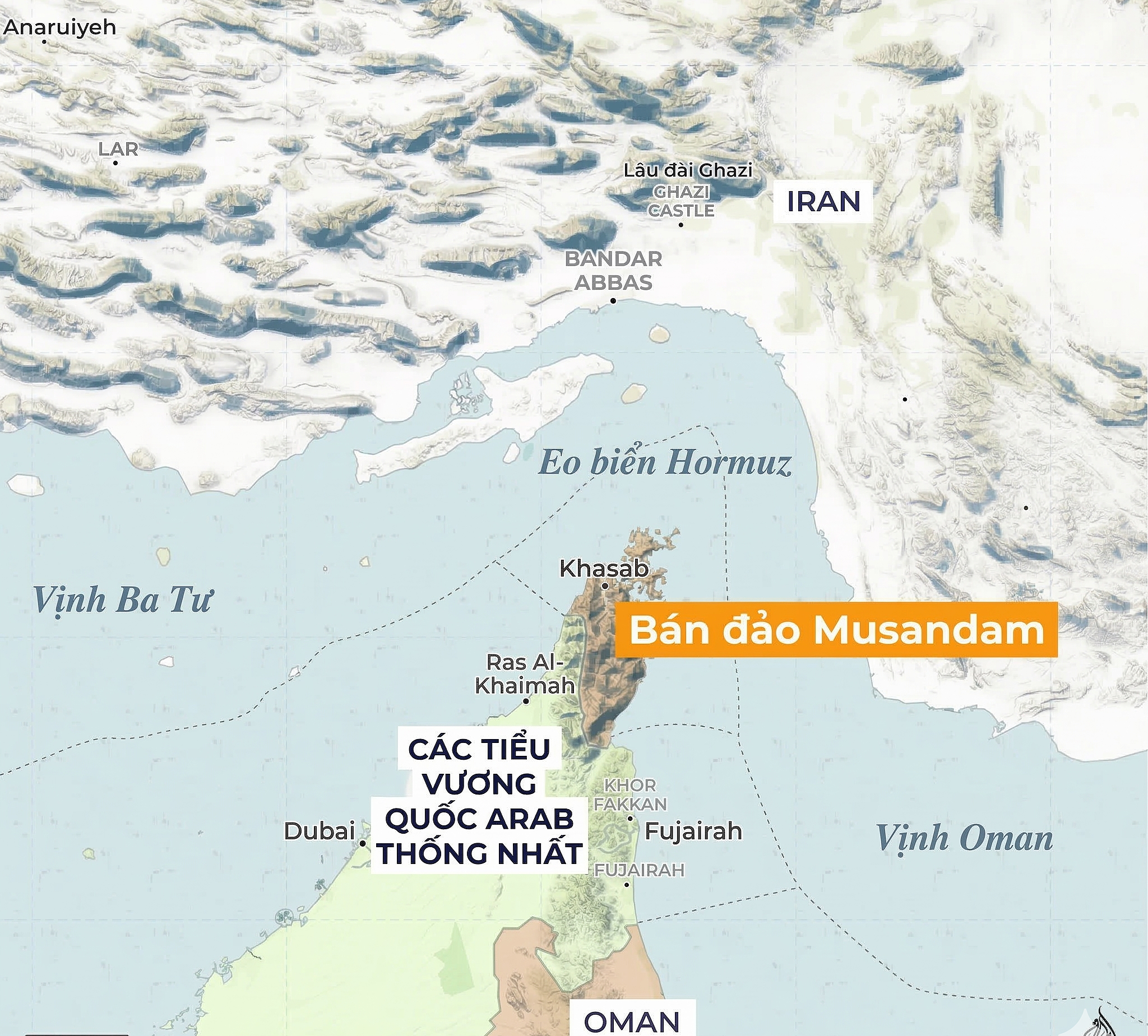 |
Location of the Musandam peninsula and the Strait of Hormuz. Graphic: Al Jazeera |
According to Arne Lohmann Rasmussen, head of analysis at Global Risk Management, about 30% of Europe's diesel imports and half of its jet fuel imports come from the Middle East.
"This is essentially a refined product crisis, a jet fuel and diesel crisis, particularly in Europe," Rasmussen told Middle East Eye.
Ellen Wald, founder of Transversal Consulting, pointed out another dilemma for Saudi Arabia.
"If the East-West pipeline were to carry all crude oil exports, it would not be able to transport natural gas or other petrochemical products," Wald said. In other words, this "pressure relief valve" pipeline now forces operators to choose between a crude oil crisis or a crisis in other commodities.
Digging alternative canals
The current crisis shows that Gulf countries find it difficult to fully escape dependence on the Strait of Hormuz. To achieve this, they would need to build many large pipelines like Petroline and entirely new export ports, things that cannot be developed overnight.
Besides Petroline and ADCOP, the Gulf region also has another pipeline connecting Kirkuk, Iraq, to Turkey's Ceyhan port on the Mediterranean Sea, with a potential capacity of up to 1,6 million bpd. Iraqi Deputy Prime Minister Hayyan Abdul Ghani Al-Sawad stated on 16/3 that the pipeline was in its final testing phase and was expected to transfer 250,000 bpd to Ceyhan within one week.
However, the total current capacity of such oil pipelines from the Gulf region is only about 3,5-5,5 million bpd, much lower than the 15-17 million bpd transported through the Strait of Hormuz before the conflict, a gap too large to fill in the short term.
Indian billionaire and leading industrialist Harsh Goenka proposed another bold option: Gulf countries would transfer oil from ships to Oman ports before reaching the Strait of Hormuz. This oil would then be transported by tanker trucks across Oman and pumped back onto other ships on the Arab coast. From there, the oil could be safely transported across the Indian Ocean.
This was also an approach the UAE studied in 2008. But unlike Goenka, the country then planned to build a 200 billion USD super-canal to allow oil tankers to "shortcut" through the Strait of Hormuz to the Arabian Sea.
Some even proposed building a canal approximately 48-80 km long through Oman's Musandam peninsula to "shortcut" the Strait of Hormuz.
However, such ideas face skepticism due to terrain and cost factors. To dig a canal through the Musandam peninsula, construction teams would have to find a way to conquer the Hajar mountain range's peaks, which are over 2,000 m high and feature rugged, rocky terrain.
This could make the "super project" cost up to 50 billion USD and take 10-20 years to build, an option considered unfeasible at this time. This is why the UAE has not mentioned the project in the past 20 years.
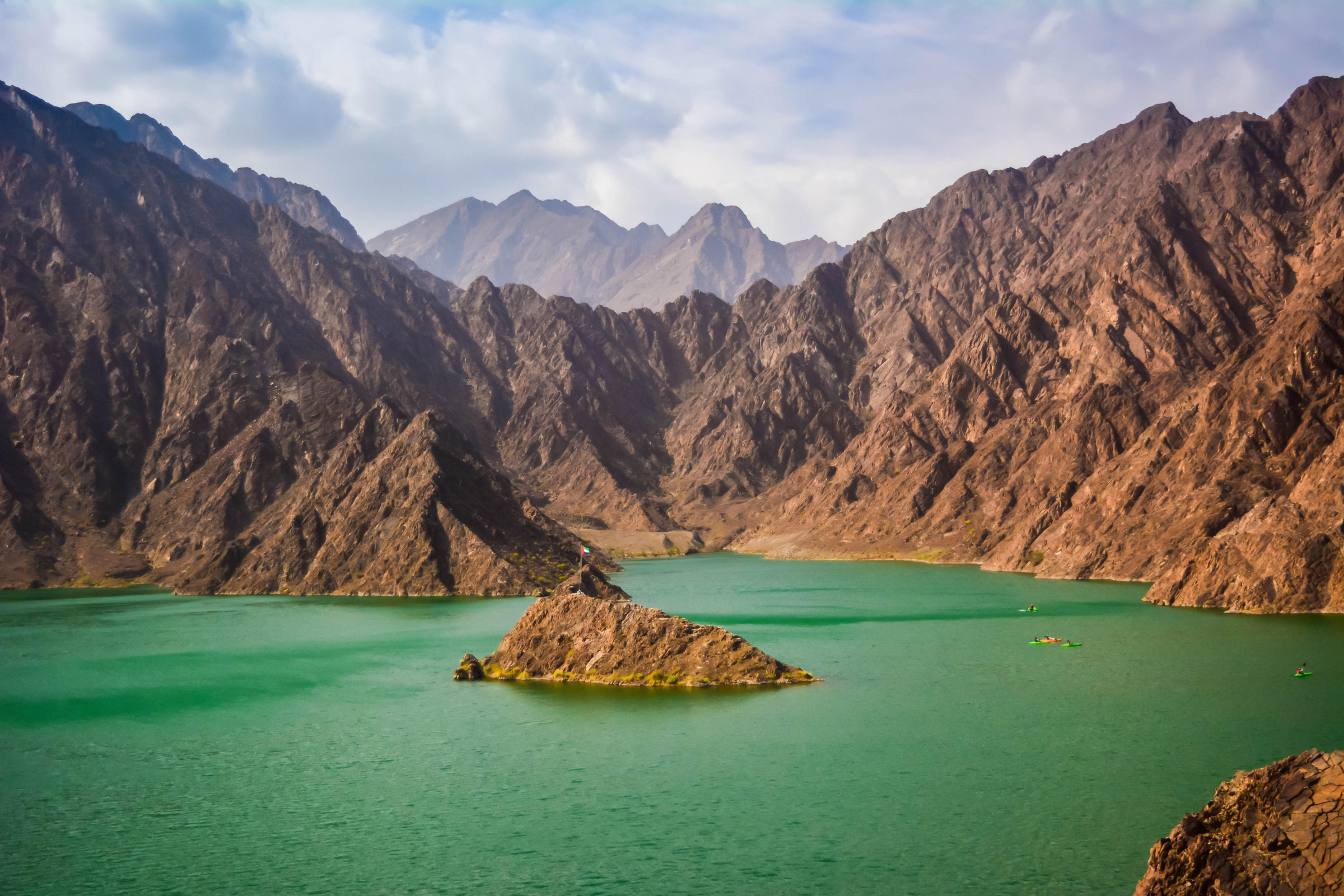 |
The Hajar mountains of UAE. Photo: Moccae |
"Many studies have been conducted, but nothing is certain," a senior UAE official said.
Therefore, as the conflict with Iran lengthens, the US is considering military options to keep the strait open, such as escorting ships or providing insurance support for carriers, as they did during the Iran-Iraq War. However, the current situation is far more complex, and effectiveness is no longer as certain as before.
By Nhu Tam (Based on ENR, Firstpost, The Times)