Amidst scorching summer heatwaves, Ms. Vuong, a resident in the heart of Xuzhou city, Jiangsu province, stated that her home's temperature consistently stays below 26 degrees Celsius, even without using air conditioning.
This natural coolness comes from the Ngoa Long Son coal mine, which is no longer operational. Despite its closure, water accumulated in the mining tunnels maintains a temperature of about 19 degrees Celsius year-round, serving as a natural coolant.
How Chinese cities are cooling down without air conditioning. Video: CGTN
To utilize this resource, a local enterprise pipes water from the coal mine to heat exchange stations in residential areas. There, they repurpose the existing network of pipes used for winter heating to circulate cold water, around 20 degrees Celsius, throughout apartments during summer.
After absorbing room heat, the mine water is pumped back underground via a closed-loop process, consuming no water resources and using no chemical refrigerants.
This pilot model saves about 50% energy consumption and reduces 50 tons of CO2 emissions annually for nearly 100 households. Economically, Ms. Vuong and her husband previously spent approximately 400 Chinese yuan (55 USD) each month on air conditioning electricity, but now spend only 410 Chinese yuan for the entire four-month cooling season.
Professor Lin Boqiang, Dean of the Energy Policy Research Institute at Xiamen University, noted that leveraging resources like those in Xuzhou helps conserve energy and reduce emissions.
"However, this is a very small-scale case because it depends on special conditions that most places do not have", he observed.
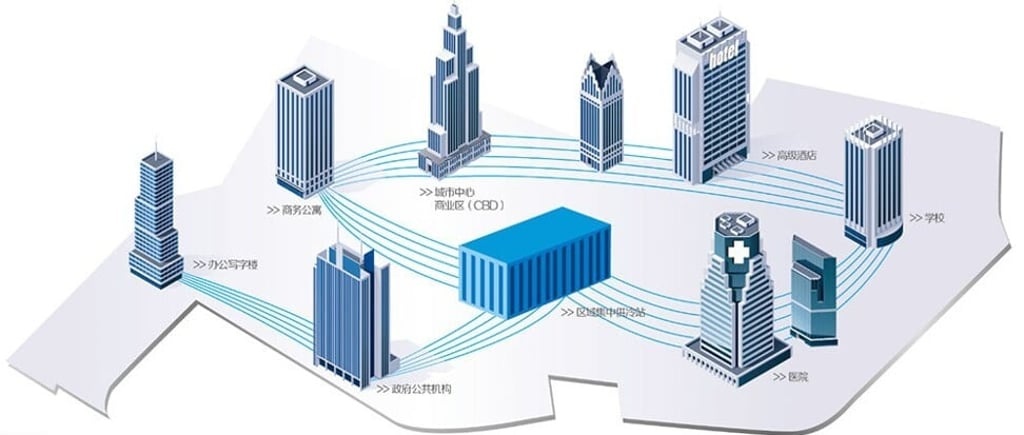 |
Centralized cooling station model in Shenzhen, with the operational plant in the middle, surrounded by office and commercial high-rises. Photo: SCMP
The story in Xuzhou is just one part of a broader trend of rethinking urban infrastructure across China.
To cope with record heatwaves without overloading the power grid, many cities are adopting "district cooling" models. Under this approach, cold water is produced at centralized energy stations and then distributed through underground pipes to numerous buildings, rather than each building installing its own cooling units.
In the Qianhai Free Trade Zone in Shenzhen city, Asia's largest centralized cooling station provides services for 2,75 million square meters of building space. The system distributes cooling capacity in the form of chilled water or other mediums from a central source to multiple buildings via an underground pipe network.
"It is like an industrial chilled water plant used for air conditioning", Pho Kien Binh, director of Qianhai Energy Company, explained in 2024.
"Centralized cooling systems reduce the amount of machinery by 20% compared to installing individual cooling units. Fewer machines mean less refrigerant gas is used. That is a way to reduce emissions", he stated.
When the entire network of 10 stations is completed, the project is estimated to save 130 million kWh of electricity and reduce 130,000 tons of CO2 emissions annually.
Similarly, Guangzhou city is also constructing 8 centralized energy stations to serve an 8 km2 area.
In addition to distributing chilled water, some cities are also implementing "ice thermal storage" technology. This technology freezes water at night when electricity prices are low and demand is minimal, then releases this coolness during peak daytime hours to alleviate pressure on the power grid. Some locations, like Beijing, opt for ground-source heat pump systems, utilizing the stable temperature of the earth to regulate air conditioning year-round.
The entire centralized cooling system is coordinated by smart energy management platforms. By analyzing real-time data on weather and population density, the system automatically determines the appropriate time and volume for cooling distribution.
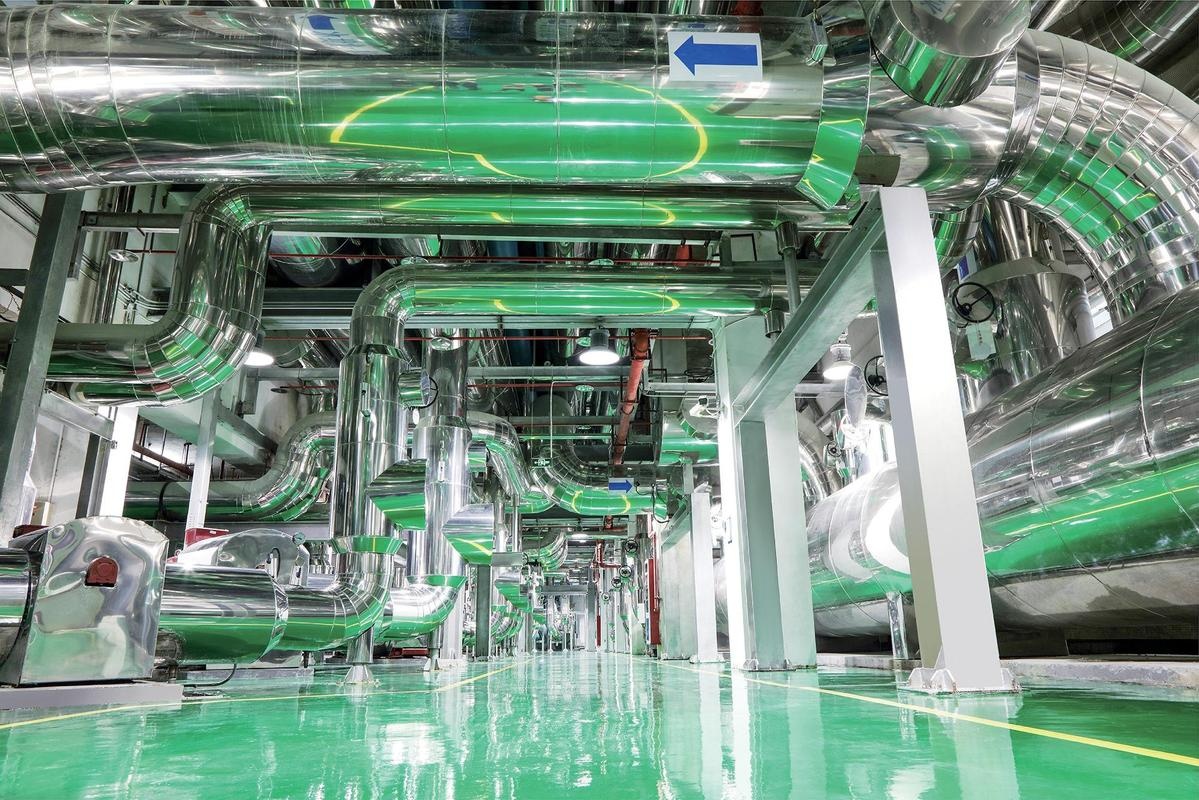 |
System of cooling station number two in Shenzhen city. Photo: China Daily
This shift marks a significant change in China's urban development philosophy. Cooling is no longer just about turning on a personal air conditioner; it is being integrated directly into city planning as essential infrastructure, similar to power, water supply, or public transportation systems.
By Hong Hanh (Source: CGTN, Global Times, SCMP)