On 21/3, Iranian missiles struck Dimona, a town in Israel, injuring 33 people. Among the wounded was a 10-year-old boy, seriously injured by shrapnel, according to Israel's military.
Karmel Cohen, a medical responder at the scene, described devastation and chaos in Dimona following the missile strike.
Israeli media shared images showing an object rapidly descending from the night sky. Despite an air defense missile launch from the ground, the target was not intercepted. The Iranian missile crashed into the town, creating a large fireball.
Moment missile crashed into Dimona town, Israel, on 21/3 evening. Video: BRICS News.
Israel's military reported "interception efforts" after detecting the missile, but their air defense missile missed its target. Earlier, Israeli air defense also failed to intercept an Iranian missile aimed at Arad town.
Israeli Prime Minister Benjamin Netanyahu called the attacks on Dimona and Arad, which injured 75 people, "a very difficult evening." He vowed Israel would continue striking Iran.
Iran's state television confirmed the Dimona attack was a direct response to a prior strike on Iran's Natanz nuclear facility.
Earlier, Iran's atomic energy organization accused the US and Israel of attacking the Natanz uranium enrichment complex. However, it noted "no radioactive material leakage was recorded."
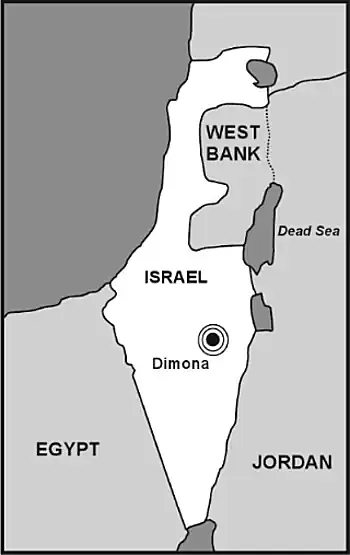 |
Location of Dimona town in Israel. Graphic: Matthewreilly.
Following the Natanz attack, Rafael Grossi, Director General of the International Atomic Energy Agency, urged all parties to "restrain military actions to avoid any risk of a nuclear incident."
Dimona is widely believed to be the Middle East's only nuclear weapons storage site, though Israel has never officially acknowledged possessing such weapons. The Natanz facility, conversely, houses underground centrifuges for Iran's nuclear program and sustained damage during a 12-day conflict in 6/2025.
Israel's military stated they "were unaware of the attack" on Natanz.
Three weeks of intense bombing campaigns by the US and Israel have not diminished Iran's capacity for missile and drone retaliation across the region. On 21/3, the United Arab Emirates reported facing airstrikes after Iran warned Abu Dhabi against allowing its territory to be used for attacks on islands near the Strait of Hormuz.
On 21/3, G7 foreign ministers and European Union foreign policy officials issued a joint statement. They called on Iran to "immediately and unconditionally" cease attacks on their Middle Eastern allies and expressed "support for our partners in the region against the unjustified attacks by Iran and its proxy forces."
The conflict between Israel, the US, and Iran is now entering its fourth week with no signs of de-escalation. Instead, it is intensifying with strikes targeting energy infrastructure and nuclear facilities, raising significant concerns about a larger regional crisis.