After three weeks of fighting, the conflict between the US, Israel, and Iran collapsed the fragile balance among Gulf oil powers. The conflict quickly went beyond military scope, as Iran's energy infrastructure and US allies' became targets in retaliatory attacks.
For the first time in decades, Iran blockaded the Hormuz Strait, a route for about 20% of global crude oil and liquefied natural gas (LNG) supply. This move stranded oil and LNG tankers, causing tension in insurance and shipping markets, and sending energy prices soaring.
Analysts likened this move to a cut into one of the "global economic arteries", leaving an indelible scar for both the Middle East and the world energy market. It will reshape trade flows, investment decisions, and risk calculations for many years to come.
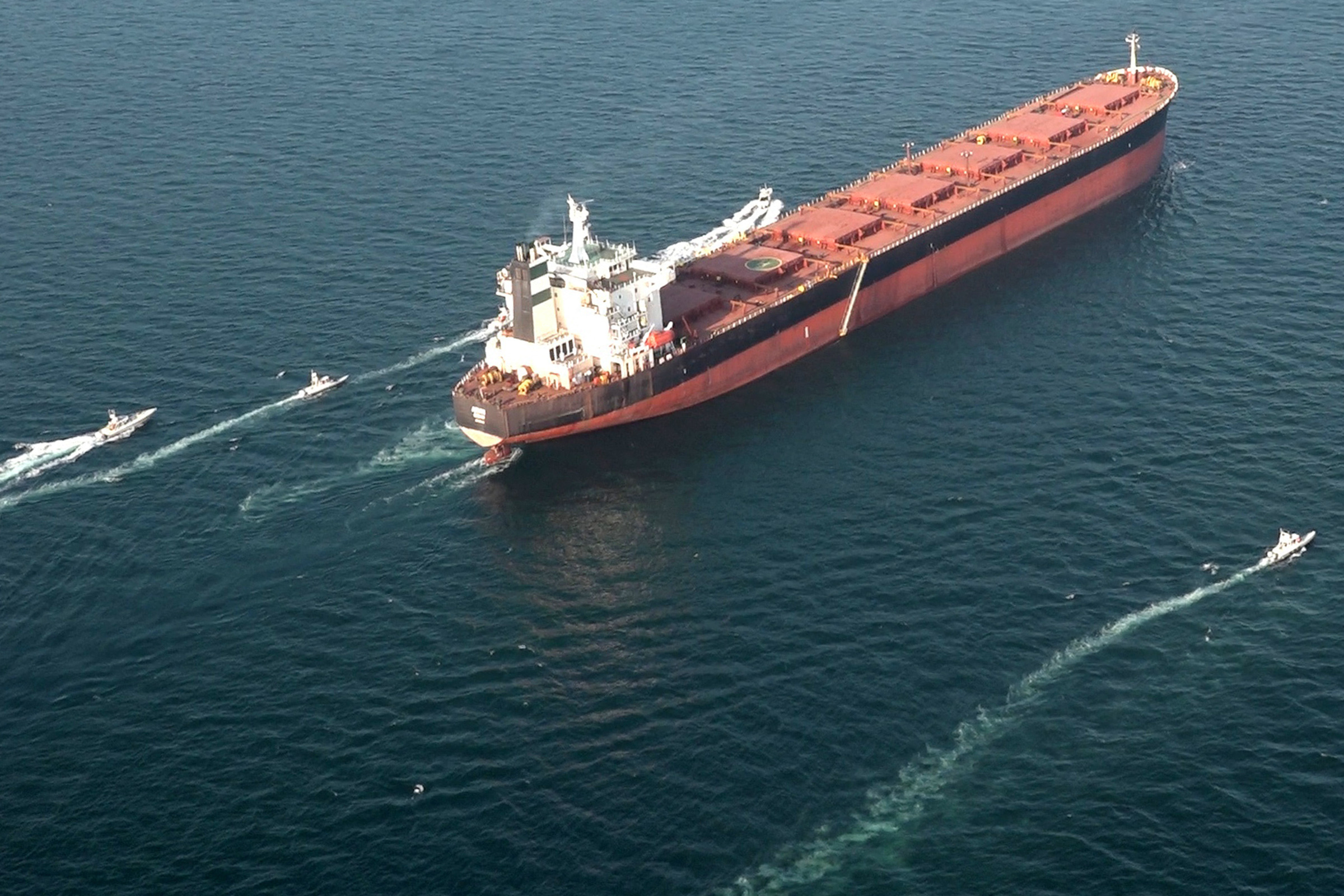 |
Cac xuong IRGC di chuyen quanh mot tau cho dau trong cuoc dien tap tren eo bien Hormuz ngay 17/2. Anh: AFP
Hormuz's lingering effects
Iran warned that shipping activity through Hormuz would not return to pre-conflict levels, and even if a ceasefire occurred, trust could not be restored overnight. An international protection mechanism for vessels passing through the Hormuz Strait will likely remain necessary long after the conflict ends.
Meanwhile, the US has so far been unable to establish a naval coalition to escort oil tankers through Hormuz, highlighting the political and logistical complexity of ensuring safety for this critical "bottleneck".
The US and Israel both claimed to have significantly degraded Iran's military power, but Tehran can still disrupt the Hormuz Strait without modern weapons. Asymmetric, low-cost measures, such as: naval mines, unmanned aerial vehicles (UAVs), or unmanned surface vehicles (USVs), are enough to force cargo ships to divert or slow down.
"Iran has built a large quantity of anti-access/area denial systems over the past several decades", said Michael Eisenstadt, director of military and security studies at The Washington Institute for Near East Policy, listing examples such as: anti-ship cruise missiles, naval mines, submarines, air defense missiles, and UAVs.
Shipowners and insurance companies will be more cautious about the Gulf, even if Hormuz reopens, due to the risk of their cargo ships being attacked by Iran at any time, driving up related costs.
Restoring confidence will take time, as clearly demonstrated by the Red Sea shipping route. Houthi forces in Yemen began attacking vessels linked to the US and Israel through these waters in 11/2023 to show support for Palestinians in the Gaza conflict. These attacks stopped in 10/2025, but ship traffic there only reached about 60% of its previous level.
When a route is considered dangerous, its psychological "scar" will last longer than the sound of gunfire, commented Ron Bousso, a Reuters columnist.
The indelible scar
The war will leave profound and lasting consequences for the Middle East's oil and gas industry. For decades, the region's energy powers largely avoided direct military confrontation, subtly competing while maintaining oil and gas flows.
Tensions between Saudi Arabia and Iran primarily played out through proxy wars in Yemen and Libya. The most serious case occurred in 2019, when Houthi forces launched missiles and UAVs at Saudi Arabian energy infrastructure, temporarily halving the country's oil production.
The Organization of the Petroleum Exporting Countries (OPEC), comprising mostly Gulf members, has repeatedly overcome regional tensions, such as the 1990-1991 Gulf War or the 2003-2011 Iraq War, without prolonged export disruptions.
But this war between the US, Israel, and Iran has completely overturned these existing calculations. Gulf producers will likely have to re-evaluate operations and accelerate efforts to reduce dependence on the Hormuz Strait.
During the Iran-Iraq War from 1980-1988, when many oil tankers were sunk in the Gulf, Saudi Arabia built a large-scale east-west pipeline, connecting oil refining complexes in the east to the Yanbu export gateway on the Red Sea coast.
Oil exports from Yanbu are on track to reach record highs in March and are likely to remain so in the long term. This creates a structural shift in regional trade flows.
Other producers will also seek to diversify export routes. Iraq could push to expand the capacity of its northern pipeline from Kirkuk to Turkey's Ceyhan port on the Mediterranean, while the United Arab Emirates (UAE) could increase capacity for its Fujairah oil terminal in the Gulf of Oman. These projects are costly and politically complex, but the war has shown that the cost of inaction is even higher.
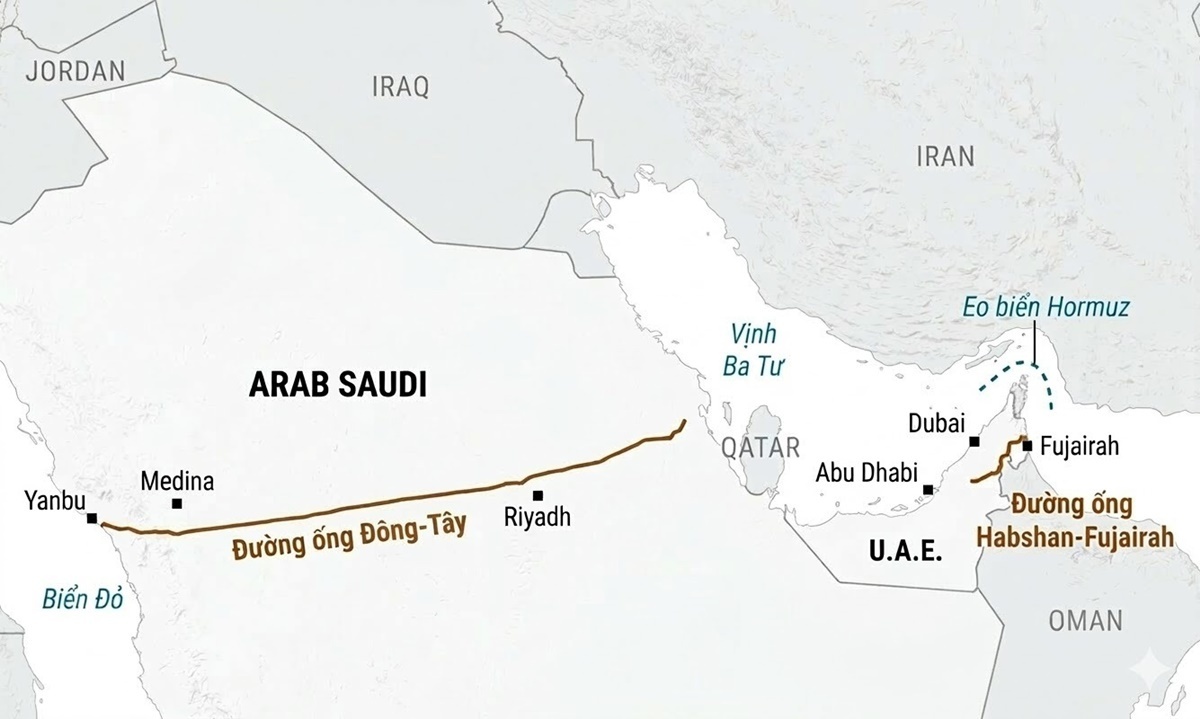 |
Vi tri duong ong Dong - Tay va duong ong Habshan-Fujairah. Do hoa: WSJ
Importing countries must also adjust strategies, seeking alternative supplies, even if it means higher transport costs and lower efficiency. Strategic stockpiling, diversification, and building backup plans, once seen as expensive insurance, are now essential requirements.
"The key thing when it comes to the Hormuz Strait is there really isn't another way out for this scale of energy flow", Joel Hancock, an energy expert at Natixis CIB, told TIME. "The Hormuz Strait is a true 'bottleneck' because you almost have no alternative export routes".
By Nhu Tam (According to Reuters, AFP, TIME)