At a dock in Bandar Abbas, Mohammad Torabian now has almost no work. Before the conflict between the US, Israel, and Iran erupted in late February, up to 50 trucks carrying food and meat arrived daily to unload goods, providing livelihoods for around 500 people in the area.
"Business is very bad now. There is no work here anymore," Torabian told AP.
This bleak situation illustrates the pressure from US sanctions on Bandar Abbas, a crucial trade gateway in southern Iran. As maritime activity declines, the impacts are becoming evident across various sectors of the city's economy.
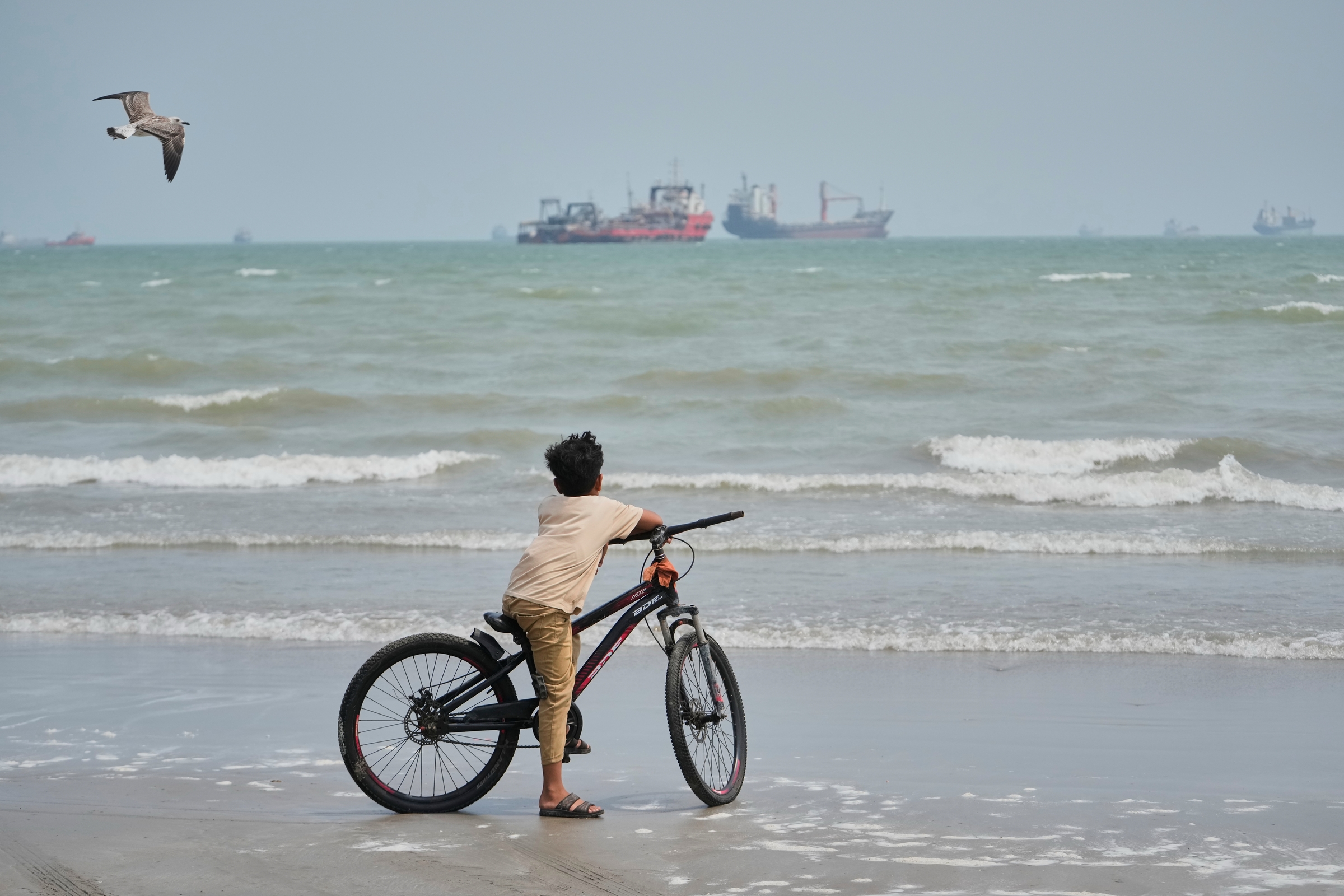 |
A boy stops his bicycle on the beach in Bandar Abbas, Iran on 7/9. Photo: AP
The US reimposed a naval blockade on Iran-related shipping in mid-July, following the collapse of negotiations between Washington and Tehran. This measure focuses on preventing vessels carrying Iranian goods and oil from passing through strategic shipping lanes.
In late August, the US continued its "economic strangulation" campaign against Iran, while warning of consequences for countries that did not support Washington's efforts. This followed a series of sanctions imposed by the US and its allies since 2018.
The impact of these blockade measures is clear from satellite images of Iran's two major ports: Shahid Rajaee and Imam Khomeini, according to Iran International.
Shahid Rajaee, located near Bandar Abbas, is Iran's largest container port, handling 85-90% of the country's container traffic and 55% of its total import and export goods. The port has a capacity of approximately 100 million tons of cargo annually, according to data released by the Iranian news agency IRNA in July.
Pre-conflict satellite images showed numerous ships concentrated at the berths and dense loading and unloading activities. Subsequent images revealed a significant reduction in the number of vessels, with many loading and unloading areas no longer operating as before.
A similar situation was recorded at Imam Khomeini port in southwestern Iran, the country's largest import gateway. Both the number of ships and the activity at the berths have decreased compared to previous levels.
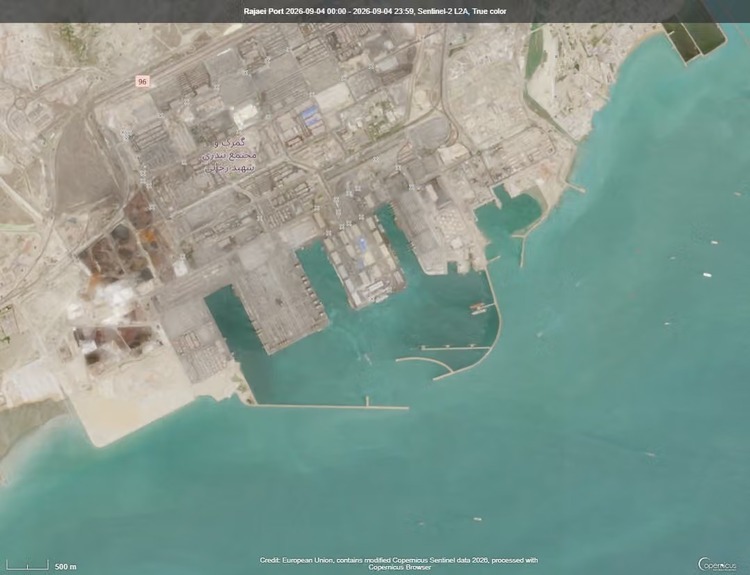 |
Satellite images of Shahid Rajaee port near Bandar Abbas on 2/1 and 4/9. Photo: Copernicus
According to data from the maritime platform Kpler, Iran previously exported about two million barrels of oil daily before the US blockade. By August, this figure had fallen to just 220,000-255,000 barrels per day, and these oil shipments remain trapped within the blockade zone.
The amount of Iranian oil already loaded onto ships outside the blockade area is also rapidly decreasing. Kpler reported that this volume was about 90 million barrels in mid-July but is now only around 29 million barrels and could be depleted by October.
This is particularly critical for Tehran because oil contributes about one-third of the state budget and is Iran's primary source of foreign currency. When oil cannot reach customers, the flow of foreign currency into the economy diminishes, while the economy still needs to maintain imports of goods and raw materials.
Alternative transportation routes are struggling to meet the volume of goods previously shipped by sea. According to Kpler, Iran can only transport a maximum of about 40,000 barrels of oil daily by truck. The railway system also lacks specialized wagons to transport large volumes of oil and petroleum products.
However, the blockade is not only choking outgoing oil shipments. Iran also relies heavily on its seaports for importing food, manufacturing raw materials, and consumer goods. The situation in Bandar Abbas demonstrates that this impact has spread to businesses providing services for trade activities.
Mahsa Shojaei, an employee at a customs clearance company in Bandar Abbas, stated that most of their previous work involved importing rice, tea, and coffee from India and Pakistan. Currently, the company's workload has decreased by 80-90%.
In stores across Bandar Abbas, purchasing power has also declined. Mehrdad Jahangiri, who sells children's clothing, reported that his store's sales have dropped by about 50% compared to the same period last year.
"There are no customers. The market is very bleak," Jahangiri said. He mentioned that his family has had to cut many expenses due to reduced income. Some other stores have had to lower prices or offer installment plans to regular customers.
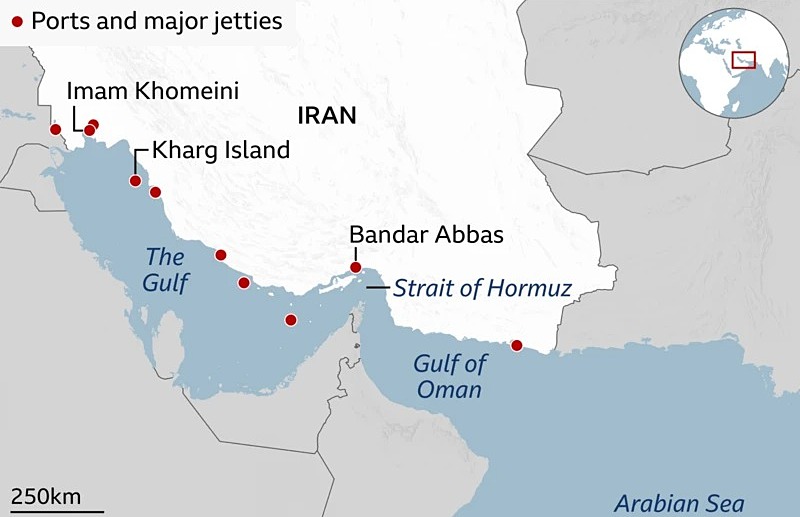 |
Location of Iranian ports and jetties in the Persian Gulf. Graphic: BBC
Iranian President Masoud Pezeshkian acknowledged that the economy is severely affected by US sanctions, proposing a gasoline price increase to offset deficits. Parliament Speaker Mohammad Bagher Ghalibaf stated on 6/9 that exchange rate fluctuations, inflation, unemployment, and market management are major challenges, urging the government to act swiftly to address economic difficulties.
Economy Minister Ali Madanizadeh announced that Tehran would respond to US economic pressure with reform measures, rejecting the view that sanctions could force Iran to change its policies. The Ministry of Economy also established an "economic war headquarters" to handle issues arising from the conflict.
Despite growing economic pressure, there are no clear signs that Tehran will alter its stance. Ellie Geranmayeh, an Iran expert at the European Council on Foreign Relations, believes the US campaign will significantly impact Iranian households.
"But if you say that pressure can make Iran surrender at the negotiating table, I don't believe it. What we have seen so far suggests that the Iranian government is likely to continue resisting," Geranmayeh told WSJ.