Sergey Chemezov, CEO of the Russian defense corporation Rostec, announced on 26 November that a new loitering munition has been developed, with its completion occurring last year. He stated, "A new type of loitering munition has been released. This unmanned aerial vehicle (UAV) is already in series production and engaged in combat. You will soon witness how quickly it is deployed."
Loitering munitions, also known as "suicide drones," are capable of circling over a designated area and only attacking once a specific target is identified.
According to Chemezov, the new UAV has a range of tens of kilometers and carries a warhead weighing several kilograms. It is designed to destroy HIMARS multiple rocket launcher systems, all types of NATO-standard howitzers, counter-battery radars, armored vehicles, and enemy command posts.
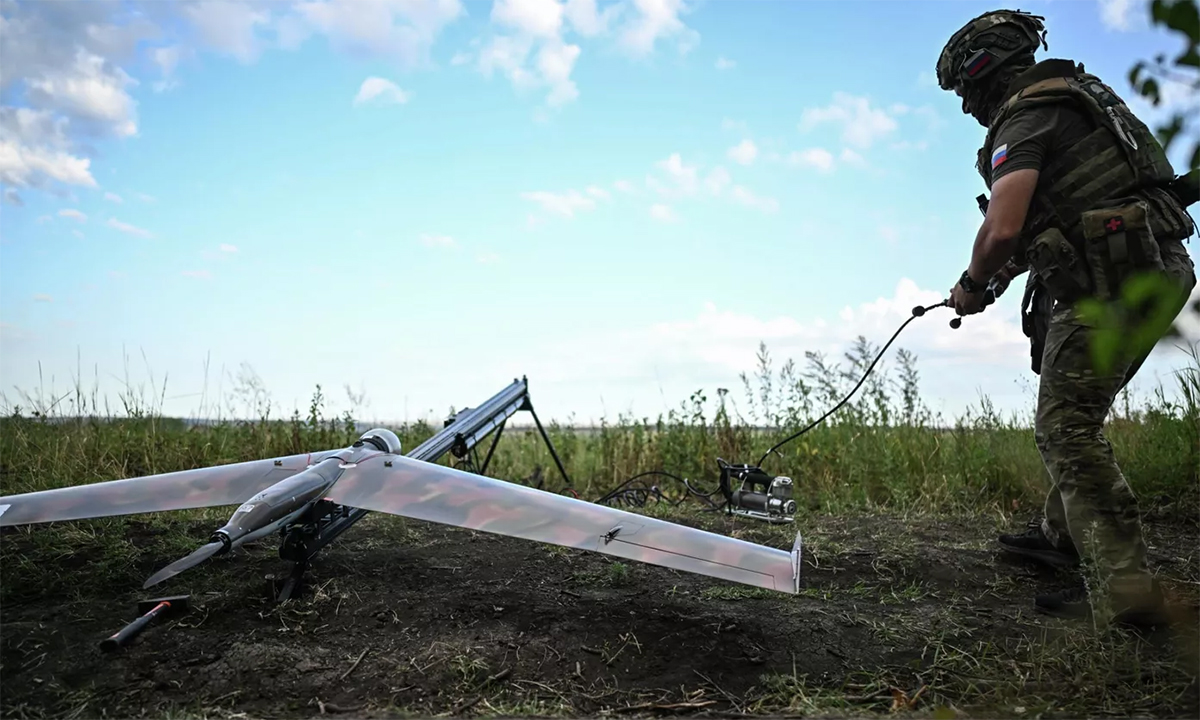 |
Russian personnel prepare a reconnaissance UAV for takeoff in Lugansk province on 11 August. _Russian Ministry of Defense_ |
Specific images and technical specifications of this UAV have not yet been released. Chemezov noted that Rostec is developing attack variants from existing reconnaissance UAVs.
A Rostec official pointed out that HIMARS multiple rocket launchers were once promoted as a "wonder weapon," but they did not alter the course of the conflict. He asserted that Pantsir air defense missile systems have neutralized many HIMARS volleys in real combat. Russia is also deploying a version of Pantsir carrying 48 missiles to counter large-scale UAV attacks.
HIMARS is a self-propelled multiple rocket launcher mounted on a wheeled chassis, capable of hitting targets up to 300 km away, depending on the munition and configuration. HIMARS launcher vehicles can reach a maximum speed of 85 km/h and quickly leave their firing positions to avoid counter-battery fire.
Western media reported in May 2024 that Ukraine possessed 39 HIMARS launcher vehicles. Of these, at least three systems were completely destroyed, and two were damaged and sent to the US for repair.
Since then, the Russian military has released many videos of striking Ukrainian HIMARS batteries using Iskander-M ballistic missiles, Lancet loitering munitions, and first-person view (FPV) drones. These strikes have resulted in the complete destruction of many systems. The number of combat-capable HIMARS systems remaining with the Ukrainian military is currently unknown.
Nguyen Tien (According to TASS, RIA Novosti, AP)