The Islamic Revolutionary Guard Corps (IRGC) on 20/3 released a video from an infrared sensor tracking an aircraft resembling an F-35 stealth fighter. Seconds later, a projectile struck and exploded, damaging the aircraft. The IRGC claimed the U.S. F-35 fighter jet was "hit and severely damaged," but did not disclose the weapon used.
CNN, citing two sources familiar with the matter, reported that the F-35 made an emergency landing at an airbase in the Middle East after being "hit by suspected Iranian fire."
Colonel Tim Hawkins, spokesperson for Central Command (CENTCOM), confirmed that a U.S. Air Force F-35A aircraft made an emergency landing while on a combat mission over Iran. "The aircraft landed safely and the pilot is in stable condition. The incident is under investigation," he stated, seemingly implying the F-35 pilot was injured.
U.S. military magazine Military Watch believes Iran used the Majid air defense system, also known as AD-08, to attack the U.S. F-35.
The Majid air defense weapon system is a product of the Defense Industries Organization under the Iranian Ministry of Defense. It first appeared at a parade on 18/4/2021 and participated in the "Velayat 1400 Sky Defender" exercise in October 2021.
The Belgium-based Army Recognition research group stated that Majid is a short-range air defense system, developed to intercept a wide range of targets such as unmanned aerial vehicles (UAVs), cruise missiles, helicopters, and low-flying fighter jets.
Majid uses an ARAS-2 tactical vehicle chassis, providing high mobility on the battlefield. Each combat vehicle is equipped with two launcher clusters, carrying up to 4 ready-to-fire missiles, mounted on a 360-degree rotating platform. A sophisticated electro-optical system for target detection and lock is positioned in the center.
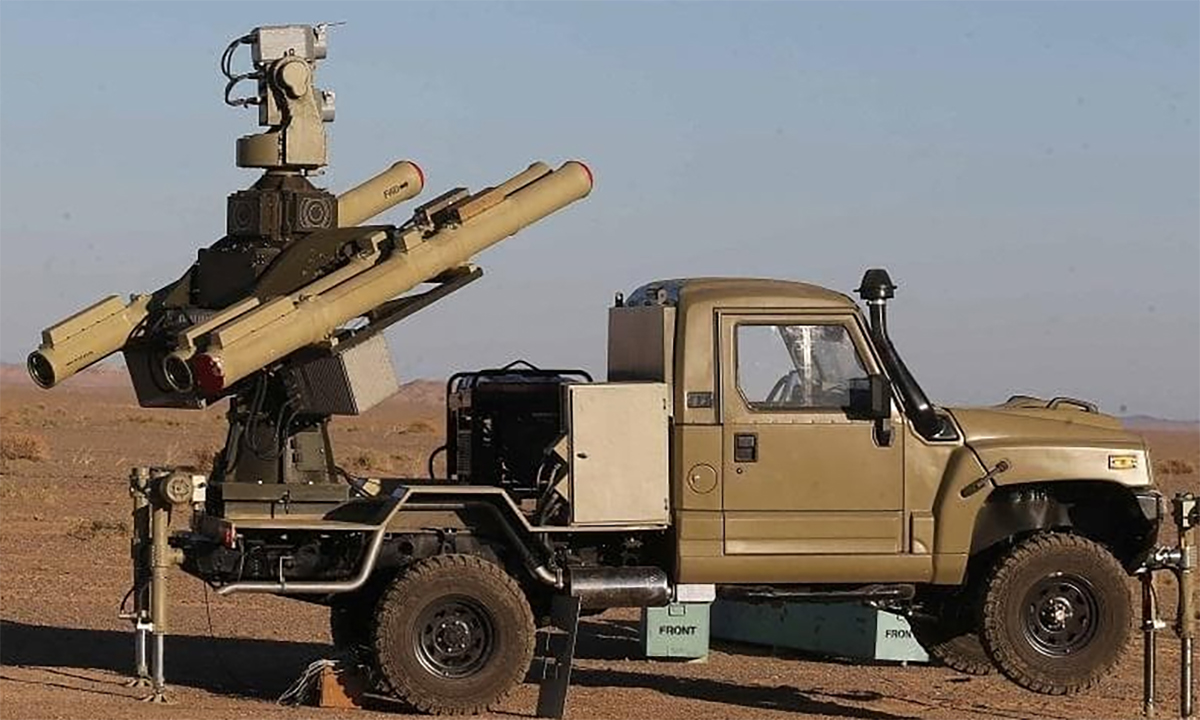 |
A Majid air defense missile launcher in an image released in November 2021. Photo: Iran Press |
"Majid's sensors can simultaneously track 4 flying objects at a maximum range of 15 km and an elevation angle of 0-12 degrees, providing parameters for the missiles. If combined with the Kashef-99 three-coordinate phased array radar, the target detection range can increase to 30 km," Army Recognition reported.
The system's missile is 2,6 m long, nearly 0,16 m in diameter, weighs 75 kg, and reaches a speed of about 2,470 km/h. It is equipped with a thermal imaging seeker, has a maximum range of 8 km, and can engage targets at an altitude of 6 km.
"Using a thermal imaging seeker, instead of radar, reduces Majid's combat range. However, it allows it to track aircraft that are stealthy against radar but not optimized for thermal signal suppression. The infrared tracking and guidance mechanism is also unaffected by enemy electronic warfare measures," Military Watch explained.
A thermal imaging seeker also does not emit radio signals like radar, thus not activating radar warning receivers on target aircraft and significantly limiting enemy pilot reaction time. This also enhances the system's stealth, avoiding the risk of anti-radiation missile strikes.
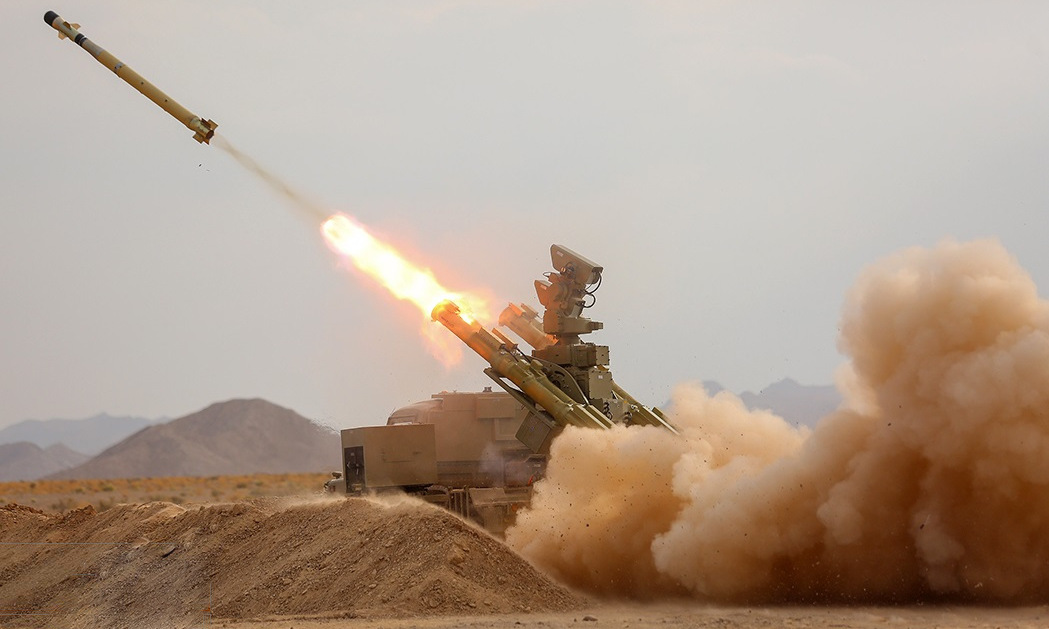 |
Iran's Majid system firing during an exercise in Isfahan province in 2023. Photo: Fars News |
In addition to the Majid system, the U.S. military news site also suggested the possibility that Iran used a man-portable air-defense system (MANPADS) to damage the F-35.
Iran is believed to have spent 580 million USD to purchase 500 launchers and 2,500 9M336 rounds of the Russian-made 9K333 Verba MANPADS system. The 9M336 has a range of 6,5 km and a ceiling of 4,5 km, which is lower than that of Majid.
The advantage of the Verba is that its missile uses a multi-spectral optical seeker, with three separate sensors to detect ultraviolet, near-infrared, and mid-infrared signals. This helps the Verba missile distinguish targets from countermeasures more effectively, while limiting the effectiveness of counter-measures such as infrared lights and laser emitters.
The U.S. and Israel have not lost manned fighter jets over Iranian airspace, but Iranian air defense units have shot down at least 11 U.S. MQ-9 Reaper armed UAVs and an unspecified number of Hermes 900 aircraft, one of the most modern UAV types in Israel's inventory.
Thomas Newdick and Howard Altman, editors for the U.S. military specialized website War Zone, pointed out that Iranian air defense systems can be easily camouflaged and continue to pose a significant threat. Meanwhile, the F-35 faces increasing risks, especially when performing direct attack missions and operating deeper within Iranian airspace.
"Despite suppression efforts by the U.S. and Israel, Iran still possesses mobile air defense systems, and these systems can appear anywhere, giving pilots very little time to react," the two U.S. experts stated.
Nguyen Tien (According to Army Recognition, Military Watch, AP)