More than a week after the catastrophic flash floods, triggered by an ice avalanche in the Himalayas, ravaged the border region between Nepal and China, authorities in both countries are still searching for and identifying victims. According to the latest statistics, the flash floods have left over 1,270 people dead and more than 4,700 missing.
As rescue and recovery efforts continue following the disaster, many questions are being raised about Nepal's early warning and disaster prevention systems.
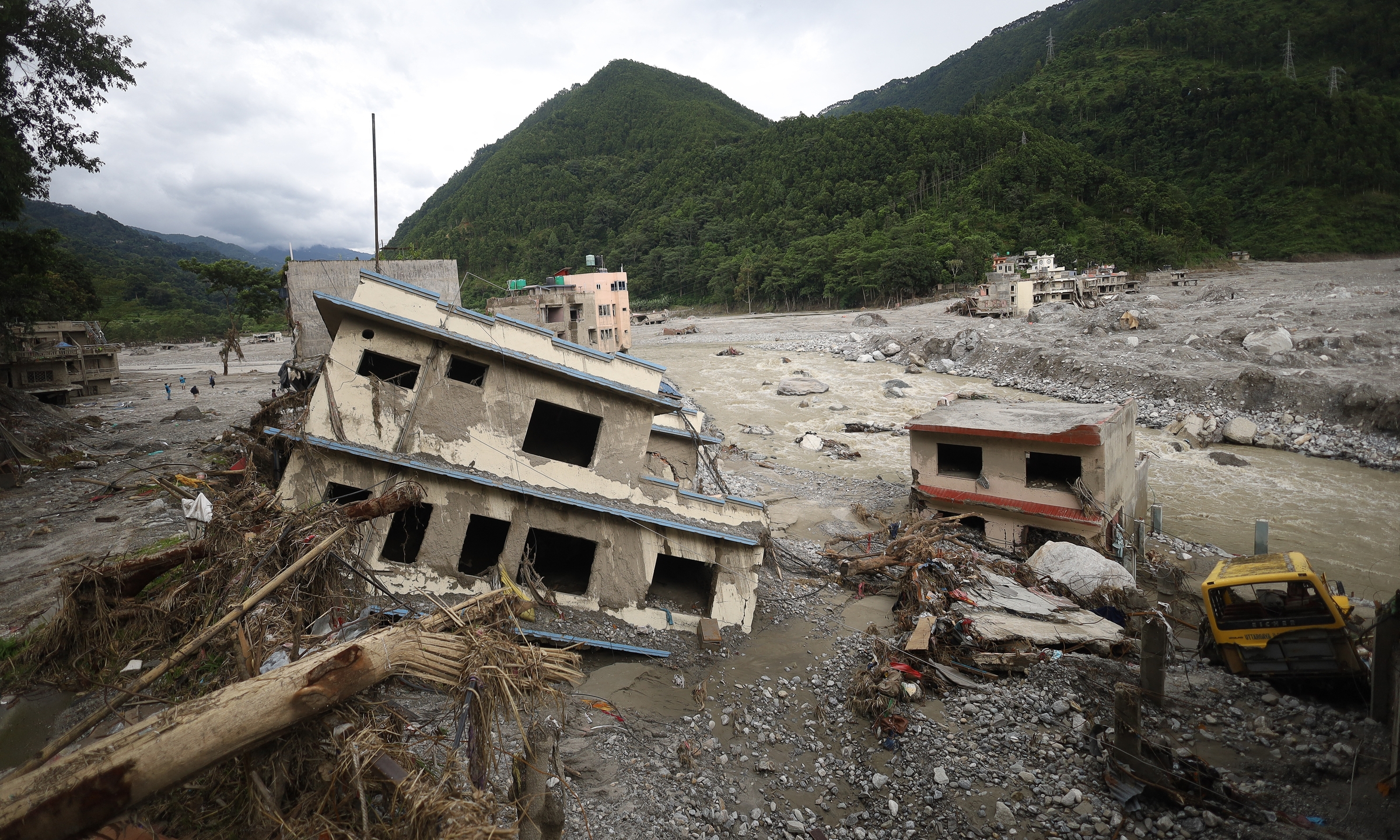 |
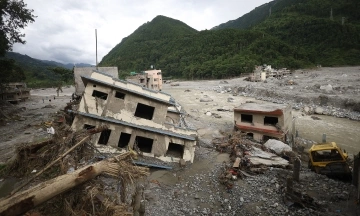
Houses lie exposed along the Trishuli River in Nuwakot district, Nepal, on 4/9, more than a week after the flash floods. *Photo: AFP*
The disaster struck too quickly
According to a report from the expert consortium HiRISK, an organization that provides risk data for high-mountain regions of Asia, the disaster began at 8:37 AM on 26/8. A massive ice mass on the 7,234-meter-high Langtang Lirung peak in Nepal collapsed, sweeping rocks and debris down into the Trishuli River valley below. The Trishuli is a border river originating in Tibet and a main tributary of the Gandaki River basin in central Nepal.
The enormous volume of ice and rock that crashed into the Trishuli River created a flash flood traveling at an average speed of up to 193 km/h. It swept away everything in its path towards the border town of Gyirong in China before surging into Nepalese villages downstream.
Chinese scientists stated that they, along with their Nepalese counterparts, had developed a cross-border early warning system to monitor glacial lakes in the Himalayas. This system had previously issued timely warnings over the past few years, helping to prevent damage downstream.
However, during the flash floods on 26/8, events unfolded too suddenly. The *Kathmandu Post* reported that 23 minutes after the ice mass collapsed, the head of Rasuwa district informed the Department of Hydrology and Meteorology Nepal. Fifteen minutes later, an evacuation order was issued to residents of four districts: Rasuwa, Nuwakot, Dhading, and Chitwan, by which time the flash flood had already inundated border villages.
The region is accustomed to monsoon floods, but floodwaters usually rise slowly, allowing authorities sufficient time for warnings and evacuations. Officials also typically focus on monitoring the risk of glacial lake outburst floods, while ice avalanches are highly unpredictable.
In an article for *Conversation*, Prashidha Khatiwada, a seismic and structural engineer at Swinburne University of Technology, Australia, argued that the flash floods clearly exposed the limitations of Nepal's current warning system.
"For communities near the disaster's origin, flood warnings truly came too late", he said.
The HiRISK report indicated that new early warning systems had recently been installed around some glacial lakes in China, but the area still lacked an operational system specifically for ice avalanche risks.
"Because the initial avalanche swept through so quickly, warning times from traditional flow monitoring systems were almost impossible to catch up with, making early evacuation difficult for residents", the report emphasized.
"Theoretically, if an ice and rock avalanche upstream is detected early, we would have about 20 minutes to issue an alarm. However, monitoring equipment in this area is scarce. By the time sensors detect an anomaly, the mudslide could already be on its way", explained Kang Shichang, a mountain hazard expert at the Chinese Academy of Sciences.
Manoochehr Shirzaei, a geophysics expert at Virginia Tech, stated that satellite images of the ice mass and surrounding rock taken a few days before the disaster recorded signs of unusually rapid movement.
"We believe this ice mass may have been moving for years, even decades, before suddenly accelerating in recent months", he said. "This phenomenon could stem from global warming, increased water flow at the base of the ice, or changes in slope. While it's unclear if the crack was only within the ice mass or extended deep into the bedrock, the detachment and long-distance slide of a large amount of ice and rock wreaked havoc downstream".
HiRISK noted that this disaster showed some warning signs on 24/8, such as unusually fast ice surface movement and glacial meltwater turning murky brown. However, early warning systems based on water flow could not detect these anomalies.
Xu Baiqing, deputy director of the Tibetan Plateau Research Institute, said the incident occurred partly because the previously ruptured glacial lake had not been included in the warning system's list of key monitoring targets.
"The event also exposed the danger of these types of natural disasters when changes occur too suddenly and their impact spreads across borders, leaving downstream areas unprepared", he said.
An impossible task
The path of destruction from Nepal's flash floods. *Video: BBC*
According to Khatiwada, to prevent a recurrence of such tragedies, Nepal needs to enhance the reliability of its monitoring systems, create more accurate risk maps, and automate its warning network. Signal dissemination should not rely solely on mobile phones but must integrate backup channels such as sirens, loudspeakers, and on-site rapid response teams.
Technologies for early detection of ice avalanche risks are not new. The 2025 Birch ice slide in the Swiss Alps is a prime example. By detecting abnormal movements of the ice mass early, authorities were able to evacuate all residents of Blatten just before the avalanche buried much of the village.
However, geologist Philip Prince at Virginia Tech believes that deploying warning systems in the Himalayas is an entirely different matter, due to the much more rugged terrain and vast area.
According to Shirzaei, current monitoring technologies are insufficient to predict incidents similar to the 26/8 flash floods. He suggests building multi-layered warning systems not only to prevent ice and rock avalanches but also to stop the cascading disasters they cause.
Solutions could include expanding satellite monitoring to detect early hotspots and unusual ice movements, combined with developing response scenarios and close on-site monitoring when conditions permit. Nevertheless, all measurement efforts are only truly effective when accompanied by a rapid and timely warning communication system that reaches residents in the area.
"We absolutely have the technology to build a reliable early warning system, but it must be implemented in multiple layers", he said. "And all of it will only truly work when coupled with a response plan and regular drills so that people know exactly what to do and where to go as soon as an alarm sounds".
But Prince argues that such a sophisticated monitoring and warning model is nearly impossible given the harsh realities of the Himalayas. Furthermore, the enormous scale of the world's highest mountain range makes it difficult for scientists to know where to focus among hundreds of massive ice blocks at risk of collapse.
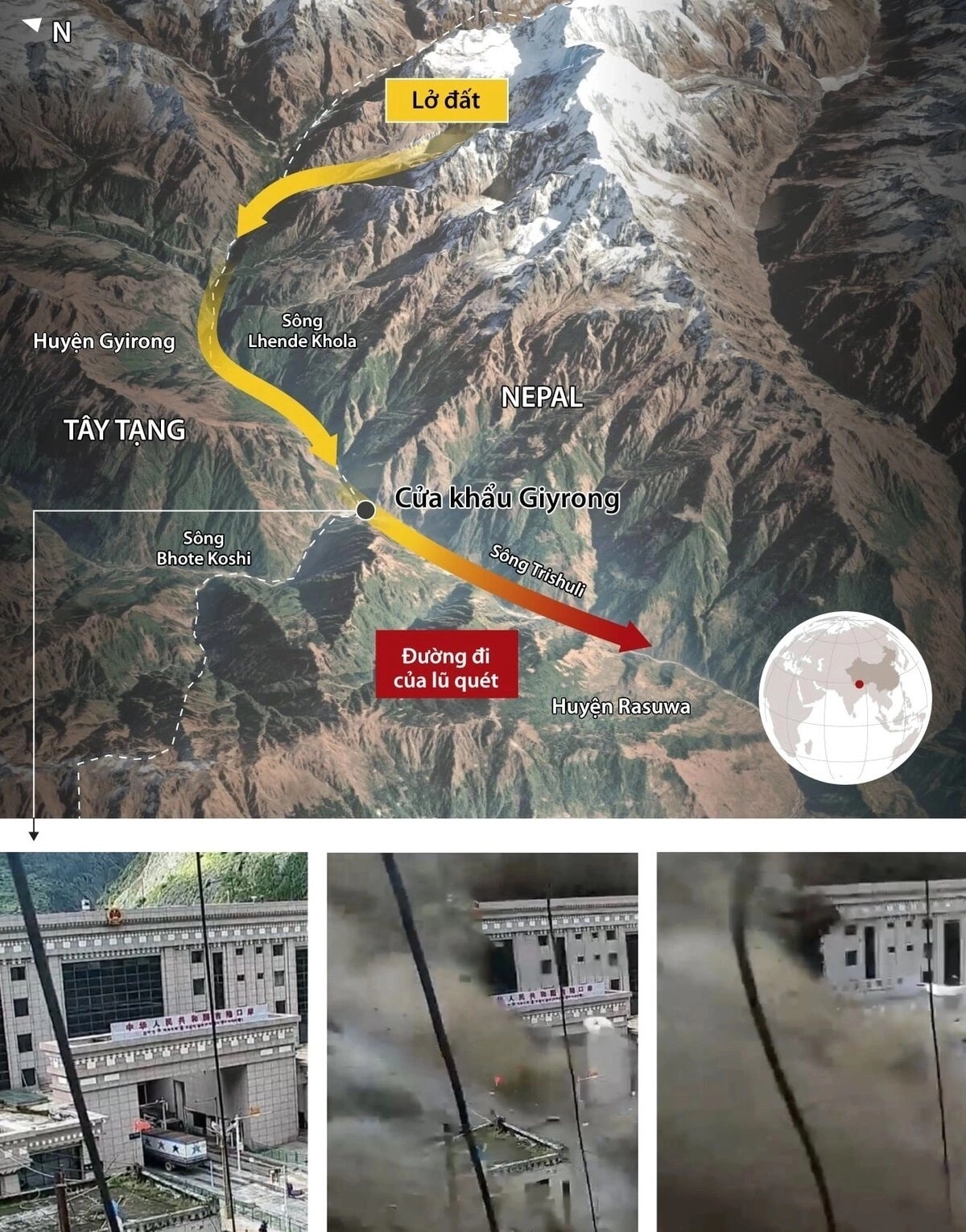 |
The path of the tsunami-like flash flood on the Nepal-China border on 26/8. *Graphic: Reuters*
"The resources required to monitor all similar high-risk points across the Himalayas are truly immense", Prince stated.
Shirzaei emphasized that disaster response in this shared mountain region requires countries to strengthen cross-border cooperation and proactively share data. "Data that helps protect people must be easily accessible from anywhere", he said.
Vu Hoang (According to AFP, SCMP, AP)