Many drivers express concerns that E10 gasoline may lead to higher fuel consumption, weaker performance, or long-term engine durability issues. These debates emerged many years ago in markets that implemented E10. The US widely sold this fuel type since the 1990s, while Australia, Thailand, and many European countries also adopted it as a solution to reduce emissions and dependence on fossil fuels.
Chemically, ethanol contains less energy than mineral gasoline. According to data from the US Department of Energy (DOE), ethanol’s volumetric energy density is about 30% lower than mineral gasoline. This means that when ethanol is blended with gasoline, the energy produced per liter of fuel will slightly decrease.
However, since E10 contains only 10% ethanol, the actual difference in fuel consumption is often small. The US Environmental Protection Agency (EPA) and various test studies in the US reported that E10 typically increases fuel consumption by about 1-3% compared to mineral gasoline, under equivalent operating conditions. This finding has also been observed in tests conducted in Australia and Europe.
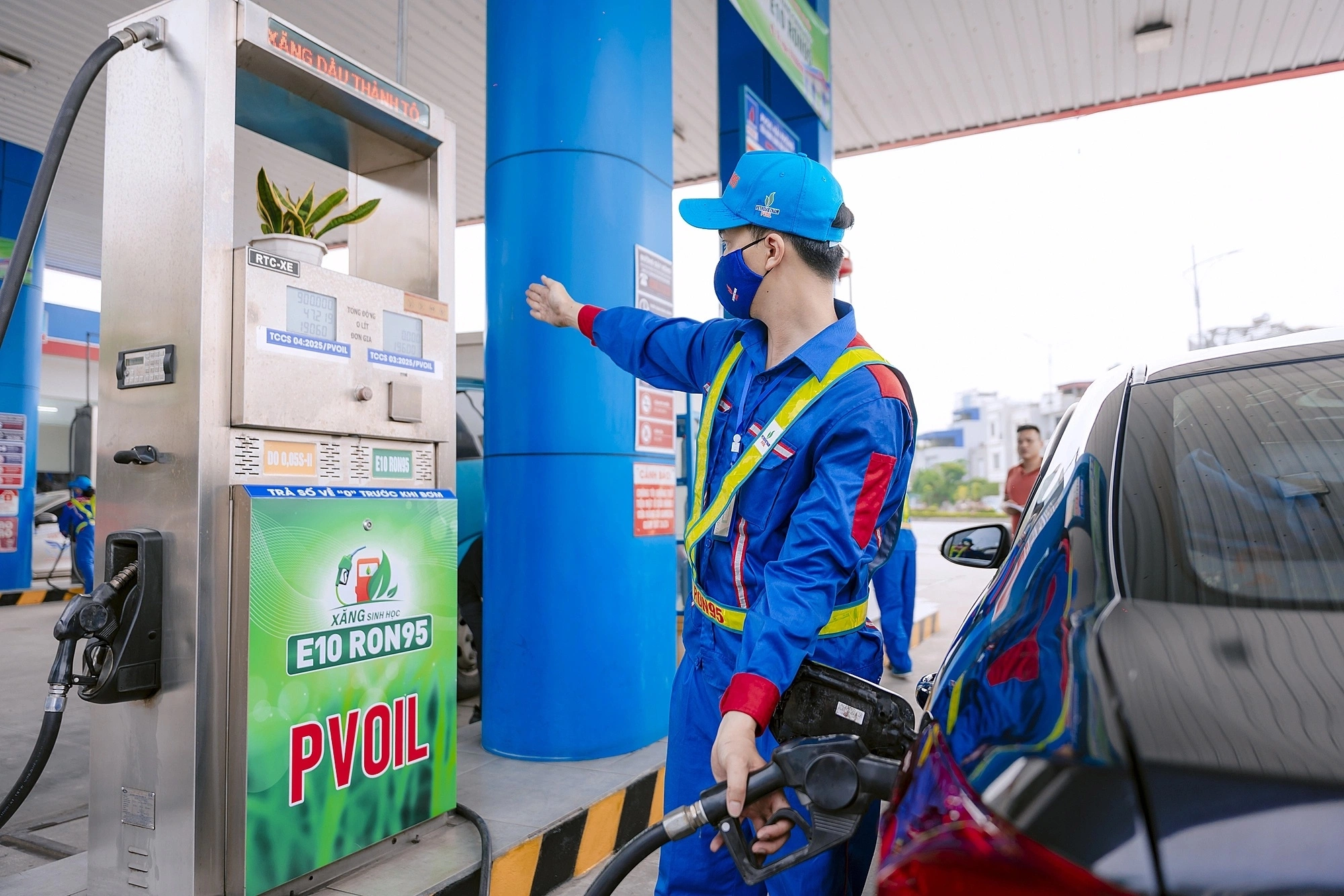 |
Biofuel E10 being piloted in Hanoi, 8/2025. Photo: Xuan Hai |
Furthermore, a study by the US National Renewable Energy Laboratory (NREL) indicated that vehicles using E10 experience a small increase in fuel consumption, yet it is difficult to notice under daily use conditions due to influences from factors like load, air conditioning, traffic, or driving habits. For many drivers, a difference of a few percent is almost imperceptible in real-world driving.
Ethanol is not entirely disadvantageous for performance. This biofuel has a higher octane rating than regular gasoline, which helps prevent knocking better, meaning it resists pre-ignition when compressed. This is why some car manufacturers optimize high-performance engines to take advantage of ethanol-containing fuel. In studies by SAE International and the US Department of Energy, modern engines with electronic fuel injection systems can maintain nearly equivalent power when using E10.
Experts suggest that the perceived "weaker car" sensation reported by users sometimes stems from changes in fuel quality between gas stations, driver psychology, or different operating conditions, rather than solely from the 10% ethanol blend.
Beyond international research, a 2023 study conducted in Vietnam by Hanoi University of Science and Technology, in collaboration with Toyota Vietnam and BSR, on Toyota Corolla Cross petrol and hybrid models, showed that E10-fueled cars recorded slightly reduced power and acceleration compared to traditional RON95-V in some tests, with the 10-100 km/h acceleration time increasing by about 4,5%. However, the overall difference in fuel consumption between fuel types was not large. In some conditions, such as traffic jams or highway driving, E10-fueled hybrid cars even showed lower consumption than RON95-V. This study also noted that E10 helps reduce CO and unburnt hydrocarbon emissions for both hybrid and traditional internal combustion engine vehicles.
E10 gasoline still has inherent drawbacks. Ethanol tends to be more hygroscopic than mineral gasoline. If fuel is stored for a long time in a humid environment, water can accumulate and cause fuel phase separation. Additionally, before ethanol became globally prevalent, some older vehicle models used rubber seals, fuel lines, or materials not optimized for bio-alcohol. Ethanol could cause these materials to degrade faster over time. However, for modern automobiles manufactured in the last two decades, E10 compatibility has almost become a technical standard in many markets.
In the US, the world's largest ethanol consuming market, E10 is now the standard fuel for most gasoline-powered automobiles. Many European countries like the UK, France, and Germany have also transitioned to E10 in recent years to reduce CO2 emissions. Brazil has used sugarcane-ethanol blended gasoline for many decades and now widely sells both E27 and E100 for flex-fuel vehicles.
Environmental benefits are the biggest reason E10 is promoted globally. Ethanol contains oxygen in its molecular structure, promoting cleaner combustion. Many international studies report that E10 helps reduce CO and unburnt hydrocarbon gases compared to conventional mineral gasoline. However, some studies note that NOx emissions may increase when using fuel with an ethanol ratio higher than 10%. A report by Argonne National Laboratory (US) indicates that ethanol fuel can help reduce greenhouse gas emissions throughout its entire lifecycle, especially when ethanol is produced from corn or sugarcane.
Pham Hai