In Pennsylvania, police can stop a driver simply for holding a phone, even if the phone is off, while operating a vehicle. Hamburgers, lipstick, shaving kits, stress-relief toys, and all other types of distracting objects remain completely legal.
Known as the Paul Miller Law, this legislation became effective in 6/2025, making it illegal for drivers to hold or physically support a phone or similar electronic device while operating a vehicle. During the first year, violators received written warnings. After one year, specifically from 5/6, those warnings will convert into actual traffic tickets.
What the law actually covers
This law takes a stricter approach compared to Pennsylvania's previous texting ban. Instead of only targeting texting, the law prohibits drivers from holding an "interactive mobile device" while driving. This definition includes smartphones, tablets, laptops, and other devices capable of sending or receiving electronic data.
Pennsylvania defines "driving" very broadly. A person is considered to be driving not only when moving on the road but also when stopped at a traffic light, in a traffic jam, or temporarily stationary due to other road conditions. If waiting for a train to pass at a railroad crossing, drivers are advised against picking up their phone.
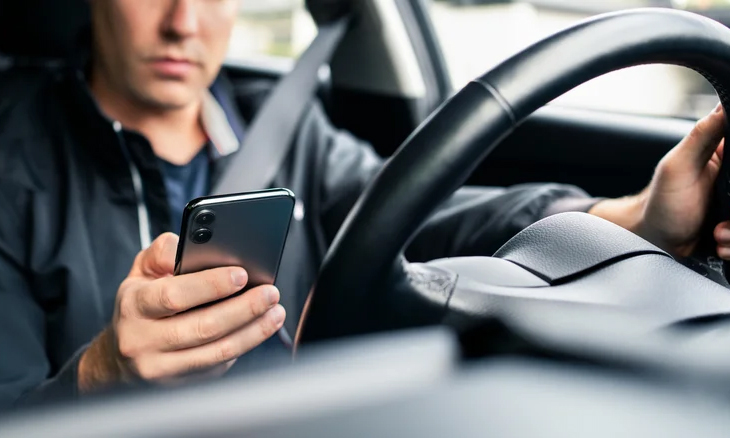 |
Drivers in Pennsylvania are not allowed to hold an interactive mobile device while driving. Photo: Shutterstock.
Penalties increase significantly
Under the new law, police have the authority to stop and fine drivers simply for holding a phone. Penalties will be much stricter if this distracted behavior leads to a fatal accident.
Specifically, drivers convicted of involuntary manslaughter by vehicle while distracted could face an additional sentence of up to 5 years in prison. Additionally, Pennsylvania's previous ban on texting while driving remains in effect. This law strictly prohibits reading, writing, or sending text messages while the vehicle is in motion, carrying a fine of 50 USD.
However, this regulation also presents some notable points. Drivers are still permitted to use a device if they have safely pulled over and stopped completely. The law also makes an exception for emergency calls to police or rescue services. In theory, this could be considered a theoretical exemption for anyone pulled over, provided they can prove they just discovered an emergency requiring immediate reporting.
Real-world loopholes
While lawmakers are striving to reduce distracted driving, this law only focuses on the act of "holding" a physical device rather than the nature of distraction itself. Accordingly, drivers can still legally mount a phone (or even a tablet or laptop) on the dashboard or windshield and interact with it via voice commands.
Furthermore, the large infotainment screens integrated into modern vehicles today — displaying everything from navigation maps and messages to music controls — are statistically just as distracting as a handheld phone.
Double standards in enforcement
The practical enforcement of the law also faces numerous inconsistencies. Bending down to look at a phone placed in a cup holder could be considered illegal if the driver touches the device, but glancing at a large screen, like a tablet integrated into the dashboard, is entirely permissible. Similarly, a driver using a smartwatch, virtual assistant, or hands-free system can still experience "cognitive distraction," even though they do not violate any specific wording of the law.
Of course, this loophole is not unique to Pennsylvania. Nearly every hands-free device law in the US draws an artificial distinction between "holding a device" and "using technology in general."
The simple reason is that holding a device is the easiest behavior for police to observe and cite with the naked eye. This means Pennsylvania and states applying similar laws are not truly prohibiting distracted driving. What they are prohibiting is only a specific form of distraction—one that police can easily see from outside the vehicle window.
My Anh (according to Carscoops)