During summer school breaks, tens of thousands of school buses sit idle in depots. Instead of leaving them unused, many localities are leveraging the batteries in electric buses to send power back to the grid. This helps alleviate pressure on the system during heatwaves.
From California to North Carolina, over 200 electric buses have participated in projects supplying power to the grid. Hundreds more are expected to join in the next few years. This solution uses Vehicle-to-Grid (V2G) technology, allowing electric vehicles to not only receive power when charging but also discharge electricity back into the grid. Vehicles typically charge when electricity demand is low or prices are cheap, then provide power to the grid during peak hours. For school buses, this model is particularly suitable because the vehicles primarily operate at the beginning and end of the day, spending most of their time parked.
Summer is an ideal time to utilize this technology. When students are on break, many buses operate minimally, while electricity demand surges due to hot weather. According to the World Resources Institute (WRI), approximately 230 of the 6,700 electric school buses in the US are involved in V2G projects. The total power these vehicles can supply simultaneously is about 8 MWh.
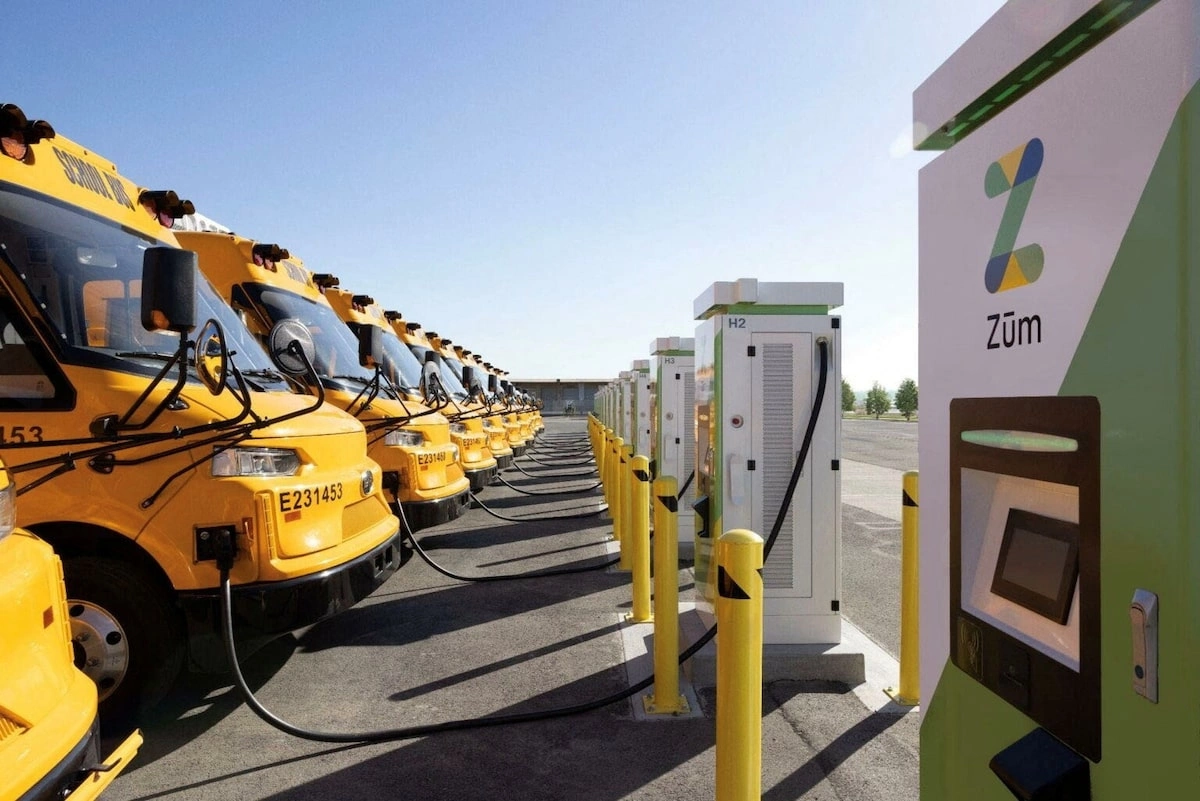 |
Electric buses participating in the Vehicle-to-Grid (V2G) project of the Oakland Unified School District are parked at a bidirectional charging area in Oakland, California. Photo: Zum |
This figure remains small compared to actual demand. The PJM Interconnection, the largest grid operator in the US, alone requires over 160,000 MW of capacity to meet the needs of around 67 million people this week, as many states record record-high temperatures.
Steve Letendre, a senior advisor for the Vehicle Grid Integration Council, believes that V2G technology is in its early stages. He states that in the future, school buses could become important energy storage resources for the power grid.
According to WRI, at least 31 utility companies in 21 US states are currently participating in V2G projects with school buses. The organization predicts that the number of electric buses in the US will more than double in the next few years, reaching about 14,600 vehicles, or about 3% of the total fleet. Most of these new vehicles will support V2G technology.
Despite this, for this model to have a significant impact, the number of participating vehicles must increase substantially. Consulting firm ICF forecasts that the US will need to add about 445,000 MW of capacity to the grid by 2030, partly due to the rapid increase in electricity demand from data centers.
Many obstacles remain
Investment cost is the biggest hurdle currently. Bidirectional chargers used for V2G are more expensive than conventional ones, and many areas must upgrade their electrical infrastructure to receive power from hundreds of vehicles simultaneously.
Additionally, the US lacks a unified set of standards for V2G technology, and related regulations are still being developed. Many vehicle owners also worry that frequent charging and discharging could accelerate battery degradation or affect warranty policies.
Some also argue that widespread adoption of electric vehicles will add further pressure to the power grid. To mitigate this concern, many schools integrate solar power systems to charge vehicles, rather than relying entirely on grid electricity.
California leads the way
California is currently the leading state in implementing V2G for school buses across the US. The state requires all electric buses purchased with public funds to support this technology. It also invests in infrastructure and collaborates with utility companies to implement numerous projects.
The largest project is located in the Oakland Unified School District, where utility company PG&E and transportation company Zum operate 74 electric buses. This fleet is expected to provide about 2,1 GWh of electricity annually to the grid.
Next month, Zum will launch another project in the San Francisco Unified School District with 104 electric buses. The power supplied to the grid is estimated at about 3 GWh annually during peak hours. By the 2027-2028 school year, the fleet will increase to 238 vehicles.
Beyond California, Connecticut will deploy 46 V2G-enabled electric buses starting in August. In North Carolina, a pilot project is exploring the use of electric buses as a backup power source for schools during natural disasters.
Meanwhile, a school district in Florida has not yet implemented V2G but plans to use 13 electric buses as cooling centers and backup power sources for residents if a hurricane causes power outages.
Ho Tan (According to Reuters)